
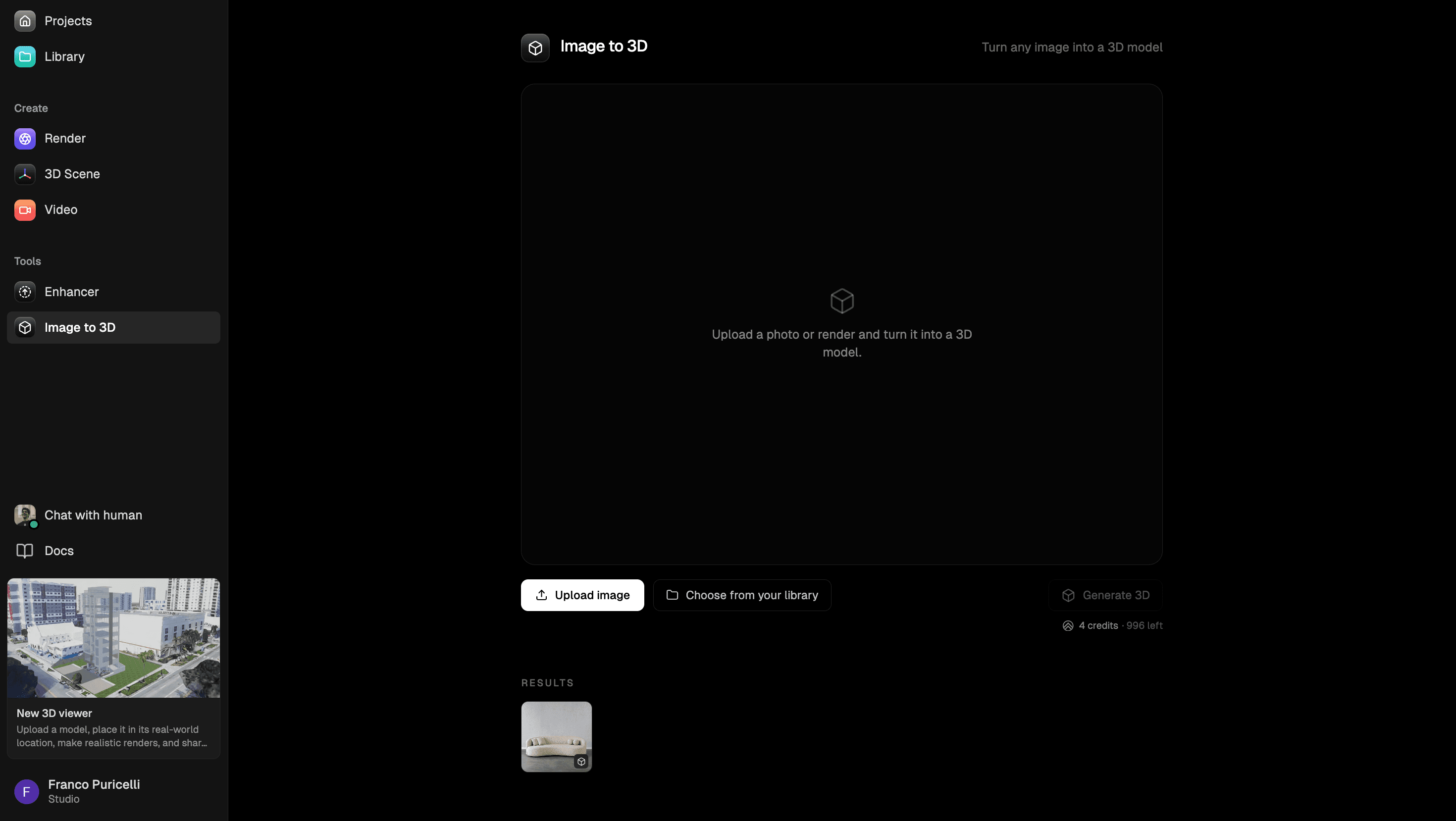
Upload
Choose one object image
Open the signed-in Image to 3D workspace and choose the same object image you checked on this page.
Upload a clear image of a single object, check it locally, then continue to the Image to 3D workspace to generate a rotatable GLB model.
This is image-to-3D only, not a text prompt tool. The result is useful for concept and visualization work, not CAD, BIM, construction documents, or dimensionally accurate geometry.
Preview here. Generate in the signed-in workspace.
Drop an object image here
Best results come from a single fully visible object on a simple background.
The upload above keeps the landing page fast and browser-local. These product screens show the signed-in steps that follow when you are ready to spend credits and create the model.
Upload
Open the signed-in Image to 3D workspace and choose the same object image you checked on this page.
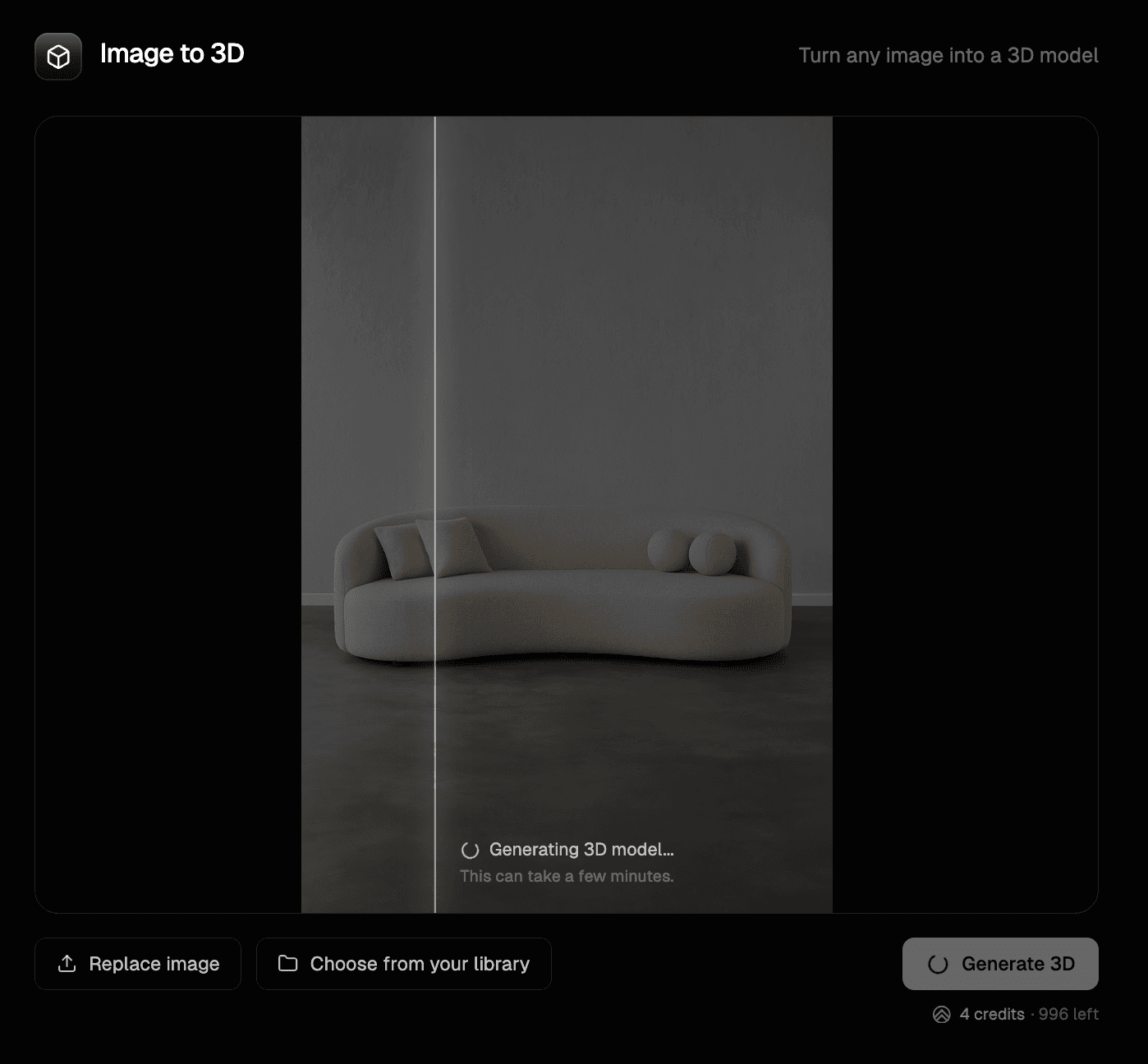
Generate
Confirm the image, spend 4 credits only when you start generation, and wait while the model is created.
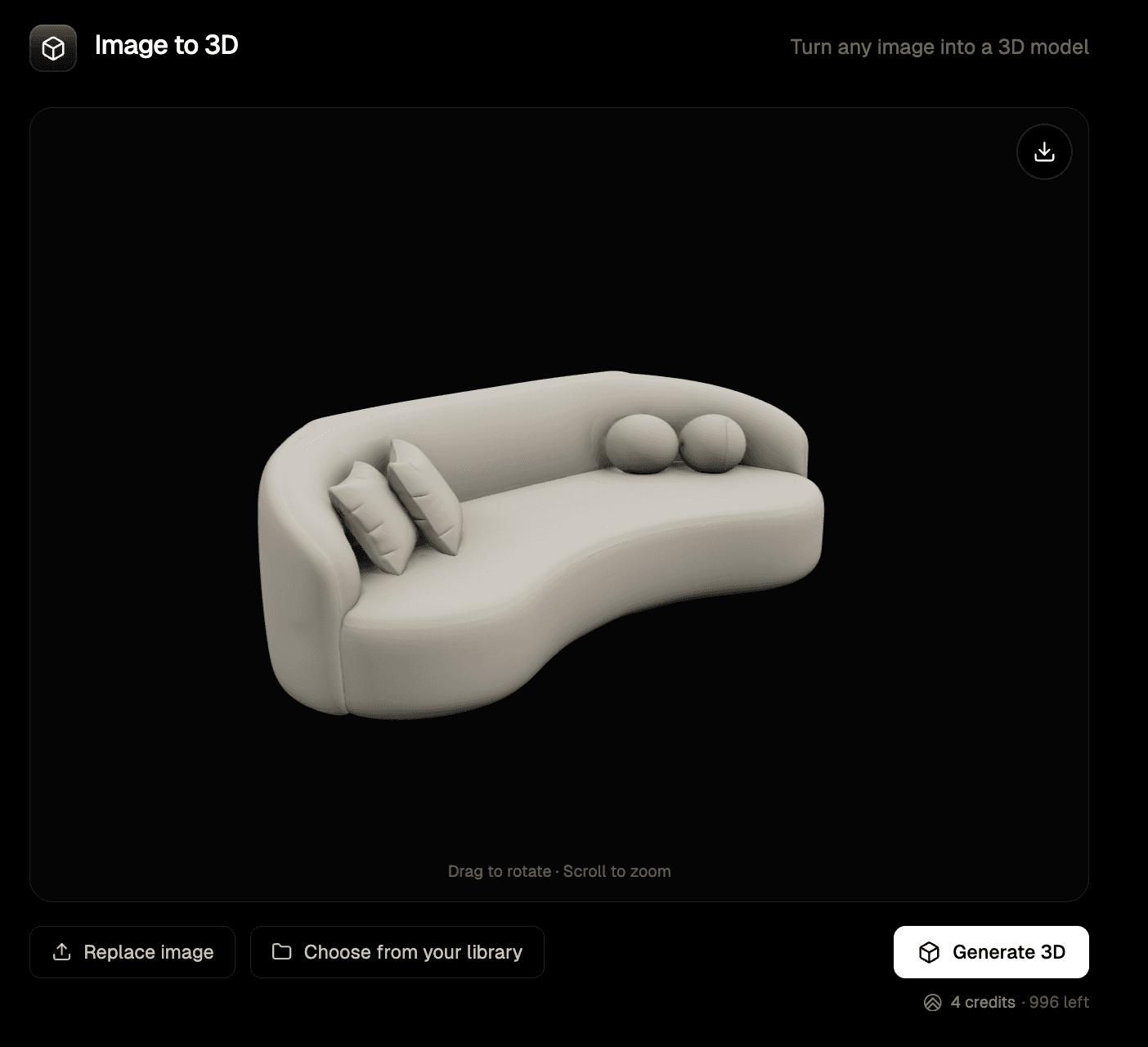
Download
Rotate the result in the 3D viewer, inspect the shape, and download the GLB file when it is useful.
Start with one fully visible object, then inspect the 3D result before you reuse it. AI 3D output should be treated as a concept model until a human checks the shape and surface quality.
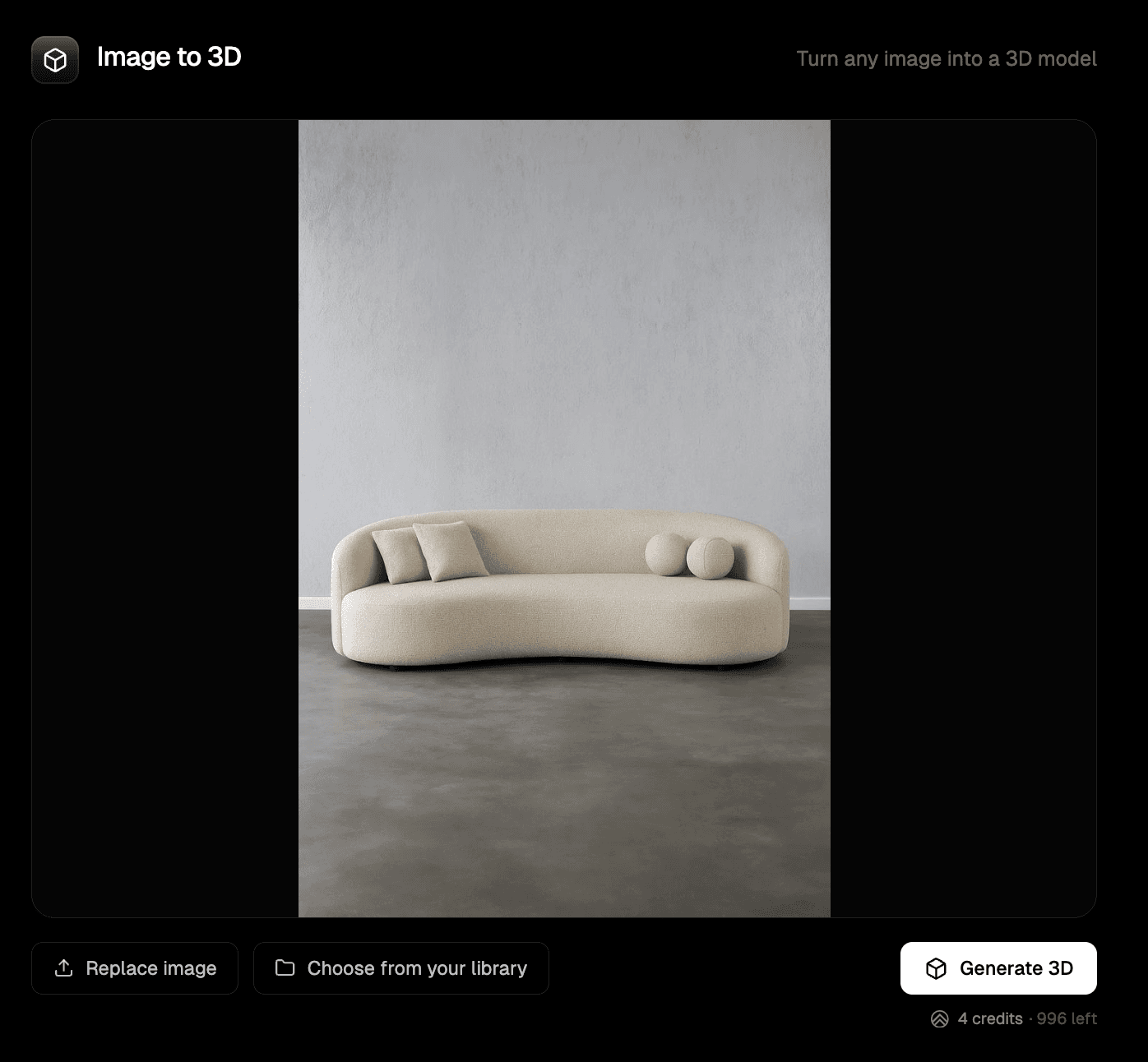
Choose a JPG, PNG, or WebP file. A front-facing photo works best when the object is not cropped, hidden, or blended into the background.
Sign in, choose the image again if needed, review the 4-credit cost, then start the Image to 3D generation.
Rotate the result, zoom in, check the surface quality, and download the GLB file when the model is useful for your next step.
An AI 3D model generator creates a 3D asset from an input. In Render a House, this page is specifically for image-to-3D: the input is a JPG, PNG, or WebP object image, and the output is a downloadable GLB concept model.
A clear image gives the model more useful shape information. A cluttered room, cropped object, floor plan, or hidden side gives the generator less to infer, so the result can be rough or incomplete.
Turn furniture, props, products, and simple references into early 3D concepts.
Download a portable model file for visual review or downstream cleanup in software that supports GLB imports.
Use Image Upscaler first when the object image is too small, soft, or compressed for a useful 3D run.
An AI 3D model generator creates a 3D model from an input. This Render a House page uses image-to-3D: upload a clear object image, generate a model in the signed-in workspace, inspect it in a 3D viewer, and download a GLB file.
No. Render a House's current Image to 3D workflow starts from an image. It does not support text-to-3D generation on this page.
Use a JPG, PNG, or WebP image up to 8 MB. The source image should be between 128 and 5000 pixels on each side.
The generated model can be downloaded as a GLB file.
Image to 3D generation costs 4 credits per generation. If a generation fails, you are not charged for that failed run.
Generation can take a few minutes. The workspace shows progress while the model is being created.
Use a single object, a front-view angle, a simple background, and enough lighting to show the object's outline. Avoid cropped objects, cluttered rooms, floor plans, and images where the subject is hidden or ambiguous.
No. The output is an AI-generated GLB model for concept and visualization workflows. It is not a dimensionally accurate CAD model, BIM object, fabrication file, or construction document.
No. This workflow is for single-object image-to-3D generation. It should not be used as a room, building, or site reconstruction tool.
Start free, then choose the monthly credit allowance that fits your rendering, enhancement, and image-to-3D work. Annual billing is also available.
$0forever
Try Render a House before choosing a paid plan.
$39per month
For professionals and small teams.
$99per month
For studios with a higher-volume workflow.
Prices are shown in USD. The signed-in pricing page shows the current checkout terms before purchase.
Use the narrower page when your starting point is a specific 2D object image and you want the literal image-to-3D flow.
Sharpen or upscale a small object image before you turn it into a 3D model.
Place a GLB, GLTF, or OBJ model in 3D Preview and save camera views for rendering.
Open the current signed-in tool to run generation and download the GLB model.
Ready when your object image is