 Render a House/Updated Oct 18, 2026
How Much Does an Interior Designer Cost in 2026?
Hiring an interior designer in the US typically costs $2,055 to $15,256, with a 2026 national average of $8,550, according to Angi. Fees are billed hourly, as a flat fee, per square foot, as a percentage of the project, or as a markup on products.
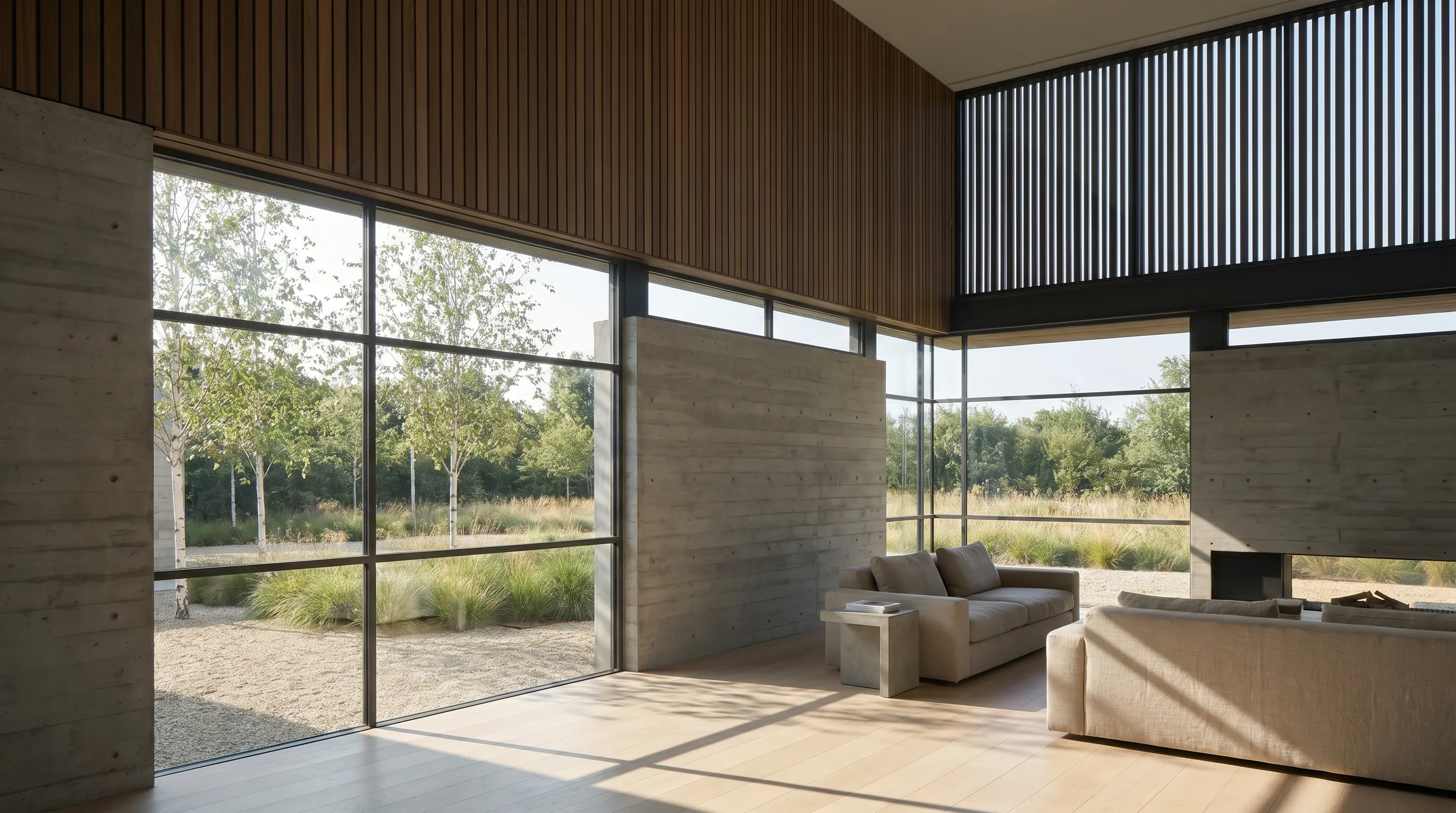
Most homeowners pay between $2,055 and $15,256 to hire an interior designer, and the 2026 national average is $8,550, based on 2,938 verified projects (Angi, checked Oct 2026). Smaller jobs cost far less: Thumbtack’s data puts the typical range at $494–$2,460 (Thumbtack, checked Oct 2026). Before you pay for a designer’s concept, you can preview styles for your own room in Render a House: upload a photo, describe the look in plain words, and compare options for free.
This guide breaks down the five ways designers charge, the published range for each, the extra fees that catch people out, and how e-design compares with full service. Every third-party figure links to the cost guide or pricing page it came from. Where a number is not published, we say so instead of estimating it.
Quick answer: An interior designer costs $2,055 to $15,256 for most US projects, averaging $8,550 in 2026 (Angi). Hourly rates run $50–$500. Per-square-foot fees run $4–$17. Percentage fees run 10%–30% of the project cost. Online e-design starts around $199 per room (Havenly list price). Figures checked October 2026.
How much does an interior designer cost?
Three large US cost guides publish national figures for hiring an interior designer. Angi and HomeAdvisor are owned by the same company and publish the same headline numbers, so treat them as one data point, not two. Thumbtack’s range is lower because it reflects the estimates requested on its platform, which include many consultations and single-room jobs.
| Source | Typical range | Average | Basis | Source link |
|---|---|---|---|---|
| Angi (2026 cost guide) | $2,055–$15,256 | $8,550 | Based on 2,938 verified projects from Angi Pros | Angi, checked Oct 2026 |
| HomeAdvisor | $2,055–$15,256 | $8,550 | Same headline figures as Angi (same parent company) | HomeAdvisor, checked Oct 2026 |
| Thumbtack | $494–$2,460 | $1,103 | Thumbtack data from estimates on its platform; skews to smaller jobs | Thumbtack, checked Oct 2026 |
None of these totals include the furniture itself unless the designer’s fee is a markup on that furniture. HomeAdvisor says furnishings and decor add $2,000 to $5,000 on top of design fees (HomeAdvisor, checked Oct 2026).
For context, the median wage for interior designers was $67,190 a year, or $32.31 an hour, in May 2025 (US Bureau of Labor Statistics, checked Oct 2026). That is what designers earn, not what clients pay: billed rates also cover overhead, unbillable hours and business costs.
How do interior designers charge?
Interior designers price their work in five main ways, and many combine two or more. The American Society of Interior Designers’ Minnesota chapter states that “there is no such thing as a ‘typical’ or ‘customary’ fee for an interior designer” and lists fixed fee, hourly fee and cost plus as the main residential methods, with per-square-foot pricing used for larger commercial projects (ASID Minnesota, checked Oct 2026).
| Fee model | How it works | Published range | Common for |
|---|---|---|---|
| Hourly | You pay for the designer’s time, often including shopping, meetings and site visits | $50–$500/hr (HomeAdvisor); $100–$500/hr (Angi); $60–$125/hr (Thumbtack) | Consultations, small or loosely defined projects |
| Flat fee | One agreed price for a defined scope | $2,000–$12,000 (Angi); $250–$50,000 (HomeAdvisor); about $1,000 to six figures (Houzz) | Full-service jobs with a clear scope |
| Per square foot | A rate multiplied by the area designed | $4–$17/sq ft (Thumbtack); $5–$17/sq ft (Angi); $5–$15/sq ft (HomeAdvisor) | Large rooms, new construction, commercial space |
| Percentage of project | A share of the total project budget or amount spent | 10%–30% (Angi); 15%–25% example (Thumbtack); 20%–45% (HomeAdvisor) | Large remodels and new builds |
| Cost-plus / markup | Designer buys at trade price and resells with a markup or commission | 15%–35% of item cost (Thumbtack); 10%–40% commission (HomeAdvisor) | Furnishing-heavy projects, usually combined with another fee |
Sources: Angi, checked Oct 2026; HomeAdvisor, checked Oct 2026; Thumbtack, checked Oct 2026; Houzz, checked Oct 2026.
Hourly rate
An hourly rate is a fee for the designer’s time. It is the most common way to pay for a consultation or a small project. HomeAdvisor lists $50–$500 an hour and says most residential designers bill $50–$200, with shopping trips and materials extra (HomeAdvisor, checked Oct 2026). Angi lists $100–$500 (Angi, checked Oct 2026), and Thumbtack lists $60–$125 (Thumbtack, checked Oct 2026).
Houzz, which interviewed 16 designers for its 2018 guide, found $125 to $150 or $200 an hour common, ranging from $50 for a junior designer to $500 for a firm principal. It also warns that travel, meetings, shopping, phone calls and site visits may be billed (Houzz, checked Oct 2026). Ask whether different tasks carry different rates and whether there is a cap on hours.
Flat or fixed fee
A flat fee is one agreed price for a defined scope. It gives you budget certainty, but only if the scope is written down precisely. Angi lists flat fees of $2,000–$12,000 for full-service projects (Angi, checked Oct 2026). HomeAdvisor’s range is much wider, $250–$50,000, because it covers everything from a single room to a whole house (HomeAdvisor, checked Oct 2026).
Houzz reported flat fees from about $1,000 to well into six figures, with one Austin designer charging $3,500–$12,000 to design a living room and a New York state designer charging $3,000 for the same space. Some flat fees include a set number of hours, with extra time billed hourly (Houzz, checked Oct 2026).
Interior designer cost per square foot
Per-square-foot pricing multiplies a rate by the area being designed. Published rates are $4–$17 per square foot (Thumbtack, checked Oct 2026), $5–$17 per square foot (Angi, checked Oct 2026) and $5–$15 per square foot (HomeAdvisor, checked Oct 2026).
Three caveats matter. HomeAdvisor says the rate often excludes furnishings and installation, and that designers may set a minimum fee for small rooms such as bedrooms or bathrooms. Thumbtack says this model is mostly used on bigger commercial jobs, but also on large residential rooms such as kitchens and primary bedrooms, and that the rate may cover the whole job or only the design fee. Angi associates it with larger spaces and new construction.
Percentage of project cost
A percentage fee is a share of the total project budget or of the amount spent. It is typical on large remodels and new builds, where the designer’s work scales with the project. Angi lists 10%–30% of the total for high-end, large or luxury renovations (Angi, checked Oct 2026). Thumbtack gives 15%–25% of the budget as an example (Thumbtack, checked Oct 2026), and HomeAdvisor lists 20%–45% of project cost (HomeAdvisor, checked Oct 2026).
The risk is incentive: a percentage fee rises when the project budget rises. Agree in writing which costs count toward the base, for example construction, furniture, or both.
Cost-plus and product markups
Cost-plus means the designer buys furniture, materials or trade services at a discount and resells them to you with a markup. ASID Minnesota defines it as the designer’s cost plus a specified percentage agreed with the client (ASID Minnesota, checked Oct 2026). Thumbtack gives 15%–35% of the product cost as an example markup (Thumbtack, checked Oct 2026), and HomeAdvisor lists commissions of 10%–40% on materials and furnishings (HomeAdvisor, checked Oct 2026).
Houzz notes that cost-plus is now rarely the only method, because clients compare prices online, and that many designers keep their markup private (Houzz, checked Oct 2026). If your designer uses it, ask for the markup percentage in the contract and whether you may buy items yourself.
What other interior design fees should you budget for?
The fee model is only part of the bill. These line items appear in the published cost guides and are easy to miss when you compare quotes:
| Fee | Published range | Source |
|---|---|---|
| Initial consultation | $200–$800 (Angi); $150–$500, two to four hours (HomeAdvisor); $350–$500 example (Thumbtack) | Angi, checked Oct 2026 |
| Mood boards, floor plans and 3D renderings | $500–$3,000 (Angi); digital renderings add 5%–10% to fees (HomeAdvisor) | HomeAdvisor, checked Oct 2026 |
| 3D renderings or virtual walkthroughs as an add-on | $500–$2,500 (Angi) | Angi, checked Oct 2026 |
| Furnishings and decor | Add $2,000–$5,000 to the budget (HomeAdvisor) | HomeAdvisor, checked Oct 2026 |
| Retainer or deposit | A flat amount such as $1,000, or 10%–50% of anticipated fees (Houzz) | Houzz, checked Oct 2026 |
| Management or purchasing fee | Sometimes a percentage of the purchase price; amount not published (Houzz) | Houzz, checked Oct 2026 |
Angi also notes that tipping a designer is not standard practice; if you choose to, it calls 5%–10% of the designer’s fee generous (Angi, checked Oct 2026). Houzz adds that mid-project changes usually cost both time and money, so ask how revisions are billed before you sign (Houzz, checked Oct 2026).
What changes the cost of an interior designer?
Two designers can quote very different prices for the same room. The published guides name the same drivers again and again:
- Scope of work. A paint-and-furniture refresh is a different job from a kitchen remodel that needs carpentry, plumbing or masonry coordinated. Thumbtack says coordinating that work adds cost (Thumbtack, checked Oct 2026).
- Size of the space. More square feet and more rooms mean more design and sourcing time. HomeAdvisor names area size as a major factor (HomeAdvisor, checked Oct 2026).
- Designer experience and reputation. Houzz’s hourly range runs from $50 for a junior designer to $500 for a principal (Houzz, checked Oct 2026).
- Location. Thumbtack says cost depends on where you live (Thumbtack, checked Oct 2026). City-by-city fee data is not published by the sources above (checked October 2026).
- Materials and furnishings. High-end finishes and custom pieces raise both the product budget and any fee tied to it. ASID Minnesota names antiques, custom furniture and moving load-bearing walls as items that significantly increase cost (ASID Minnesota, checked Oct 2026).
- Deliverables. Detailed floor plans, mood boards and 3D renderings add $500–$3,000 according to Angi (Angi, checked Oct 2026).
- Timeline and changes. HomeAdvisor lists your timeline as a cost factor, and ASID Minnesota says changes mid-project and excessive demands on a designer’s time increase cost.
E-design vs full-service interior design: which costs less?
E-design is remote interior design. You send photos, measurements and preferences, and the designer returns a concept, a layout and a shopping list. You order, receive and install everything yourself. Full-service design adds site visits, custom work, purchasing, contractor coordination and installation.
| Option | What you get | Published price | Source |
|---|---|---|---|
| Online e-design (Havenly) | Remote design for one room; you buy and install | Online design listed at $199 per room, In-Person at $699 (sale prices of $99 and $349 shown when checked) | Havenly pricing, checked Oct 2026 |
| Online e-design (Decorilla) | Flat per-room packages, plus hourly services | Hallway/entry packages at $599, $859 and $1,099; Platinum from $1,980; hourly services $119–$500/hr | Decorilla pricing, checked Oct 2026 |
| Full-service local designer | Concept, plans, sourcing, contractor coordination and install | Flat fees of $2,000–$12,000; national average $8,550 | Angi, checked Oct 2026 |
Online services change prices often and both pages above showed sale pricing when checked, so confirm the current figure before you buy. Decorilla’s package prices vary by room type; the hallway and entry tier is shown here because it was the one displayed.
Choose e-design when the work is mostly furniture, color, lighting and decor, you are comfortable ordering and assembling, and nothing structural changes. Choose full service when walls, plumbing, electrical or custom millwork are involved, when you need someone to manage trades and deliveries, or when your time is worth more than the fee difference.
How do you estimate your interior design budget?
You can turn the published ranges into a working budget before you call anyone:
- Define the scope. List the rooms and whether the job is decor only, a remodel, or new construction.
- Measure the area. Multiply length by width for each room in square feet.
- Apply a per-square-foot range. At the published $5–$17 per square foot (Angi), a 300 sq ft living room works out to $1,500–$5,100 in design fees. That is simple arithmetic on the published range, not a quote.
- Add the extras. Include a consultation, any renderings, and furnishings, using the ranges in the fee table above.
- Compare against e-design. If a single-room e-design package covers what you need, the gap between the two figures is what full service is costing you.
- Get three written quotes. Ask each designer to state the fee model, hours or scope included, markup on products, retainer, and how revisions are billed.
How can you save on interior design?
Lower interior design costs come from paying for less designer time, not from cutting the designer out of the decisions that need expertise.
- Arrive with a clear direction. Hourly fees grow with every round of “maybe something warmer.” Reference images or a visual of your own room shorten the concept phase.
- Pay only for the design. Some designers sell a design fee for the concept and plan, which you can then carry out yourself (Houzz, checked Oct 2026).
- Use e-design for decor-only rooms. Save full service for rooms with construction.
- Work in stages. ASID Minnesota suggests scaling back or doing the work in stages if the quote is above budget (ASID Minnesota, checked Oct 2026).
- Freeze decisions early. Mid-project changes are among the most expensive line items in every guide above.
- Ask about markups. Know whether you may source some furniture yourself without a fee penalty.
Visualize options before you hire
The cheapest design hour is the one you never need to book. Before you hire, it helps to see a few directions for your actual room so you know which style you are paying a designer to develop.
- AI interior design generator: upload a photo of your room, describe a style such as “warm Japandi with oak and linen,” and get a render back in about 30–60 seconds. Try several styles on the same photo and keep the ones you like as a brief.
- Renovation AI: upload a photo of the space you plan to remodel and describe the changes, such as new flooring, cabinets or finishes, to see a before and after.
Render a House accepts PNG, JPG and WebP photos, plus SKP, GLB, GLTF, OBJ and STL 3D models, so a designer’s SketchUp file can be uploaded directly. PDFs are not accepted; export a floor plan to PNG or JPG first. The free plan gives 3 credits a day at 1K resolution with a watermark, and no card is required. A standard render uses 1 credit. Paid plans start at $19 a month for 120 credits; see pricing or the render cost calculator for estimates. Video is available on paid plans only.
Bring the renders to your first consultation. A designer can react to a concrete picture faster than to a verbal description, which matters when you are paying by the hour.
What an AI visualization cannot replace
An AI render shows what a style could look like in your room. It does not do a designer’s job, and it is not a CAD or construction tool. Specifically, it cannot:
- Produce measured drawings, permit sets or construction documents.
- Guarantee that a pictured sofa or tile exists, is in stock, or fits your dimensions.
- Check structural, electrical, plumbing or code constraints.
- Source trade-only products, manage contractors or handle deliveries and installation.
Use visualization to narrow down a direction and to communicate it. Use a designer, architect or contractor for anything that has to be built, measured or approved.
Where do these interior design prices come from?
All third-party prices on this page were read directly from the pages below in October 2026 and are in US dollars. Cost guides update their figures, so the live page wins if it differs.
- Angi, How Much Does It Cost to Hire an Interior Designer? (updated August 31, 2026; 2,938 verified projects).
- HomeAdvisor, interior designer and decorator cost guide (updated June 19, 2026).
- Thumbtack, interior designer cost guide (based on estimates requested on Thumbtack).
- Houzz, How Much Does It Cost to Hire an Interior Designer? (published August 18, 2018, from interviews with 16 designers; older than the other sources).
- ASID Minnesota, Costs and Fees (fee definitions; no price ranges published).
- US Bureau of Labor Statistics, Occupational Outlook Handbook: Interior Designers (wages, not client fees).
- Havenly pricing and Decorilla pricing (first-party e-design prices).
Not published (checked October 2026): a national breakdown of designer fees by city, and a typical markup percentage from ASID.
Related guides
- AI interior design tools compared for trying room styles yourself before hiring.
- Best AI interior design rendering tools for photoreal room visuals.
- Best room planner apps for laying out furniture to scale.
- Best home remodel apps for planning a renovation.
- 3D architectural rendering cost if your designer quotes renderings separately.
FAQ
How much does an interior designer charge per hour?
- Published hourly rates run from about $50 to $500. HomeAdvisor lists $50–$500 and says most residential designers bill $50–$200 an hour; Angi lists $100–$500; Thumbtack lists $60–$125; Houzz says $125–$200 is common, from $50 for a junior designer to $500 for a firm principal (all checked October 2026).
How much does an interior designer cost per square foot?
- Published per-square-foot rates are $4–$17 (Thumbtack), $5–$17 (Angi) and $5–$15 (HomeAdvisor), checked October 2026. HomeAdvisor notes the rate often excludes furnishings and installation, and Thumbtack says per-square-foot pricing is most common on bigger commercial jobs and large rooms such as kitchens.
How much does it cost to have an interior designer do one room?
- It depends on the service level. Online e-design is priced per room: Havenly lists online design at $199 per room and Decorilla lists flat per-room packages starting at $599 for a hallway or entry (checked October 2026; both run frequent sales). For full service, Houzz reported designers charging $3,000 and $3,500–$12,000 to design a living room in its 2018 guide.
What percentage do interior designers charge?
- Angi lists 10%–30% of total project cost, Thumbtack gives 15%–25% of the budget as an example, and HomeAdvisor lists 20%–45% (checked October 2026). Separately, markups or commissions on furniture and materials run 15%–35% (Thumbtack) or 10%–40% (HomeAdvisor) of the item cost.
Is e-design cheaper than hiring a full-service interior designer?
- Yes, usually by a wide margin. Published e-design packages start in the low hundreds of dollars per room, while Angi puts the 2026 national average for hiring an interior designer at $8,550. E-design gives you a plan and a shopping list; you order, coordinate and install yourself.
Can I see design ideas for my room before hiring a designer?
- Yes. Render a House lets you upload a photo of your room and describe a style in plain words to get an AI render in about 30–60 seconds. The free plan gives 3 credits a day at 1K resolution with a watermark and needs no card. It is a visualization, not a construction plan or a substitute for a designer.
Keep reading
Related guides and comparisons

20 Best AI Interior Design Tools in 2026 (Free & Paid)
Compare 20 AI interior design tools for room redesign, architecture, floor plans, virtual staging, and client renders, with vendor-sourced prices and tradeoffs.
7 Best Home Remodel and Renovation Apps in 2026 (AI)
Seven home remodel and renovation apps compared: Render a House renovation AI, Remodel AI, Houzz, Hover, Planner 5D, REimagineHome and Homestyler, with prices.
8 Best Room Planner Apps in 2026 (Free & Paid)
Compare eight room planner apps (Render a House, Planner 5D, RoomSketcher, Homestyler, Floorplanner, IKEA, Roomstyler, Magicplan) by free plan, platform and price.
