 Render a House/Updated Sep 7, 2026
Topaz AI Pricing 2026: Gigapixel ($149/yr), Photo AI ($199/yr) & Video AI ($299/yr) Compared
Gigapixel is $149/yr, Photo AI is $199/yr, and Video AI is $299/yr — each billed annually upfront. The Topaz Studio bundle covers all eight Topaz apps for $399/yr: less than Video AI plus either other desktop app bought separately, and only $51/yr more than the cheapest two-app combination, Gigapixel plus Photo AI at $348/yr.
Topaz Labs does not sell one product. It sells five: Gigapixel (upscaling), Photo AI (restoration), Video AI (video enhancement), Astra (browser-based video, no GPU), and Topaz Studio, the bundle that wraps all of them plus three smaller apps into one subscription. Each is priced and billed on its own, which is the first thing that makes a Topaz budget harder to pin down than a single-product licence.
Every figure below is quoted directly from Topaz's own pricing FAQ, published in the structured data on each product page — Gigapixel, Photo AI, Video AI, and Topaz Studio. Topaz ended perpetual licensing for its current apps; every plan on this page is a recurring subscription.
Topaz AI pricing at a glance
| App | Personal — no commitment | Personal — annual upfront | Pro — annual upfront |
|---|---|---|---|
| Gigapixel | $29/mo | $149/yr | $499/yr |
| Photo AI | $39/mo | $199/yr | $599/yr |
| Video AI | $59/mo | $299/yr | $699/yr |
| Astra (Standard tier, cloud) | $39/mo ($19 promo) | $328/yr | $2,512/yr (Pro tier) |
| Topaz Studio (all 8 apps) | $69/mo | $399/yr | $799/yr |
Two patterns hold across Gigapixel, Photo AI, Video AI, and Studio. First, the no-commitment monthly price is always the most expensive way to pay — see the payment-term sectionbelow. Second, none of the four offers a no-commitment monthly option at the Pro tier — Pro is sold only as an annual commitment, billed monthly or upfront. Astra is priced on a different ladder: Standard, Plus, and Pro are its own credit tiers rather than a Personal/Pro split, and each is simply monthly or annual, with no middle "annual billed monthly" rung.
Which Topaz app do you actually need?
The apps solve different problems, and picking the wrong one is the most common way to overpay. Here is what each is actually for, before the pricing gets more granular.
Gigapixel — image upscaling only
A dedicated upscaler: it increases an image's pixel dimensions, up to 16x, using AI models chosen for the source type (photo, art, text-heavy scan, low-resolution source). It does not denoise, sharpen unrelated defects, or remove objects — those are Photo AI's job. If the only thing you need is a bigger image, Gigapixel is the cheaper of the two desktop apps at $149/yr. Topaz notes that its predecessor, Gigapixel AI, was the first commercially available AI image upscaler when it launched in 2019, which is most of why "Gigapixel" is still the generic name people search for even when what they mean is any AI upscaler, ours included.
Photo AI — the full restoration suite
The broader restoration workflow: sharpening, denoising, upscaling, object removal, lighting and color correction, and face recovery in one pass, plus a RAW-specific denoise path for photographers shooting RAW. At $199/yr it costs $50/yr more than Gigapixel alone and includes upscaling as one feature among many rather than the whole product.
Video AI — desktop video enhancement
Frame-by-frame video enhancement — upscaling to 4K or 8K, noise and compression-artifact removal, stabilization, frame interpolation up to 60 FPS, and SDR-to-HDR conversion. It runs locally on a GPU and plugs into Premiere Pro and DaVinci Resolve. At $299/yr it is Topaz's most expensive individual app, and the only one of the three with no image-upscaling use case at all.
Astra — browser-based, no GPU
Astra is the odd one out: a browser-based video enhancement platform that needs no installation and no local GPU, using the same underlying models as Video AI. Its Standard tier lists at $39/mo, currently discounted to $19/mo as a limited-time offer, or $328/yr billed upfront. Read those two together carefully: Topaz describes the $328 as saving 30% against the regular monthly rate ($39 × 12 = $468), not against the $19 promotional one, so while the promo lasts, twelve monthly payments at $19 come to $228 and undercut the annual plan by $100. Both tiers carry the same 4,800 credits a year. Against Video AI, the annual plan is $29/yr more than Video AI's $299 annual-upfront price, because you are paying for cloud compute instead of your own hardware.
Topaz pricing by payment term
Every Topaz app is sold three ways: no-commitment monthly, an annual commitment billed monthly, and the same annual commitment paid upfront. The gap between the first and the third is large everywhere:
| Product | No-commitment monthly × 12 | Annual, paid upfront | Cost of no commitment |
|---|---|---|---|
| Gigapixel Personal | $348/yr ($29 × 12) | $149/yr | +$199/yr (+134%) |
| Photo AI Personal | $468/yr ($39 × 12) | $199/yr | +$269/yr (+135%) |
| Video AI Personal | $708/yr ($59 × 12) | $299/yr | +$409/yr (+137%) |
| Topaz Studio Personal | $828/yr ($69 × 12) | $399/yr | +$429/yr (+108%) |
The number Topaz never states directly is smaller but still real: paying the same annual commitment monthly instead of upfront costs more too, not just the same total spread over twelve payments.
| Product | Annual commitment, billed monthly | Same commitment, paid upfront | Gap for paying monthly |
|---|---|---|---|
| Gigapixel | $19/mo × 12 = $228/yr | $149/yr | +$79/yr (+53%) |
| Photo AI | $25/mo × 12 = $300/yr | $199/yr | +$101/yr (+51%) |
| Video AI | $39/mo × 12 = $468/yr | $299/yr | +$169/yr (+57%) |
| Topaz Studio | $45/mo × 12 = $540/yr | $399/yr | +$141/yr (+35%) |
Video AI's gap is the widest at 57%, with Gigapixel just behind at 53%; Topaz Studio's is the narrowest at 35%, because more of the bundle's value sits in the flat $399 upfront anchor. In every case, committing to a year and then paying it off monthly is the worst of both options — you get none of the flexibility of month-to-month and none of the saving of paying once.
Is the Topaz Studio bundle cheaper than buying apps separately?
Topaz's own pricing page runs part of this arithmetic itself: buying Video AI, Photo AI, and Gigapixel separately at their lowest annual prices totals $647/year, against $399/year for Studio — and that $647 does not include the five other apps Studio also bundles in. Add the cheapest way into one of those, Astra Standard at $328/yr, and the comparison gets sharper still:
| What you buy | Annual |
|---|---|
| Video AI, annual upfront | $299/yr |
| Photo AI, annual upfront | $199/yr |
| Gigapixel, annual upfront | $149/yr |
| Subtotal (Topaz's own comparison) | $647/yr |
| + Astra Standard, annual upfront | $328/yr |
| Sum of all four, bought separately | $975/yr |
| Topaz Studio (Personal), all 8 apps | $399/yr |
| Studio savings vs. the four separately | $576/yr (59% less) |
Video AI, Photo AI, Gigapixel, and Astra Standard bought separately come to $975/yr. Topaz Studio, which includes those four plus Gigapixel iOS, Bloom, Topaz Image Web, and Mosaic on top, is $399/yr — a $576/yr difference, or 59% less. The one case where the bundle does not win outright is narrower than that: Gigapixel and Photo AI bought together, and nothing else, comes to $348/yr — $51 cheaper than Studio. Add a single app beyond that pair and Studio is the better deal.
Personal vs Pro: what the commercial-use gate costs
Topaz publishes no student or education pricing for any app — unusual for consumer creative software, and worth knowing before you go looking for a discount that does not exist. The tier split that does exist, Personal versus Pro, is really a commercial-use gate more than a feature upgrade:
| What changes | Personal | Pro |
|---|---|---|
| Commercial use | Orgs under $1M annual revenue | No revenue threshold |
| Studio video cloud credits | 300 / month | 600 / month |
| Studio cloud export limit (Bloom/Express) | 32 MP | 100 MP |
| Seat management for teams | Not included | Included |
| AI models | Full base model set, cloud Wonder 1 | Adds pro-exclusive and expanded local models |
The commercial-use line is the one that forces an upgrade regardless of how you use the software: every Personal subscription restricts commercial use to organizations under $1 million in annual revenue. A studio that crosses that line has to move every seat to Pro — at $499 to $799/yr depending on the app, roughly 2 to 3.3 times the matching Personal price (2.0x on Studio, 3.35x on Gigapixel) for the same feature set plus the removed revenue cap.
Can you use Topaz AI for free?
Not permanently. There is no free tier for Gigapixel, Photo AI, Video AI, Astra, or Studio. What exists instead is a free trial on every desktop app — Topaz confirms this explicitly for Video AI, whose trial lets you process and preview footage with a watermark on exported files until you subscribe, and the same download-and-try mechanism is present on the Gigapixel and Photo AI product pages.
If what you actually need is an occasional 2x or 4x upscale rather than a subscription you might use twice a year, our image upscaler previews the output dimensions for free, with no trial window and no watermark, before you sign in for anything.
Costs beyond the Topaz AI subscription
The subscription is not the whole bill. Three things sit outside it, and the first is the one most people forget to budget for before buying.
Hardware and GPU
Gigapixel, Photo AI, and Video AI all run their core models locally on your own GPU — that is how "unlimited local rendering" is unlimited. Topaz publishes exact GPU and VRAM tiers per app on its own system-requirements pages rather than one number for the whole lineup, so the real cost here is whatever machine clears that bar, which for video work is routinely a four-figure GPU. Astra removes this cost entirely by rendering in the cloud, which is also the trade our own image upscaler makes — no GPU purchase, at the cost of a per-image credit instead of unlimited local runs.
Plugins and host apps
The Photoshop, Lightroom Classic, Affinity, Premiere Pro, and DaVinci Resolve integrations are real and free to use once you own the Topaz subscription — but none of those host applications are free themselves. A studio already paying for Creative Cloud or a Resolve licence is stacking a Topaz subscription on top of another recurring cost, not replacing one.
Cloud credit overage
Studio's cloud video credits (300/mo Personal, 600/mo Pro) expire at the end of each month with no rollover, and Topaz sells additional credits at $0.10 each once you run out. A studio that renders heavily in Astra inside a Studio plan can turn what looks like a flat $399/yr into a variable monthly line item.
The real cost of a year on Topaz AI
Put together, here is what three common workloads actually cost for a year, using Topaz's own annual-upfront prices.
| Workload | What it buys | Annual total |
|---|---|---|
| Occasional upscale, one app | Gigapixel Personal, paid annually upfront | $149/yr |
| Photographer using all 3 desktop apps | Topaz Studio instead of Video + Photo + Gigapixel separately ($647/yr) | $399/yr, saves $248/yr |
| No capable GPU, browser-only video work | Astra Standard, annual upfront, vs. Video AI Personal + a GPU | $328/yr, no hardware to buy |
The middle row is the one worth double-checking against your own usage. Studio beats buying separately outright once Video AI is one of the apps you use — Video plus either other desktop app already costs more than Studio's $399/yr on its own. The one combination where it does not win is Gigapixel and Photo AI together with nothing else: at $348/yr, that pair is $51 cheaper than Studio, and stays cheaper unless you eventually add Video AI, Astra, or another app in the bundle.
What AI upscaling and restoration cannot do
Topaz is explicit about some of its own limits, and the rest are true of AI upscaling generally, ours included. Worth stating plainly before a client presentation depends on it:
- It cannot recover detail that was never captured. Upscaling estimates plausible texture from patterns it has seen before; it is not reconstructing the original scene. A window that was a blurred smear in the source stays an AI-estimated guess at a window in the output, however sharp the edges look.
- Tiny text, dimensions, and technical annotations are not reliable. A drawing's dimension strings or a scanned label can come out subtly wrong at high magnification — verify anything a client or contractor will act on before it leaves your desk, the same rule our own upscaler states in its own FAQ.
- Intel Macs lose Topaz's newest models. Topaz states directly that its generative Wonder models require cloud rendering on Intel Macs and cannot run locally there, with previews and exports running "significantly slower" than on Apple Silicon even for the core models that do run locally. A studio still on Intel hardware is paying the same subscription for a slower, cloud-dependent version of the product.
- It will not remove every rendering mistake or compression artifact. Heavy JPEG banding, geometry errors, and lighting mistakes in the source image are separate problems from resolution, and upscaling does not fix them — it can even make a compression artifact more visible by sharpening the edges around it.
When Topaz AI pricing makes sense
Topaz earns its price when the restoration models are doing work you would otherwise pay a person for: recovering footage that was genuinely shot badly, cleaning up decades-old family photo scans, or running a high-volume image pipeline where $199 to $299 a year disappears against a single billable hour. It also earns its price the moment you use more than one app on a regular basis — the bundle math above holds for any two of the three desktop apps, not just all three, so a photographer paying for Photo AI and Gigapixel separately ($199 + $149 = $348/yr) is already close enough to Studio's $399/yr that adding Video AI or Astra on top is close to free.
It is also the right call for anyone who has already crossed the $1 million commercial-use threshold: at that point Pro pricing is not optional, so the question stops being "is Topaz worth it" and becomes "which Topaz apps do we actually use," since every app not in active use is $200–$400/yr of Pro pricing for nothing.
When to consider an alternative
Consider skipping it if the whole job is making one kind of image bigger. Gigapixel's upscaling models are tuned for photography, digital art, and text-heavy scans — categories that do not describe an architectural render, which has no film grain or sensor noise to model in the first place. Paying $149 a year for a model library built around problems your source images do not have is the clearest case of the wrong tool on this whole page.
The same logic applies to Video AI and Astra if you have no video at all: $299–$328/yr buys frame interpolation, SDR-to-HDR conversion, and stabilization that a rendering studio publishing still images will never touch. In both cases, a narrower, purpose-built tool — ours included — costs less and asks fewer questions about which of eight apps you need.
Is Topaz AI worth the cost?
For restoration work — old photo scans, archival footage, genuinely degraded sources — Topaz's model range is deeper than anything bundled into a general-purpose tool, and Photo AI or Video AI at $199–$299/yr is a fair price for it.
The weaker case is the one this whole page keeps circling back to: if the only thing you need is a bigger, sharper version of an image you already like — a rendered elevation for a presentation board, a screenshot for a portfolio — you are paying for Gigapixel's denoise, face-recovery, and RAW models you will never touch just to get the resize.
| Tool | Lowest ongoing price | What you get for it |
|---|---|---|
| Topaz Gigapixel | $149 / yr | Local desktop upscaling; needs your own GPU, no per-image metering |
| Topaz Studio (all 8 apps) | $399 / yr | The whole suite, including restoration and video — far past one upscaling job |
| Topaz Astra Standard | $328 / yr | Browser-based, no GPU, but video-focused and metered in credits |
| Magnific | $132 / yr (Premium) | Upscaler bundled into a general image and video platform; one shared credit pool |
| Render a House | Free · $39 / mo | Browser-based 2x/4x upscaling, no GPU; narrower than Photo AI, and credits are shared across every tool |
Our image upscaler solves that narrower problem: 2x or 4x dimension increase with AI-estimated detail, previewed in the browser before you sign in, for JPG, PNG, and WebP files. It is not a substitute for Photo AI's or Video AI's restoration and video pipelines — it does not denoise, remove objects, or touch video at all — but it does the one job Gigapixel is priced at $149/yr to do, starting free at 3 credits a day, with Pro plans at $39/mo, or $312/yr for 240monthly credits shared across every Render a House tool, not metered per upscale the way Astra's cloud credits are. Full plan details are in the pricing docs.
Weighing a different upscaler brand instead? Magnific AI pricing runs the same numbers for a generative-detail competitor with a very different cost structure, or see the best AI image upscalers for architectural renders for the wider comparison.
Common questions about Topaz AI pricing
How much does Topaz AI cost?
Topaz Labs prices each app separately: Gigapixel is $149/year, Photo AI is $199/year, and Video AI is $299/year, all billed annually upfront (Pro tiers run $499, $599, and $699/year). The Topaz Studio bundle covers all eight Topaz apps for $399/year on the Personal tier, or $799/year on Pro.
Is Topaz AI a one-time purchase?
No. Every Topaz app is sold only as a subscription — monthly with no commitment, monthly on an annual commitment, or annual paid upfront. There is no perpetual licence for any current Topaz app; the standalone desktop installer still exists, but it will not run without an active subscription.
Is there a free version of Topaz AI?
No permanent free tier exists for any Topaz app. Gigapixel, Photo AI, and Video AI each ship a downloadable free trial that lets you process and preview files before paying; Topaz states that trial exports from Video AI carry a watermark until you subscribe.
What is the difference between Topaz Photo AI and Gigapixel?
Gigapixel is a dedicated upscaler with more upscaling models and support for larger scale factors, up to 16x. Photo AI is broader: it bundles upscaling with denoising, sharpening, object removal, lighting and color correction, and face recovery in one workflow. Topaz's own guidance is that Gigapixel is the better pick for high-volume or high-magnification upscaling, and Photo AI is the better pick if you need the wider restoration toolkit.
Is Topaz Studio worth it over buying apps separately?
Topaz's own pricing page runs this arithmetic: Video AI, Photo AI, and Gigapixel bought separately at their lowest annual prices total $647/year, against $399/year for Studio, which includes those three plus five more apps. Studio only loses on price in one narrow case: buying just Gigapixel and Photo AI together, with nothing else, costs $348/year, which is $51 less than Studio.
Does a Topaz Personal subscription include commercial use?
Only in a limited form. Every Personal-tier subscription — Gigapixel, Photo AI, Video AI, and Studio — restricts commercial use to individuals and organizations under $1 million in annual revenue. Crossing that line requires the Pro tier, which removes the revenue threshold and adds seat management, at roughly 2 to 3.3 times the Personal price depending on the app.
Keep reading
Related guides and comparisons
ChatGPT for architectural rendering: does it work?
Partly. ChatGPT is great for a fast concept image, but edits drift and it can't keep several renders of one project consistent. Render a House can.
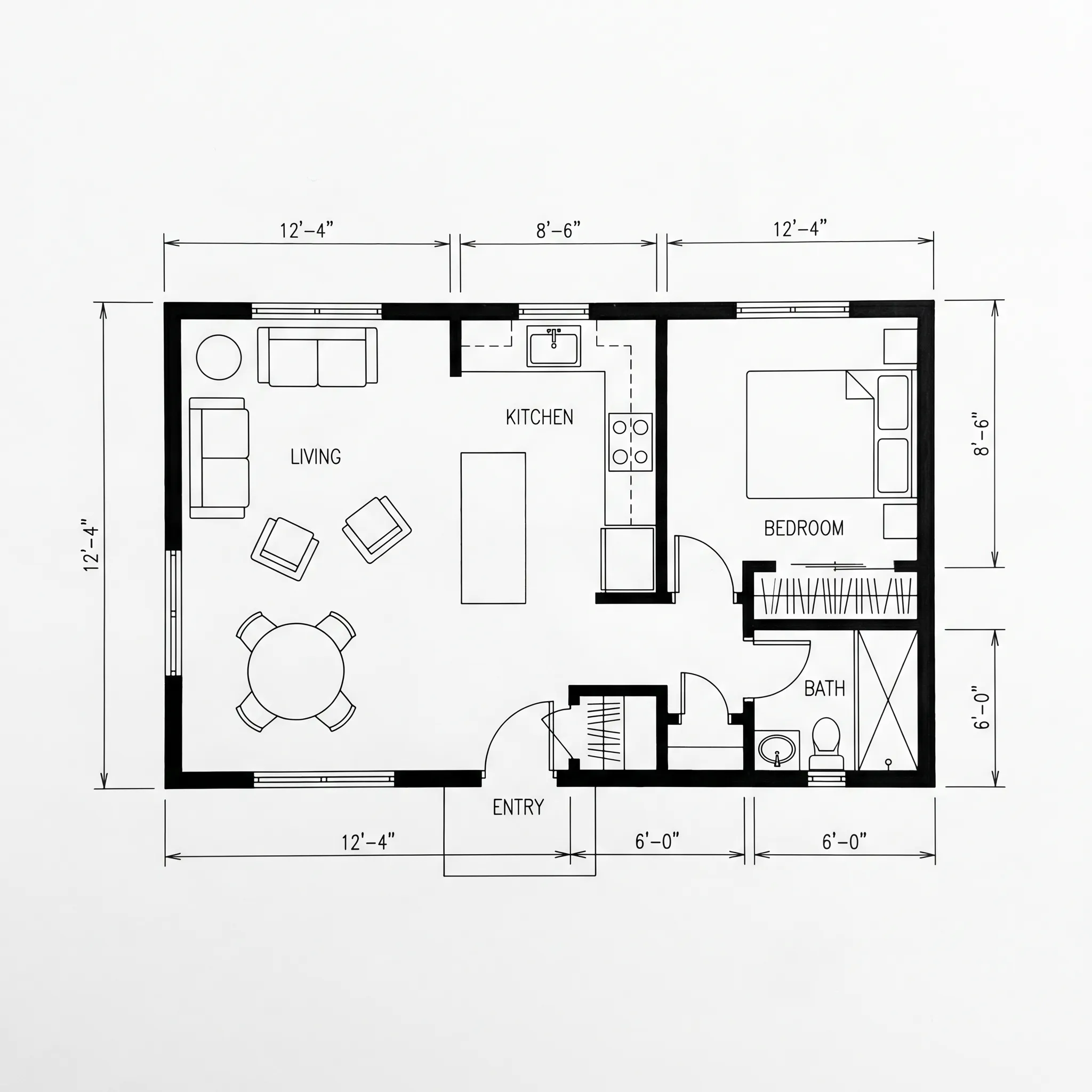
How to Turn a 2D Floor Plan Into a 3D Render With AI (5 Steps)
Turn a 2D floor plan into a 3D render with AI in 5 steps. Render a House makes a photorealistic image in 30–60 seconds, free to start.
Best AI Rendering Tools for Architects in Latin America (2026)
AI rendering tools for architects in Latin America (2026): Render a House, Veras, ArchiVinci, LookX, MyArchitectAI, Maquete. Languages, prices.
