 Render a House/Updated Sep 7, 2026
Lumion 2026 System Requirements: CPU, GPU, RAM, and Why It Won't Run on a Mac
Lumion 2026 needs a dedicated GPU scoring 8,000 or higher on PassMark's G3DMark benchmark, 16 GB of RAM, and 64-bit Windows. There is no macOS build, and Lumion's own support team says running it in Parallels or VMware Fusion on a Mac "will cause crashes, glitches and License Key lock-ups."

That last part is worth sitting with before the rest of the specification. Some rendering tools are inconvenient on a Mac. Lumion is a different case: Act-3D, the company that makes it, states directly that there is no version for macOS, no plan to build one, and no supported way to run the Windows build inside a virtual machine on Apple hardware.
Every figure below comes from Lumion's own system requirements page for Lumion Pro 2026, current as of the 2026.1 update released 14 July 2026. Where a number differs by version, the version-by-version table covers Lumion 2023 through 2026.
Lumion system requirements at a glance
Lumion publishes three tiers — Minimum, Recommended, and High-end — and scores the graphics card by benchmark rather than by naming a chip family. That is a different approach from a vendor like Autodesk, which names a DirectX version and a Shader Model. Lumion instead quotes a PassMark G3DMark score, which measures a card's general 3D performance regardless of brand or generation.
| Component | Minimum | Recommended | High-end |
|---|---|---|---|
| Operating system | 64-bit Windows 10 (v2004) or newer | 64-bit Windows 10 (v2004) or newer | 64-bit Windows 10 (v2004) or newer |
| Graphics card | G3DMark 8,000+ — e.g. GTX 1060, Radeon RX 580 | G3DMark 14,000+ — e.g. RTX 3060, Radeon RX 6700 XT | G3DMark 22,000+ — e.g. RTX 3090, RTX A6000, Radeon RX 6800 XT |
| Graphics card memory | 6 GB or more | 10 GB or more | 16 GB or more |
| CPU | Single-thread CPUMark 2,200+ | Single-thread CPUMark 2,600+ | Single-thread CPUMark 3,000+ |
| RAM | 16 GB or more | 32 GB or more | 64 GB or more |
| Display | 1920 × 1080 | 1920 × 1080 | 1920 × 1080 minimum |
| Storage | 105 GB free on the Windows/Documents drive | 105 GB free, SATA3 SSD or NVMe | 105 GB free, SATA3 SSD or NVMe |
| Power supply | 80+ gold-rated, sufficient wattage | 80+ gold-rated, sufficient wattage | 80+ gold-rated, sufficient wattage |
Minimum: entry-level
A GPU scoring G3DMark 8,000 or higher — Lumion names the NVIDIA GeForce GTX 1060, Quadro K6000, or AMD Radeon RX 580 as reference points — 6 GB or more of video memory, 16 GB of system RAM, and a CPU with a single-thread CPUMark of 2,200 or higher. Lumion's own copy is unusually blunt about this tier: "This configuration is not recommended, as it can only handle simple projects," and it advises against buying new hardware to this spec.
Recommended: complex projects
G3DMark 14,000 or higher (an RTX 3060, Quadro RTX 2000 ADA, or Radeon RX 6700 XT clears it), 10 GB or more of VRAM, 32 GB of RAM, and a CPUMark of 2,600 or higher. Lumion sizes this tier for a complex single building with detailed interiors, or a small park or city block reconstructed from OpenStreetMap data.
High-end: masterplans and animation
G3DMark 22,000 or higher — an RTX 3090, RTX A6000, or Radeon RX 6800 XT — with 16 GB or more of VRAM, 64 GB of RAM, and a CPUMark of 3,000 or higher. This is the tier Lumion attaches to masterplans, stadiums, and multi-floor buildings using fine-detail nature and 3D grass. There is no published tier above it.
The other set of requirements: Lumion View
Lumion sells a second product with a completely different hardware floor, and conflating the two is the most common way to misread this specification. Lumion Viewis a lightweight plugin for SketchUp, Revit, and ArchiCAD built for early-stage design review, not final rendering — and it runs on hardware that would not clear Lumion Pro's Minimum tier.
| Requirement | Lumion View |
|---|---|
| Operating system | Up-to-date Windows 10 64-bit (v2004) or newer |
| Graphics card | Ray-tracing-capable integrated GPU — Intel Arc or Radeon 760M and newer, PassMark 5,500+ (e.g. Intel Core Ultra 5 135H, Ryzen 7640U) |
| CPU | Single-thread CPUMark of 2,500 or higher |
| RAM | 16 GB |
| Disk space | 300 MB free |
| Note | 4K rendering is not possible at these specs |
The graphics line is the tell. Lumion Pro explicitly rules out integrated graphics — its own hardware guide says the card "needs to be a dedicated system and not onboard graphics." Lumion View asks for the opposite: a ray-tracing-capable integrated GPU, the kind built into a current Intel Core Ultra or AMD Ryzen chip with no discrete card at all. Two products, two documents, and a search for "Lumion system requirements" can land on either one depending on which page ranks that day.
Which version of Windows does Lumion need?
Lumion 2026 accepts 64-bit Windows 10 (version 2004, Build 19041) or newer, or Windows 11 (version 24H2, Build 26100) or newer. Lumion adds a caveat rather than a hard cutoff: its system requirements page notes that "Windows 10 has reached end of life support and only receives critical security updates," and recommends migrating to Windows 11 — but it has not removed Windows 10 from the supported list the way some CAD vendors have for their newest release.
The Windows 10 floor itself has not moved since Lumion 2023. Lumion's knowledge base states that "Lumion 2023 and newer requires Windows 10 version 2004 or newer, or preferably Windows 11." What has moved is which Windows 11 build counts as preferred — 21H2 (Build 22000) for Lumion 2023 through 2025, 24H2 (Build 26100) for 2026 — which tracks Microsoft's own release cadence rather than anything Lumion changed on its end.
Does Lumion run on a Mac?
There is no Mac version of Lumion Pro
There is no macOS build of Lumion Pro and there never has been. Lumion's support team answers the question directly in its knowledge base: "Can you install Lumion on OSX? No. Lumion cannot be installed on OSX, and there are no plans to make Lumion available on OSX." Unlike a modeller such as Revit, which at least publishes a supported way to run its Windows build inside a virtual machine on a Mac, Lumion closes that door too.
Parallels and VMware Fusion are explicitly unsupported
The same article states it without hedging: "Parallels and VMware Fusion for OSX are not supported and will cause crashes, glitches and License Key lock-ups." That is a specific, named failure mode — not a generic "unsupported configuration" disclaimer — and it rules out the exact workaround that makes Revit usable on a Mac. A Boot Camp install, where the Mac fully boots into Windows rather than running it in a virtual machine, is the only route Lumion support has ever pointed to for Intel Macs, and Boot Camp does not exist on Apple silicon at all.
The exception: Lumion View runs natively on Apple silicon
The one genuine exception is Lumion View for SketchUp, which ships a native Apple silicon build. It supports M2 Pro for rasterization, and M3 or M4 (Pro, Max, or Ultra) for both rasterization and ray tracing, alongside 16 GB of RAM and SketchUp 2025 or newer. That covers early-stage, in-viewport visualization only — the moment a project needs Lumion Pro's asset library, animation tools, or final-image rendering, the Mac path ends.
Lumion graphics card requirements explained
Why Lumion scores GPUs instead of naming a spec floor
Lumion's graphics requirement is a moving target by design. Rather than naming a DirectX version or a list of certified cards, it quotes a PassMark G3DMarkscore — a single number PassMark computes from thousands of submitted benchmark runs across GPU generations and vendors. The practical effect is that Lumion's requirement stays current without Lumion having to republish a card list every time NVIDIA or AMD releases a new generation; you just look up your card's current G3DMark score and compare it to the tier.
Lumion is also unusually direct that this has to be a dedicated card. Its 2026 hardware guide calls the graphics card "the single most important component for Lumion" and states it "needs to be a dedicated system and not onboard graphics." That rules out the integrated GPUs in most non-gaming laptops for Lumion Pro, even though those same chips are exactly what Lumion View is built to run on.
Integrated graphics: where Intel Arc fits
One qualifier moved in the 2026 guide: Intel graphics are now an accepted exception, but only from a specific point onward. The note reads "Intel: A series or newer B series; A580 or B580 or better cards only". That is Intel's discrete Arc line, not the integrated graphics bundled into a standard laptop CPU — so "Intel graphics" on a spec sheet is not, by itself, enough to know whether a machine qualifies.
Which GPU to buy, by what you render
| What you render | VRAM | Notes |
|---|---|---|
| A single residential model, or early-stage massing studies | 6 GB | Clears the entry tier's G3DMark 8,000 floor. Autodesk-style certification lists don't exist here — Lumion scores the card, not the model name |
| A detailed home, a small landscape, or an OpenStreetMap city block | 10 GB | The Recommended tier, and the one Lumion itself calls out as suitable for 'complex' projects |
| Fine-detail nature, 3D grass, or a multi-floor building with heavy interiors | 16 GB | High-end tier. This is also the floor for comfortable 4K rasterization and 1080p ray tracing, both of which Lumion states need at least 8 GB on their own |
| A detailed city, airport, or stadium at masterplan scale | 16 GB or more | Lumion's own ceiling. There is no published tier above High-end |
Other hardware requirements
CPU
Lumion scores the CPU the same way it scores the GPU — a PassMark single-thread CPUMark, not a core count or a named family. 2,200 or higher clears Minimum (Lumion's example is a Ryzen 5 1600X or Core i7-4790S), 2,600 clears Recommended (Ryzen 5 3600, Core i5-8600), and 3,000 clears High-end (Ryzen 5 5500, Core i7-11700T). Every reference chip Lumion names is a mid-range part from its own tier, not a flagship — a signal that single-core speed, not raw core count, is what the application actually leans on while you edit a scene.
RAM
16 GB, 32 GB, or 64 GB, matched to the same three tiers. Unlike some CAD vendors, Lumion does not publish a formula tying RAM to project file size — the tiers are qualitative ("simple project" versus "ultra complex"), which makes RAM the hardest line in this specification to size against a specific job before you've already loaded it.
Storage
105 GB of free disk space, and Lumion is specific about where: on whichever drive holds your Windows user account and Documents folder, not just wherever you choose to install the application. That figure is identical across all three tiers — Minimum, Recommended, and High-end all ask for the same 105 GB — and Lumion recommends a SATA3 SSD or NVMe drive at the Recommended tier and above.
Power supply
Lumion is one of the few applications in this cluster to publish a power-supply requirement at all: an 80+ gold-rated unit with sufficient wattage for the graphics card installed, at every tier. It is a reasonable line for a vendor whose entire product is built around keeping a discrete GPU under sustained real-time load, and an easy one to miss if you are pricing a build against the RAM and GPU rows alone.
Internet
An internet connection is required for the PC running Lumion, full stop — Lumion does not describe an offline licensing mode. The requirement is stated identically for Lumion Pro and Lumion View.
Lumion system requirements by version
Lumion switched from numbered releases (Lumion 12 was the last) to year-named releases starting with Lumion 2023, which rebuilt the render engine around ray tracing. That makes the version table below closer in shape to Autodesk's than to Blender's — rows are calendar years, not point releases.
| Version | Released | Windows | GPU/CPU/RAM |
|---|---|---|---|
| Lumion 2026 | February 2026 | Windows 10 (v2004/Build 19041)+ or Windows 11 (24H2/Build 26100) recommended | Unchanged from 2023–2025 and Lumion 12 |
| Lumion 2025 | April 2025 | Windows 10 (v2004)+ or Windows 11 21H2 (Build 22000)+ recommended | Unchanged from 2023–2024 and Lumion 12 |
| Lumion 2024 | March 2024 | Windows 10 (v2004)+ or Windows 11 21H2 (Build 22000)+ recommended | Unchanged from 2023 and Lumion 12 |
| Lumion 2023 | March 2023 | Windows 10 (v2004)+ or Windows 11 21H2 (Build 22000)+ recommended | Same G3DMark/CPUMark/RAM tiers as Lumion 12 |
| Lumion 12 and earlier | 2021 and before | Windows 10 (v1809)+ or Windows 11 | Baseline for the GPU/CPU/RAM tiers every later release still quotes |
The standout fact is what did notchange. Lumion's own 2026 hardware guide states it plainly: "there are no changes in hardware requirements for Lumion 2026 from those for Lumion 2025/2024/2023/Lumion 12." The G3DMark, CPUMark, and RAM tiers on this page have held for roughly five years and two full render-engine rewrites. The only line that has moved release over release is the recommended Windows 11 build — 21H2 for 2023 through 2025, 24H2 for 2026— which tracks Microsoft's update calendar rather than anything in Lumion itself.
One consequence: a machine bought to run Lumion 2023 still meets the published spec for Lumion 2026. There is no equivalent here to Revit dropping Windows 10 outright, or Blender raising its GPU floor at a major version. The reason to upgrade hardware for Lumion is a bigger project, not a newer release.
Quick recommendations by use case
| Who you are | Machine | Target spec | Notes |
|---|---|---|---|
| Student or new user | Any Windows laptop with a discrete GPU | 16 GB RAM · 6 GB VRAM, G3DMark 8,000+ | Meets the Minimum tier. Lumion itself warns this configuration 'is not recommended' for anything beyond simple projects |
| Solo freelancer | Desktop or 16-inch workstation laptop | 32 GB RAM · 10 GB VRAM, G3DMark 14,000+ | The Recommended tier, sized for a single detailed home or a small landscape |
| Interior designer | Desktop with a modern dedicated GPU | 32 GB RAM · 10–16 GB VRAM | Interiors lean on texture and material memory more than polygon count, so VRAM matters more here than the CPU line |
| Small to mid-size firm | Workstations, one shared render machine | 64 GB RAM · 16 GB VRAM, G3DMark 22,000+ | High-end tier — masterplans, animations, and fine-detail nature all live here |
| Mac-based practice | No supported configuration for Lumion Pro | — | Lumion View for SketchUp runs natively on Apple silicon, but the rendering engine itself does not run on macOS at any specification |
| Early-stage design review only | Any machine that runs the host CAD software | 16 GB RAM · integrated GPU with ray-tracing support | Lumion View's floor, not Lumion Pro's — see the two tables above |
Best laptops for Lumion in 2026
Lumion does not endorse specific machines, and neither does this page. Because Lumion Pro requires a dedicated GPU at every tier, a laptop bought for it needs a real mobile discrete card, not the integrated graphics that satisfy Lumion View. Price bands below are approximate street prices for a Windows 11 laptop at the time of writing and move constantly; the specifications are the durable part.
Budget tier
Roughly $1,300 to $1,800. A discrete mobile GPU clearing G3DMark 8,000 (an RTX 3050/4050-class card), 16 GB of RAM, and a 512 GB SSD or larger — the 105 GB storage requirement eats more than a third of a 256 GB drive before you install anything else. This meets Lumion's Minimum tier, which is Lumion's own words "not recommended" for a new purchase, and is realistic for a student or a first machine used mostly for learning the interface.
Mid tier
Roughly $2,000 to $2,800. A mobile RTX 4060 or 4070-class GPU (10 GB or more of VRAM, clearing G3DMark 14,000), 32 GB of RAM, and a 1 TB SSD. This is Lumion's Recommended tier and covers a single detailed building or a small landscape comfortably.
Pro tier
$3,200 and up, and often a desktop rather than a laptop once you're at this tier, since a mobile GPU clearing G3DMark 22,000 is rare and thermally constrained. 16 GB or more of VRAM, 64 GB of RAM, and fast NVMe storage. Justified by masterplan-scale scenes, animation output, or fine-detail nature assets — not by wanting the biggest number on a spec sheet.
Common hardware problems and what causes them
- Lumion runs, but drops frames or looks worse than expected. Almost always a GPU below the G3DMark figure for the project's actual complexity, not a broken setting. Check the card's current G3DMark score against the tier — scores shift slightly as PassMark's sample size grows, so a card bought two years ago may have moved between tiers on paper without changing at all in hardware.
- Lumion crashes or the license locks up on a Mac. Expected if it's running inside Parallels Desktop or VMware Fusion. Lumion's own support documentation names this exact failure mode and does not offer a fix, because the configuration itself is unsupported.
- Installation fails or Lumion won't launch on a laptop with Intel graphics. Check whether the chip is a genuine Arc discrete GPU (A-series or newer B-series, A580/B580 or better) rather than the integrated graphics bundled into the CPU. Only the former is accepted for Lumion Pro.
- Installer or project loading fails with a disk-space error. Lumion's 105 GB figure applies to the drive holding the Windows user account and Documents folder specifically, not wherever the application itself was installed — a common trap on machines with a small system SSD and a larger secondary drive.
- Textures or nature assets look blurry or take a long time to appear. Usually VRAM pressure rather than a driver problem — Lumion's own note states 4K rasterization and 1080p ray tracing each need at least 8 GB of graphics memory on their own, on top of whatever the scene itself already occupies.
How to get more out of the hardware you have
- Keep GPU drivers current.Lumion's own hardware guidance repeats this at every tier — it is the single most-cited fix in its own documentation, not a generic suggestion.
- Buy on G3DMark and CPUMark, not on a model name you recognize. A card or chip that looks impressive by reputation can still sit below the tier you need; the benchmark score is the number Lumion actually checks against.
- Reserve ray tracing for final output, not live editing. Rasterization is the lighter mode of the two and is what the Minimum and Recommended tiers are sized around; switching to ray tracing only when composing a final Photo or Movie keeps day-to-day editing responsive on modest hardware.
- Give the 105 GB its own drive if you can. Keeping the Windows user account and Documents folder on a dedicated SSD, separate from a smaller system drive, avoids the installation and loading failures that show up when that specific volume runs low.
- Never route around the Mac limitation with Parallels or VMware. Lumion's own documentation is specific about the failure mode here, and there is no configuration of either product that Act-3D supports.
The cloud alternative
Every requirement on this page exists because Lumion renders in real time on your own GPU. Move that step off the machine and the GPU floor, the VRAM figure, and the Windows requirement all go with it.
This is the specific case where Render a House closes a gap Lumion cannot close on its own: it runs in a browser, so it needs no dedicated GPU, no G3DMark score, and no Windows install — including on the Mac that Lumion Pro will never support, in any configuration, at any specification. Upload a flat image of a Lumion scene, a floor plan, or a sketch and it generates a photorealistic concept image without asking what card is inside the machine you're using. It's free to start, with 3 renders a day, and paid plans start at $39/mo.
The clearest use case is a mixed-hardware team: a firm running Lumion on Windows workstations for walkthroughs and animation, where a Mac-based designer or a client on a laptop without a dedicated GPU still needs to produce or review a still concept image without waiting for the Lumion machine to free up.
What browser rendering cannot do
It is not a replacement for Lumion, and treating it as one wastes time on the wrong task. Browser rendering has no real-time viewport — no walkthrough, no live camera path, no scrubbing a timeline the way Lumion's Movie mode does. It holds no scene file, no asset library, and no LiveSync connection back to a CAD model, so a change in your model or floor plan means generating again rather than watching an open scene update. It will not produce an animation, a VR export, or a deterministic frame you can re-render identically twice.
What it is good at is the single concept image, generated in seconds from a flat input, for the moment in a project when standing up a full real-time scene is more setup than the deliverable is worth.
Common questions about Lumion hardware
What are the minimum system requirements for Lumion 2026?
A dedicated NVIDIA or AMD GPU scoring 8,000 or higher on PassMark's G3DMark benchmark with 6 GB or more of video memory (a GTX 1060 or Radeon RX 580 clears it), a CPU scoring 2,200 or higher on a single-thread CPUMark, 16 GB of RAM, a 1920 × 1080 display, and 105 GB of free disk space on the drive holding your Windows user account and Documents folder. Lumion states plainly that this configuration is not recommended for a new PC purchase and will struggle past simple projects.
How much RAM do you need for Lumion?
Lumion publishes three flat tiers rather than tying RAM to model size the way some CAD vendors do: 16 GB at the Minimum tier, 32 GB at Recommended, and 64 GB at High-end. Lumion's own support articles state that hardware requirements, including these RAM figures, have not changed since Lumion 12 — the number that has moved since then is the recommended Windows build, not the memory.
Does Lumion work on a Mac?
No. Lumion's support team states directly that Lumion cannot be installed on macOS and there are no plans to make it available on macOS. Lumion's real-time engine is built for Windows graphics APIs that have no macOS equivalent, and Act-3D has never shipped a native build.
Can you run Lumion in Parallels or a VM on a Mac?
Act-3D explicitly does not support it. Lumion's own knowledge base says running Lumion under Parallels Desktop or VMware Fusion for macOS "will cause crashes, glitches and License Key lock-ups." That is a stronger warning than a typical vendor's "not tested" disclaimer — it names the specific failure modes.
What graphics card do you need for Lumion?
Any dedicated NVIDIA or AMD card with enough raw performance, measured by PassMark's G3DMark score rather than by feature support: 8,000+ for Minimum, 14,000+ for Recommended, 22,000+ for High-end. Integrated graphics are explicitly excluded for Lumion Pro — the 2026 hardware guide says the GPU "needs to be a dedicated system and not onboard graphics," with one exception for Intel's newest Arc-based chips, which Lumion allows starting from the A-series.
Is Lumion View the same thing as Lumion Pro?
No, and the two are sold as separate products with separate licenses — upgrading from View to Pro isn't a plan change. Lumion View is a lightweight plugin for SketchUp, Revit, and ArchiCAD aimed at early-stage visualization; it runs on far lighter hardware, including ray-tracing-capable integrated graphics, and even has a native Apple silicon build. Lumion Pro is the full rendering application this page is mostly about, and it has no Mac build at all.
Does Lumion 2026 still support Windows 10?
Yes, technically. Lumion 2026's own system requirements list Windows 10 version 2004 (Build 19041) or newer as an accepted floor, alongside Windows 11 24H2 (Build 26100) or newer. Lumion adds that Windows 10 has reached end of life and recommends migrating to Windows 11, but — unlike some CAD vendors that have dropped Windows 10 outright for their newest release — Lumion has not removed it as a supported option.
Sizing hardware against a different tool in the same shortlist? Enscape system requirements, Twinmotion system requirements and D5 Render system requirements cover the other real-time renderers architects compare against Lumion most often — D5 is the other Windows-only one here, though unlike Lumion it says nothing about Parallels either way, and SketchUp system requirements is the modeller most Lumion projects start from. If your firm is also comparing offline renderers, Blender system requirements and Revit system requirements run the same exercise for a free tool and a BIM platform, respectively. Costing the subscription as well as the machine? Lumion pricing covers what Act-3D charges for View, Pro, and Pro Floating.
Keep reading
Related guides and comparisons
ChatGPT for architectural rendering: does it work?
Partly. ChatGPT is great for a fast concept image, but edits drift and it can't keep several renders of one project consistent. Render a House can.
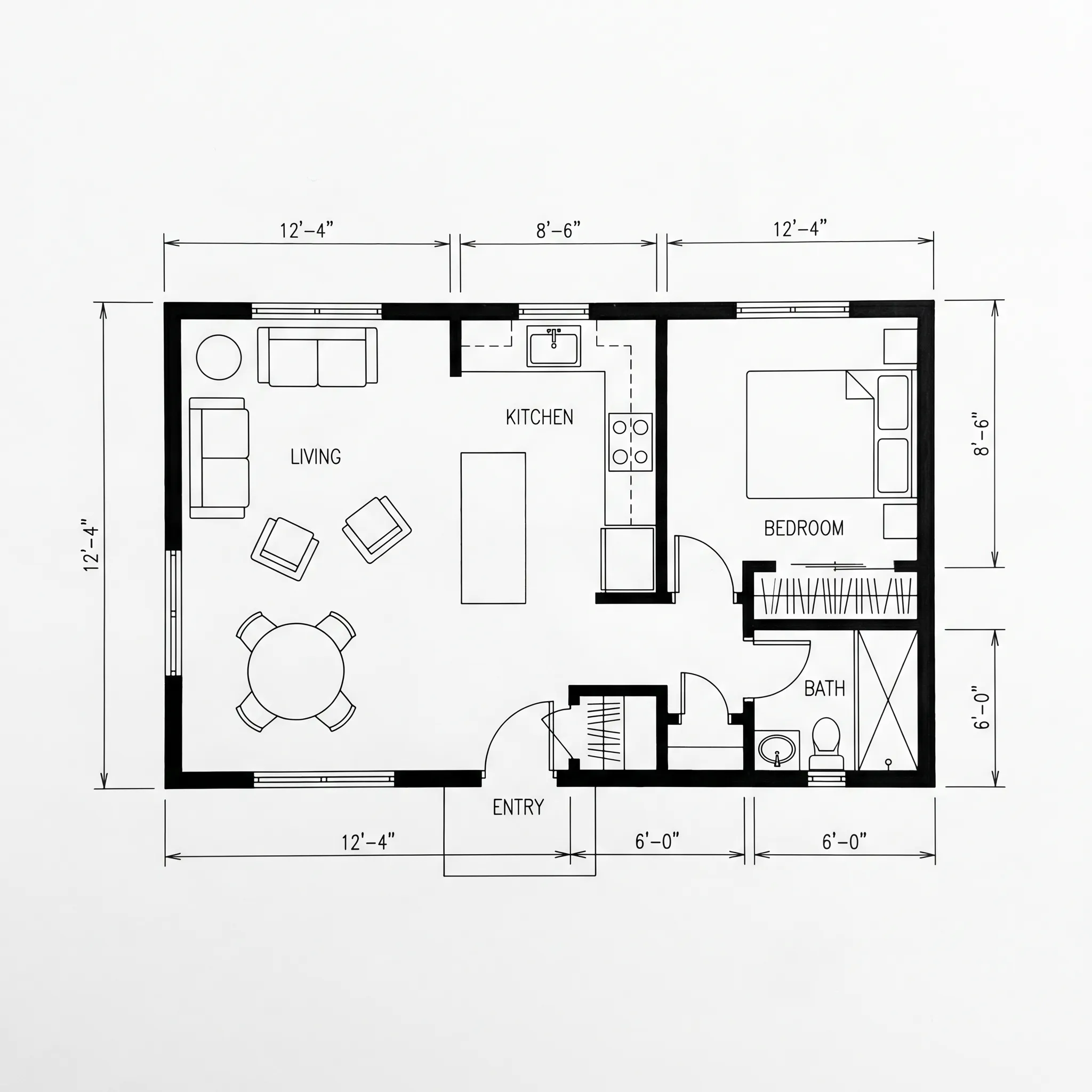
How to Turn a 2D Floor Plan Into a 3D Render With AI (5 Steps)
Turn a 2D floor plan into a 3D render with AI in 5 steps. Render a House makes a photorealistic image in 30–60 seconds, free to start.
Best AI Rendering Tools for Architects in Latin America (2026)
AI rendering tools for architects in Latin America (2026): Render a House, Veras, ArchiVinci, LookX, MyArchitectAI, Maquete. Languages, prices.
