 Render a House/Updated Sep 7, 2026
Enscape System Requirements 2026: GPU, VRAM, and Does It Run on Mac?
Enscape asks for a 4 GB VRAM graphics card at minimum, 8 GB recommended, and 12 GB for VR. It does not publish a CPU speed or a RAM figure of its own at all.

That last part is the detail every other system-requirements page in this category gets wrong by omission: Enscape is a plugin, not a standalone application, and its own published requirements say so directly — "if your system's CPU and RAM are capable of handling Revit, for instance, and you have a capable GPU, Enscape should work." Whatever floor your CAD software set, Enscape inherits it rather than adding a second one.
Every figure below comes from Chaos's own Enscape system requirements page, current as of Enscape 4.20.0, released 26 August 2026. Enscape names its releases by version number, not by year — the version-history table below covers 3.5 through 4.20.
Enscape system requirements at a glance
Chaos publishes three tiers for Windows: Minimum, Recommended, and VR. Two of the six rows in its own table — CPU and RAM — are deliberately blank, and the next section explains why.
| Component | Minimum | Recommended | VR |
|---|---|---|---|
| Operating system | Windows 10 or higher | Windows 10 or higher | Windows 10 or higher |
| Graphics card | Intel Arc A310, or an NVIDIA/AMD dedicated GPU supporting Vulkan 1.1 | NVIDIA GeForce GTX 10-series / Quadro P-series or newer, AMD Radeon RX 5000-series or newer — or step up to an RTX 3070 Ti / RX 6800 for headroom | NVIDIA GeForce RTX 4070 Ti or AMD RX 7900 XT |
| VRAM | 4 GB | 8 GB | 12 GB |
| CPU | Not specified by Enscape — see below | Not specified by Enscape — see below | Not specified by Enscape — see below |
| RAM | Not specified by Enscape — see below | Not specified by Enscape — see below | Not specified by Enscape — see below |
| Additional software | .NET Framework 4.5.2+, Visual C++ 2015–2019 Redistributable, Vulkan Runtime | Same as minimum | Same as minimum, plus a Meta Quest 3 or HTC Vive Pro 2 |
Minimum requirements
A 4 GB VRAM graphics card that supports Vulkan 1.1 — an Intel Arc A310 clears this, as does effectively any NVIDIA or AMD dedicated card sold in the last several years. Enscape uses ray tracing for its real-time rendering and hands almost all of the calculation to the GPU, which is why the graphics card is the entire minimum specification.
Recommended requirements
8 GB of VRAM on a GTX 10-series, Quadro P-series, or Radeon RX 5000-series card or newer — or Chaos's own stronger pick, an RTX 3070 Ti or RX 6800, for a bit more headroom on larger scenes. This is the tier that clears daily studio work without compromise.
VR requirements
12 GB of VRAM on an RTX 4070 Ti or RX 7900 XT. Chaos is explicit that for VR, the GPU's clock speed matters more than the VRAM total, though it still recommends buying as much VRAM as you can afford. A Meta Quest 3 or HTC Vive Pro 2 covers the headset side.
Why doesn't Enscape publish a RAM or CPU number?
Most rendering plugins publish a CPU clock speed and a RAM figure alongside their GPU numbers. Enscape's own documentation does not, and it says exactly why: a good CPU speeds up loading, but the number that matters is whatever your host application already needs to run.
| Host application | Its own RAM floor | Source |
|---|---|---|
| Revit 2027 | 16 GB Minimum / 32 GB Value / 64 GB Performance | Autodesk's own tiered figures |
| SketchUp | 8 GB — Trimble's only published figure; no separate minimum tier | Trimble's Recommended Hardware Requirements |
| Rhino 8 | 8 GB — the same single figure for both Windows and Mac | McNeel's own system-requirements page |
That means the RAM number worth budgeting against is never on Enscape's own page. If you run Revit at its Value tier, you already have the 32 GB Enscape needs and then some. If you run SketchUp at Trimble's own 8 GB recommendation, that is also the number Enscape is quietly relying on — and it is thinner than what most studios actually run in practice. Buy RAM against your CAD software's own page, not against Enscape's, because Enscape's page has nothing to say on the subject.
Does Enscape work on Mac?
Yes, with real restrictions. Enscape runs on Apple Silicon Macs with macOS 14.8.1 Sonoma or newer, alongside SketchUp, Rhino, Archicad, or Vectorworks. It does not run alongside Revit on Mac, for a reason that has nothing to do with Enscape: Revit itself has never shipped a Mac version, so there is no host application for the plugin to attach to.
Which Mac chips are supported
Only Apple Silicon — M1, M2, M3, or M4. Chaos's own table lists specific qualifying Macs by chip generation:
- M1: MacBook Air (2020), MacBook Pro (2021), iMac (2021), Mac mini (2020) at the base tier, or a MacBook Pro (M1 Pro/Max, 2021) or Mac Studio (M1 Max/Ultra, 2022) with 32 GB of unified memory for larger projects.
- M2: MacBook Air (2022/2023), MacBook Pro (2022), Mac mini (2022) at the base tier, or a MacBook Pro (M2 Pro/Max), Mac Studio (M2 Max/Ultra), or Mac mini (M2 Pro) with 32 GB, up to a Mac Pro (M2 Ultra, 2023) with 64 GB.
- M3: MacBook Air (2024), MacBook Pro (2023), iMac (2023) at the base tier, or a MacBook Pro (M3 Pro/Max) with 36 GB of unified memory.
- M4: MacBook Air (2024), Mac mini (2024), iMac (2024), MacBook Pro (2024) at the base tier, or a Mac mini (M4 Pro) or MacBook Pro (M4 Pro/Max) with 48 GB.
One knock-on requirement worth flagging: Chaos notes that SketchUp versions before 2024 do not officially support macOS Sonoma, so a Mac running Enscape with SketchUp needs SketchUp 2024 or newer for a second, independent reason — nothing to do with Enscape's own floor.
What's not supported on Mac
- Revit, full stop. Not an Enscape limitation — Autodesk has never built a native Mac version of Revit.
- Intel Macs.Chaos's own requirements list "Macs with Intel CPU and Intel or AMD GPU" under Unsupported Hardware, explicitly.
- VR.The VR Requirements column for macOS reads "Not currently supported," with no exceptions listed for any Apple Silicon generation.
- A separate "Recommended" tier. Unlike Windows, macOS gets one baseline specification per chip rather than a distinct minimum-versus-recommended split.
Enscape graphics card requirements explained
Why GPU matters so much
Enscape's rendering engine is built on ray tracing, and "almost all the calculations that Enscape performs are being handled on the graphics card," in Chaos's own words. That is the reason the entire specification collapses to one component: give it enough dedicated VRAM on a Vulkan-capable card and the rest of the machine matters far less.
NVIDIA vs AMD vs Intel Arc
Chaos treats NVIDIA and AMD as equivalent tiers rather than recommending one over the other: GTX 10-series sits alongside Quadro P-series on the NVIDIA side, RX 5000-series alongside Radeon Pro on the AMD side, and an Intel Arc A310 clears the minimum outright. The one asterisk is DLSS and hardware ray-traced features, which Chaos disables on the NVIDIA GTX 1660, T1000, and T2000 lines specifically because those cards report RTX support they cannot actually deliver without performance problems.
VRAM, the number that actually decides your build
Every other number in Enscape's specification — OS version, required runtimes — barely changes across tiers. VRAM is the one that does: 4 GB, 8 GB, 12 GB. That is a straightforward tripling from minimum to VR, and it is the single figure worth checking before anything else on a spec sheet.
Recommended GPUs by use case
| What you're doing | VRAM | Notes |
|---|---|---|
| Learning Enscape, or a small residential model | 4 GB | Clears Enscape's own published minimum. An Intel Arc A310 qualifies on paper |
| Daily studio work on mid-size projects | 8 GB | Enscape's own recommended tier — a GTX 10-series, Quadro P-series, or RX 5000-series card or newer |
| Client-facing VR walkthroughs | 12 GB | An RTX 4070 Ti or RX 7900 XT. Enscape's own guidance is that GPU clock speed matters more than VRAM size here |
| Large, linked Revit models | 8 GB on the Enscape side | Revit's own Performance tier separately asks for 8 GB of VRAM at 64 GB of system RAM — that ceiling comes from Revit, not Enscape |
Which CAD apps does Enscape work with, and which versions?
Enscape ships as a single Windows installer and a single macOS installer, each covering every host application at once — you pick which CAD or CADs to install into during setup rather than downloading a separate build per application.
| Host application | Supported versions | Windows | Mac |
|---|---|---|---|
| Revit | 2023, 2024, 2025, 2026 | Supported | Not available — Revit itself has no Mac build |
| Revit LT | — | Not supported | Not supported |
| SketchUp | 2024, 2025, 2026 | Supported | Supported (2024 or newer only) |
| Rhino | 7.0, and 8.3 or later | Supported | Supported |
| Archicad | 27, 28, 29 | Supported | Supported |
| Vectorworks | 2024, 2025, 2026 (2027 preliminary since Enscape 4.19) | Supported | Supported |
Revit LT is a permanent exception, not a version gap Chaos will close later: Autodesk only allows third-party plugins in the full version of Revit, so Enscape cannot be installed into LT at any price or on any hardware.
Other hardware Enscape depends on
CPU
Enscape publishes no CPU clock speed or core count. The closest it comes is a single sentence: "a good CPU can speed up Enscape's loading times." Loading, not rendering — the rendering work is on the GPU. Buy the CPU your host application asks for; Revit ranks single-core clock speed above core count in its own published requirements, and that guidance carries over unchanged when Enscape is running alongside it.
RAM
Same answer as the CPU: no independent figure. Size the machine to your host application's own RAM tier — SketchUp and Rhino each publish 8 GB as their one recommended figure, while Revit scales from 16 GB to 64 GB depending on model size — and Enscape runs on top of whichever number that turns out to be.
Storage
Chaos does not publish a disk-space figure for Enscape itself in its system-requirements table. Budget for the installer, the asset library cache — delivered through the Chaos Cosmos platform since Enscape 4.10 — and whatever your host application already requires on top.
Internet
A stable internet connection is recommended, and Chaos is specific about why: a wired connection avoids the slowdowns a Wi-Fi link can cause when the Asset Library is loading content from Cosmos. Internet access is also required outright for license authorization, and Enscape's newer Cloud Licensing option (added in version 4.16) removes the need for a VPN or an on-premise license server, at the cost of depending on that connection more directly than the older Chaos License Server did.
Enscape version history: numbers, not years
Autodesk, Trimble, and Epic name their releases after years. Chaos does not — Enscape ships on a rolling version-number cadence, roughly every four to eight weeks, and a query like "enscape 2026 system requirements" has no literal answer because no such release exists. The table below is the real mapping: version number to release date, sourced from Chaos's own release-notes pages for every row from 4.4 onward, with the two oldest rows drawn from Chaos's public changelog history.
| Version | Released | What changed |
|---|---|---|
| 4.20.0 | 26 Aug 2026 | Composition Gridlines across the full viewport; faster Revit live updates in large projects |
| 4.19.0 | 29 Jul 2026 | Chaos Assistant in-app AI guidance; preliminary Vectorworks 2027 support |
| 4.18.0 | 7 May 2026 | Redesigned interface; Chaos Notification Center |
| 4.16.0 | 25 Feb 2026 | Cloud Licensing option — no VPN or on-premise license server required |
| 4.14.0 | 10 Dec 2025 | Light Management Browser |
| 4.10.0 | 27 Aug 2025 | Switched asset delivery to the Chaos Cosmos platform |
| 4.6.0 | 30 Apr 2025 | Added Revit 2026 support, confirming the policy of supporting the latest four Revit releases |
| 4.0.0 | 27 Mar 2024 | Adjustable Assets — recolor and re-material furniture and people presets |
| 3.5 | 16 May 2023 | Hardware ray-traced GI and reflection upgrade; full Revit 2024 compatibility |
The GPU floor itself has not moved across any of these releases — 4 GB minimum, 8 GB recommended, 12 GB for VR is the same specification Chaos published for 3.5 in 2023 and for 4.20 in 2026. What changes release to release is host-application compatibility (Revit 2026 in 4.6, preliminary Vectorworks 2027 in 4.19) and the software around the renderer — Chaos Cosmos, Cloud Licensing, the Chaos Assistant — not the hardware floor underneath it.
Quick recommendations by use case
| Who you are | Target spec | Notes |
|---|---|---|
| Student or first-time user | Any GPU that clears Enscape's 4 GB VRAM minimum | RAM and CPU ride on whichever host app you install — meet that app's own floor first |
| Solo architect on SketchUp or Rhino | 8 GB VRAM — Enscape's recommended tier | Enscape's figure only covers Enscape — if you work in SketchUp with PBR materials, Trimble separately asks for 32 GB of VRAM |
| Small firm on Revit with linked consultant models | 8 GB VRAM on the Enscape side, 32–64 GB system RAM | The RAM figure you buy against is Revit's Value or Performance tier, not anything Enscape states |
| Client-facing VR walkthroughs | 12 GB VRAM, RTX 4070 Ti or RX 7900 XT | Enscape's own VR guidance favors GPU clock speed over raw VRAM capacity |
| Mac-based practice | Apple Silicon M1–M4, 32–48 GB unified memory depending on chip | Only for SketchUp, Rhino, Archicad, or Vectorworks — Revit has no Mac build to plug Enscape into |
Best laptops for Enscape in 2026
Chaos does not endorse specific machines, and neither does this page. Because Enscape's own floor is GPU-only, the specification to buy against below leans on VRAM first and lets your host CAD application decide the RAM. Price bands are approximate street prices for a Windows 11 laptop at the time of writing and move constantly; no exact SKU price from a manufacturer was quotable, so treat these as bands, not quotes.
Budget tier
Roughly $1,200 to $1,600. A discrete GPU with 4 GB of VRAM, 16 GB of system RAM (enough for SketchUp or Rhino at their own recommended figure, thin for Revit), and a 512 GB SSD. This clears Enscape's published minimum and is the honest ceiling for a student machine or a first Enscape install.
Mid tier
Roughly $1,900 to $2,600. An 8 GB VRAM card — Enscape's own recommended tier — paired with 32 GB of RAM, which clears Revit's Value tier as well. This is the realistic default for a working architect running Enscape alongside any of its five supported host applications.
Pro tier
$3,000 and up.A 12 GB VRAM card such as an RTX 4070 Ti, 64 GB of RAM to clear Revit's Performance tier on large linked models, and fast NVMe storage. Justified by VR client walkthroughs or by federated Revit models over 600 MB — not by Enscape's own minimum, which this tier clears many times over.
Common Enscape hardware problems and fixes
- Enscape installs but performance is poor on a GTX 1660, T1000, or T2000.Expected. Chaos disables DLSS and hardware ray tracing on these specific cards from version 4.0 onward because they report RTX capability they cannot deliver cleanly. Disabling RTX features manually is Chaos's own recommendation for these three cards.
- VR headset connects but performance stutters. Check the GPU against the VR tier specifically — 12 GB of VRAM and a card in the RTX 4070 Ti / RX 7900 XT class — rather than the Recommended tier, which is specified for flat-screen use.
- Enscape will not install on a laptop with no discrete GPU. Chaos does publish a narrow exception for recent integrated graphics — 13th-generation Intel UHD 730/64EU and above, or AMD Ryzen 6000/7000 series with Radeon 660M/740M — but VR and hardware ray tracing are unavailable on any of them.
- A Revit-specific plugin conflict. Chaos names two Revit plugins, Colorizer and TechViz, as known conflicts and recommends uninstalling them before running Enscape.
- SketchUp on an Intel Mac won't show Enscape at all.Not a bug — Enscape's Mac installer only targets Apple Silicon, regardless of what SketchUp itself supports.
- Multiple GPUs installed, only one appears used. Expected. Chaos states Enscape only utilizes one GPU even when several are present, and SLI is unsupported (AFR mode in the NVIDIA driver can still help).
How to get more out of the hardware you have
- Update the graphics driver before anything else. Chaos's own tables list "the latest available drivers, or at least our recommended drivers" at every tier — this is not boilerplate, it is a stated requirement.
- Use a wired connection for the Asset Library. Chaos calls out Wi-Fi specifically as a source of slow Cosmos asset loading.
- Set up a dual-monitor workflow. Not a requirement, but Chaos states Enscape is optimized for it on both Windows and Mac.
- Uninstall Colorizer and TechViz if you run Enscape inside Revit — Chaos names both as active conflicts.
- Size RAM to your host app, not to Enscape. Since Enscape publishes no RAM figure, the safe move is matching whichever CAD application you pair it with at that app's own recommended tier, not its bare minimum.
The cloud alternative
Every requirement on this page exists because the rendering happens on your GPU. Move that one step off the machine and the GPU floor, the VRAM tier, and the host-application dependency all go with it.
Render a House runs in the browser, so there is no VRAM tier to clear and no Vulkan driver to install. It also has no host-application dependency at all — export a flat image or screenshot from Revit, SketchUp, Rhino, Archicad, or Vectorworks, or from software Enscape does not plug into, and upload it directly. It is free to start, with 3 renders a day, and paid plans are $39/mo.
The specific case where this beats a hardware upgrade: a Mac practice on Revit, where Enscape can never be installed at any price because Revit itself is not on Mac; or a firm evaluating Enscape for the first time that does not want to commit to a GPU purchase before knowing whether real-time rendering fits the workflow at all.
What browser rendering cannot do
It is not a replacement for Enscape, and the two solve different problems. Enscape is a live viewport synced to your CAD model — move a wall in Revit and the Enscape view updates immediately, with no export step and no round trip. Browser rendering works from a static image, so a design change means uploading again. Enscape also does VR walkthroughs and standalone executables for client handoff, neither of which a browser-based tool replicates.
What it is good at is the export-and-forget case: a client wants three lighting variations of a scheme that is not going to change before the meeting, and buying a GPU tier for one deadline does not make sense.
Compare Enscape against other renderers and CAD tools
Enscape is one of five real-time renderers with roughly the same shape — a GPU-bound tool layered on top of a modeler that has its own separate requirements. Reading two or three of these side by side is the fastest way to see which parts of a spec sheet are genuinely Enscape's and which ones just belong to whatever CAD software you already run.
- Lumion system requirements — Lumion is standalone rather than a plugin, so its GPU and RAM floors are both published directly, unlike Enscape's.
- SketchUp system requirements — the host-application floor that Enscape for SketchUp inherits, spelled out in full.
- Twinmotion system requirements — Epic's free real-time renderer, and how its hardware floor compares to Enscape's paid one.
- Enscape pricing — what the Solo and Team plans cost once the hardware is sorted, and the free-trial terms in full.
- Revit system requirements and Revit pricing — the modeler behind the RAM figures cited throughout this page.
- SketchUp pricing — what SketchUp itself costs, for the same reason the Revit pair is above.
- Blender system requirements — the free alternative for studios comparing a real-time plugin against a fully offline renderer.
- V-Ray system requirements — the same publisher's offline renderer, and the clearest case of one product with two hardware floors: its CPU engine needs no GPU at all, while V-Ray GPU needs the whole scene to fit in VRAM.
Common questions about Enscape's hardware
Does Enscape work on Mac?
Yes, but only on Apple Silicon (M1, M2, M3, or M4) running macOS 14.8.1 Sonoma or newer, and only alongside SketchUp, Rhino, Archicad, or Vectorworks. Enscape has no Revit build for Mac, because Revit itself has no Mac version — there is nothing to plug the plugin into. Intel Macs are explicitly unsupported, and VR is not currently available on any Mac configuration.
What GPU do I need to run Enscape?
Any Vulkan 1.1-capable dedicated GPU with at least 4 GB of VRAM, such as an Intel Arc A310, for Enscape's published minimum. Enscape recommends a GTX 10-series, Quadro P-series, or Radeon RX 5000-series card or newer with 8 GB of VRAM for daily work, and an RTX 4070 Ti or RX 7900 XT with 12 GB for VR.
How much VRAM does Enscape need?
4 GB minimum, 8 GB recommended, and 12 GB for VR — Enscape's own three published tiers. Video memory is the one number in Enscape's specification that moves; the CPU and OS requirements barely change between tiers.
Does Enscape have a minimum CPU or RAM requirement?
No. Enscape's own system-requirements page states that if your CPU and RAM can already run your host application — Revit, for instance — and you have a capable GPU, Enscape should work. There is no independent CPU clock speed or RAM figure published anywhere in Enscape's specification; it borrows whichever floor your CAD software already set.
Which Revit, SketchUp, and Rhino versions does Enscape support?
As of Enscape 4.20, the Windows plugin supports Revit 2023 through 2026 (not Revit LT), SketchUp 2024 through 2026, and Rhino 7.0 plus 8.3 or later. Archicad 27–29 and Vectorworks 2024–2026 are also supported, with preliminary Vectorworks 2027 support added in Enscape 4.19.
Is Enscape free to try?
Enscape offers a 14-day free trial with full functionality, available directly from Chaos. No separate hardware is required beyond what this page lists — the trial and the paid plugin run under the identical system requirements.
Trying the plugin before buying hardware for it? Chaos's 14-day Enscape trial runs under the identical requirements listed above, and Chaos's latest-version page is where to confirm you are matching this table against the current release rather than an older one.
Keep reading
Related guides and comparisons
ChatGPT for architectural rendering: does it work?
Partly. ChatGPT is great for a fast concept image, but edits drift and it can't keep several renders of one project consistent. Render a House can.
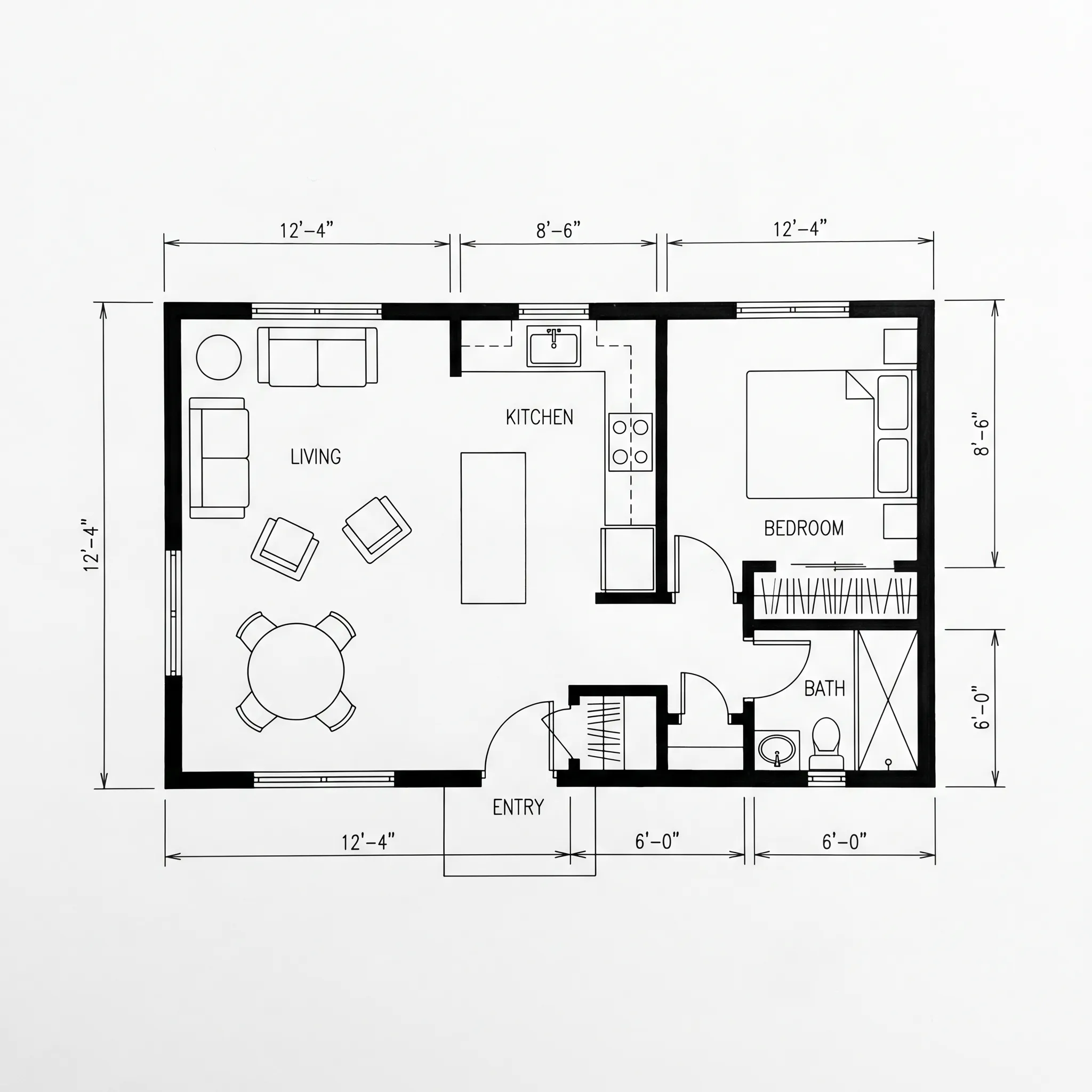
How to Turn a 2D Floor Plan Into a 3D Render With AI (5 Steps)
Turn a 2D floor plan into a 3D render with AI in 5 steps. Render a House makes a photorealistic image in 30–60 seconds, free to start.
Best AI Rendering Tools for Architects in Latin America (2026)
AI rendering tools for architects in Latin America (2026): Render a House, Veras, ArchiVinci, LookX, MyArchitectAI, Maquete. Languages, prices.
