 Render a House/Updated Sep 7, 2026
Enscape Pricing 2026: Solo, Premium, Collection, and What It Actually Costs
Enscape Solo is $574.80/yr, Premium is $670.80/yr, and Collection is $730.80/yr — all billed annually. Pay month-to-month instead and Collection alone costs $2,496 a year, more than three times the annual price.
That gap between monthly and annual billing is the first thing worth knowing about Enscape pricing, and it does not apply evenly across the range: Solo costs exactly the same either way, while Collection punishes month-to-month billing by 241%. The rest of this page works through why, what each tier actually includes, and what Enscape costs once the CAD or BIM licence it plugs into is added back in.
Prices below are Chaos's own published rates, taken from the official Enscape buy-online page, verified against the same source used for the education and Mac pages cited throughout.
Enscape pricing at a glance
| Plan | Pay monthly | Pay annually | Built for |
|---|---|---|---|
| Enscape Solo | $47.90 / mo | $574.80 / yr | Entry real-time rendering: Chaos Cloud, 6,700 assets, 100 AI credits/mo |
| Enscape Premium | $77 / mo | $670.80 / yr ($55.90/mo billed annually) | 10,000 assets, 5x the AI credits (500/mo) — Chaos's default recommendation |
| Enscape Collection | $208 / mo | $730.80 / yr ($60.90/mo billed annually) | 18,500 assets, Enscape Envision, Enscape Impact, 1,500 AI credits/mo |
Enscape sells three tiers, all as a single "dedicated personal licence" you can use on any device with your Chaos login. There is no separate Enterprise plan — Collection is the top of the published range, and anything larger goes through a volume quote from Chaos Sales.
What each Enscape plan actually includes
All three tiers ship as a named-user licence, meaning the seat is tied to one person's Chaos login rather than one machine — that person can use it on a work laptop and a home desktop without buying a second licence. A floating licence, shared across a pool of users who are not all rendering at once, is available once you convert from the free trial to a paid plan; Chaos does not publish a separate floating price on the buy-online page, so a studio that needs it should get a quote before assuming the named-user numbers below apply.
Enscape Solo — $574.80/yr
The entry tier: Enscape's real-time rendering engine, Chaos Cloud for sharing renders, 6,700 Chaos Cosmos assets, Veras AI image generation, and 100 Chaos AI credits a month. For an architect who wants a live, walkable preview of the model and nothing more, Solo is the whole product.
Enscape Premium — $670.80/yr
Chaos marks Premium as its "preferred choice." It adds 10,000 assets and five times the AI credits (500 a month) over Solo, for $96 a year more on the annual plan. If the studio uses Chaos AI features — image-to-image generation, sketch upscaling — with any regularity, the credit allowance is the reason to upgrade, not the asset count.
Enscape Collection — $730.80/yr
Everything in Premium, plus the full 18,500-asset library, Enscape Envision (scene assembly and animation sequencing) and Enscape Impact (sustainability and daylight analysis), and 1,500 AI credits a month. Collection is the only tier that adds real functionality rather than more of the same — Envision and Impact are not available at all on Solo or Premium.
Enscape pricing by payment term
Chaos prices monthly and annual billing as genuinely different offers, not the same number divided by twelve. The gap widens sharply as the tier goes up:
| Plan | Paying monthly | Paying annually | Cost of monthly |
|---|---|---|---|
| Solo | $47.90/mo → $574.80/yr if paid monthly all year | $574.80/yr | $0 — identical either way |
| Premium | $77/mo → $924/yr if paid monthly all year | $670.80/yr | $253.20/yr more paying monthly (+37.8%) |
| Collection | $208/mo → $2,496/yr if paid monthly all year | $730.80/yr | $1,765.20/yr more paying monthly (+241.5%) |
Solo is the odd one out: $47.90 a month for twelve months is $574.80, the identical figure Chaos charges for committing to a year up front. There is no reward for committing on Solo, and no penalty for not committing either.
Premium and Collection are a different story. Twelve months of Premium at the monthly rate is $924, against $670.80 if you commit annually — a $253.20 gap, or about 38% more for the flexibility of month-to-month billing. Collection is the extreme case: paying monthly for a year is $2,496, against $730.80 billed annually. That is 3.4 times the annual price for the identical product, and it is the single most consequential number on this page for anyone considering Collection for a short project rather than a standing licence.
Does Enscape cost more on Revit, SketchUp, or Rhino?
Enscape is a plugin, and it plugs into five different host applications. The price does not change based on which one you pick:
| Host application | Versions supported | Runs on Mac? | Price |
|---|---|---|---|
| Revit | 2023, 2024, 2025, 2026 | No — Revit itself is Windows-only | Same subscription price |
| SketchUp | 2024, 2025, 2026 | Yes, on Apple Silicon | Same subscription price |
| Rhino | 7.0, and 8.3 or later | Yes, on Apple Silicon | Same subscription price |
| Archicad | 27, 28, 29 | Yes, on Apple Silicon | Same subscription price |
| Vectorworks | 2024, 2025, 2026 | Yes, on Apple Silicon | Same subscription price |
What differs by host is not price but platform reach. Chaos's Enscape for Mac page lists Apple Silicon support for SketchUp, Rhino, Archicad, and Vectorworks, using the same licence and the same price as the Windows version. Revit is missing from that list for a reason that has nothing to do with Enscape: Autodesk has never built a macOS version of Revit, so no Revit plugin — Enscape or anyone else's — can run on a Mac. A firm's choice of CAD software, not its choice of renderer, is what decides whether a Mac is an option.
There is no separate "Chaos Collaboration" suite bundling Enscape with V-Ray at a discount, despite both being Chaos products. The only bundling Chaos sells is internal to Enscape itself — Solo, Premium, and Collection stacking more assets and credits at each step.
The version list above also sets a support clock, and it runs at a different speed per host. Chaos's own documentation states a "soft support" window once a new host release ships and the oldest supported version rolls off: one year for SketchUp, and two years for Revit, Rhino, Archicad, and Vectorworks. During soft support Enscape keeps working on the older version but stops receiving bug fixes for it — worth knowing before budgeting a CAD upgrade purely to keep the renderer current.
Enscape pricing for students and educators
| Buyer | Price | Notes |
|---|---|---|
| Verified student (Student Collection) | $149 / yr | One licence per student, proof of enrollment required at checkout |
| Training centers and institutions | Custom quote | Contact the Chaos Education team directly |
The student rate buys the full Student Collection — Envision, Impact, and all — for $149 a year against $730.80 commercial, about 80% off. It is one licence per verified student, sold annually only, and renews automatically until cancelled.
Can you use Enscape for free?
Not for lasting commercial use. Chaos offers a 14-day free trial covering Enscape Premium and Collection — Solo is not part of the trial offer. The trial requires a credit card up front, and billing starts automatically when it ends unless you cancel at least a day before that date.
Every paid purchase also carries a separate 14-day money-back guarantee, with one catch worth knowing before you buy: using any of the included Chaos AI credits voids the right to a refund, even inside the 14-day window.
Costs beyond the Enscape subscription
The subscription is the floor, not the budget. Enscape is not a standalone application — three costs sit outside the price list above, and the first one is usually the largest.
The CAD or BIM licence Enscape plugs into
Enscape does nothing without a licensed copy of one of its five host applications. Two are already priced on this site: SketchUp Pro is $399/yr, and Revitis $3,005/yr. Rhino, Archicad, and Vectorworks each follow their own licensing models and aren't itemized here yet — the point that matters for a budget is that the CAD or BIM seat, not Enscape, is usually the larger recurring cost.
There is one specific trap inside that Revit number. Chaos's own documentation states that Enscape is not available as a plugin for Revit LT at all — Autodesk restricts third-party plugins to the full version of Revit, and Revit LT does not qualify. Revit LT is the cheaper licence on the Revit pricing page, at roughly 81% less than full Revit, but choosing it also closes off Enscape as an option entirely, regardless of which Enscape tier you'd otherwise buy.
Hardware and GPU
Chaos's own system requirements documentation is explicit that Enscape needs a GPU with dedicated VRAM — the shared memory in Intel integrated graphics does not qualify. There is a narrow exception: recent integrated chips (13th-gen Intel with UHD Graphics 730 or better, or AMD Ryzen 6000/7000 series with Radeon 660M/740M or better) can run Enscape without a discrete GPU, but VR and hardware ray tracing are both disabled in that configuration. For most studios the practical answer is still a discrete GPU, which is exactly the line item a browser-based renderer removes.
Two smaller notes from the same documentation: Chaos recommends a dual-monitor setup, since Enscape is built to run alongside the host CAD window rather than replace it, and it flags a handful of older cards — the NVIDIA GTX 1660 line, and the T1000 and T2000 — that can run Enscape but ship with hardware ray tracing and DLSS disabled because of known driver issues. Meeting the minimum spec is not the same as getting every feature.
Training
Enscape is built to be the easy option in its category — it syncs live from the model with no separate export step, and most new users are producing usable views within a day. That is a genuine advantage over V-Ray, which typically needs formal training. It is not zero, though: Envision and Impact, the two tools exclusive to Collection, have their own learning curve on top of the base rendering workflow.
The real cost of a year on Enscape
Putting a host licence and Enscape together, here is what three common setups actually cost in a year. Licence figures are Chaos and vendor list prices; the training estimate is marked as such.
| Setup | What is in it | Total |
|---|---|---|
| Freelancer on SketchUp, Solo tier | SketchUp Pro $399 + Enscape Solo $574.80 | ≈ $974 / yr, plus a GPU |
| Three-person Revit studio, Premium tier | Revit × 3 $9,015 + Enscape Premium × 3 $2,012.40 | ≈ $11,027 / yr, plus three Windows workstations |
| Five-seat SketchUp studio, Collection tier | SketchUp Pro × 5 $1,995 + Enscape Collection × 5 $3,654 + training (~$1,500) | ≈ $7,149 / yr, runs on Apple Silicon Macs |
The middle row is the expensive one, and it is expensive for a reason that has nothing to do with Enscape: Revit itself is $3,005 a seat before any renderer is added, and it forces every machine in that studio onto Windows. The third row shows the alternative shape of the same budget — a SketchUp-based studio pays less overall and keeps the option of running everything on Apple Silicon Macs.
Enscape pricing compared to alternatives
Enscape competes directly with a handful of real-time and production renderers, plus one browser-based option that needs neither a host licence nor a GPU. These are each vendor's current published entry price:
| Renderer | Entry price | Notes |
|---|---|---|
| Enscape Solo | $47.90 / mo · $574.80 / yr | Real-time preview inside 5 host apps; runs on Apple Silicon Mac except for Revit |
| V-Ray Solo | $45 / mo · $540 / yr | Same publisher (Chaos); production-quality output, steeper learning curve |
| Lumion View | $19 / mo · $229 / yr | Lumion Pro is $1,149/yr and Windows-only; View also runs on macOS for SketchUp |
| D5 Render Pro | $30 / mo · $360 / yr | Has a genuinely usable free Community tier |
| Twinmotion | Included with a Revit subscription | Autodesk's own wording; no independent consumer price is published |
| Render a House | Free · $39 / mo | Browser-based AI rendering, no GPU and no host CAD licence; 3 renders a day on the free tier |
V-Ray, from the same publisher, is the closest price match at $45 a month — the real difference between the two is workflow, not cost: Enscape is built for live walkthroughs and instant feedback, while V-Ray targets final, production-quality stills and accepts a slower iteration loop to get there. V-Ray pricing breaks down every tier, and V-Ray system requirements covers the split between its CPU engine and V-Ray GPU, which have different hardware floors. Lumion carries the deepest asset library in the category, credit where it's due, but Lumion Pro's $1,149/yr is the most expensive entry point on this list and it is Windows-only outright — no Mac option at any tier above View.
D5 Render is the cheapest paid seat on the table at $30 a month, and its Community tier is a genuinely usable free option rather than a crippled demo — though D5's own subscription rules limit Community to personal, non-commercial use, so it is not a free route for billable work. D5 Render pricing has the full breakdown. Twinmotion is free on its own terms rather than only through Autodesk: Epic gives it away to anyone under $1M in annual gross revenue, and charges $445 a seat above that line, as Twinmotion pricing sets out. Either way it is a separate application with its own workflow, not a plugin that lives inside the Revit window the way Enscape does.
When Enscape makes financial sense
- You already own a compatible host licence. Enscape's marginal cost only makes sense on top of a SketchUp, Revit, Rhino, Archicad, or Vectorworks seat you were already paying for.
- Client meetings need a live, walkable model. Real-time synced rendering is Enscape's actual product; nothing on the comparison table above matches how fast it goes from a model change to a rendered view.
- The team is on Windows, or on a non-Revit host. Apple Silicon support on four of five host apps means the Mac question mostly answers itself once the CAD choice is made.
- The Chaos AI credits get used, not ignored. Premium's 500 monthly credits and Collection's 1,500 are worth paying for only if Veras-style AI generation is part of the actual workflow — otherwise Solo's 100 credits and lower assets count cover the same rendering job for less.
When to consider alternatives
Three situations make a cheaper option, or no separate renderer at all, the better call:
- The host is Revit and the studio is Mac-based. No renderer fixes this — Revit itself needs Windows, so the cost is a Windows machine, not a plugin choice.
- Real-time preview isn't the deliverable. Enscape trades rendering fidelity for speed; it is a rasterized and lightly ray-traced live preview, not a full offline path-traced renderer. A studio whose final output is print-quality stills for a competition board is usually better served by V-Ray or a dedicated offline pipeline.
- Usage is occasional, not a standing workflow. Collection month-to-month is $208, so the fourth month ($832) already costs more than a full annual term at $730.80, and running it monthly for a year ($2,496) costs more than three annual terms ($2,192.40). Month-to-month only wins for a project of three months or less. D5's free Community tier, or a per-render tool that charges only when you actually generate an image, both undercut Enscape for infrequent use.
Is Enscape worth the cost?
For a studio already paying for SketchUp, Revit, Rhino, Archicad, or Vectorworks and presenting live to clients, yes — Enscape does the thing it is built for better than anything else in its price range, and the annual Solo or Premium plans are priced reasonably against that.
The two things worth being deliberate about are the ones Chaos doesn't put in the headline price: paying monthly on anything above Solo carries a real penalty, up to 3.4x on Collection, and the subscription is additive to a CAD or BIM licence you already have to be paying for separately.
The other honest limit is what real-time rendering is not. Enscape's whole value proposition is speed — a change in the model shows up in the viewport in roughly a second — and it buys that speed by rasterizing and lightly ray-tracing rather than fully path-tracing a scene the way V-Ray or an offline renderer does. For a client walkthrough or a design-review meeting that trade is exactly right. For a hero image on a competition board or a print campaign, where the deliverable is a handful of frames rather than an interactive session, the extra minutes an offline renderer takes usually earn back more fidelity than Enscape's live preview is built to deliver.
If the render step itself is the part you want to remove entirely — no GPU, no host licence, no plugin — Render a House takes an exported view, screenshot, OBJ, or GLB and returns a photorealistic image in a browser. It starts free at 3 renders a day, and paid plans are $39/mo, or $312/yr, well under any Enscape tier's annual cost. Full plan details are in the pricing docs.
For the exact GPU, RAM, and OS numbers behind the hardware note above, see Enscape system requirements. Pricing a different renderer at the same time? KeyShot pricing and Lumion pricing cover the same ground for their categories, and if Archicad is the host application in question, Archicad pricing runs the licence math this page assumes you already have. Enscape alternatives puts Lumion, V-Ray, Twinmotion and D5 Render side by side, with Render a House on the last line. For the AI side, see what Enscape's AI includes vs Render a House.
Common questions about Enscape pricing
How much does Enscape cost?
Enscape Solo costs $574.80 per year, Premium costs $670.80 per year, and Collection costs $730.80 per year, all billed annually. Chaos also sells month-to-month plans at $47.90, $77, and $208 respectively — the monthly Collection plan alone works out to $2,496 a year if kept for twelve months.
Is Enscape free?
Not permanently. Chaos offers a 14-day free trial covering Enscape Premium and Collection, which requires a credit card and bills automatically unless you cancel at least a day before it ends. There is no lasting free tier for commercial use.
How much is Enscape for students?
Verified students pay $149 per year for the Student Collection, about 80% less than the $730.80 commercial Collection price. It is one licence per student, requires proof of enrollment at checkout, and is sold annually only — there is no monthly student plan.
What is the difference between Enscape Solo, Premium, and Collection?
The three tiers scale the same way: more assets and more monthly AI credits at each step. Solo includes 6,700 assets and 100 AI credits a month; Premium adds 10,000 assets and 500 credits; Collection adds 18,500 assets, 1,500 credits, and two extra tools — Enscape Envision and Enscape Impact — that neither lower tier includes.
Does Enscape cost more for Revit than for SketchUp?
No. Enscape charges one price regardless of which of its five supported host applications — Revit, SketchUp, Rhino, Archicad, or Vectorworks — you plug it into. What differs is platform support, not price: Enscape for Revit only exists on Windows, because Revit itself has no macOS build.
Does Enscape work on a Mac?
Yes, for four of its five host applications. Chaos's own Mac page lists SketchUp, Rhino, Archicad, and Vectorworks as supported on Apple Silicon, and the same licence and price work on both operating systems. Revit is the exception, and it is Revit's limitation, not Enscape's — Autodesk has never shipped Revit for macOS.
Keep reading
Related guides and comparisons
ChatGPT for architectural rendering: does it work?
Partly. ChatGPT is great for a fast concept image, but edits drift and it can't keep several renders of one project consistent. Render a House can.
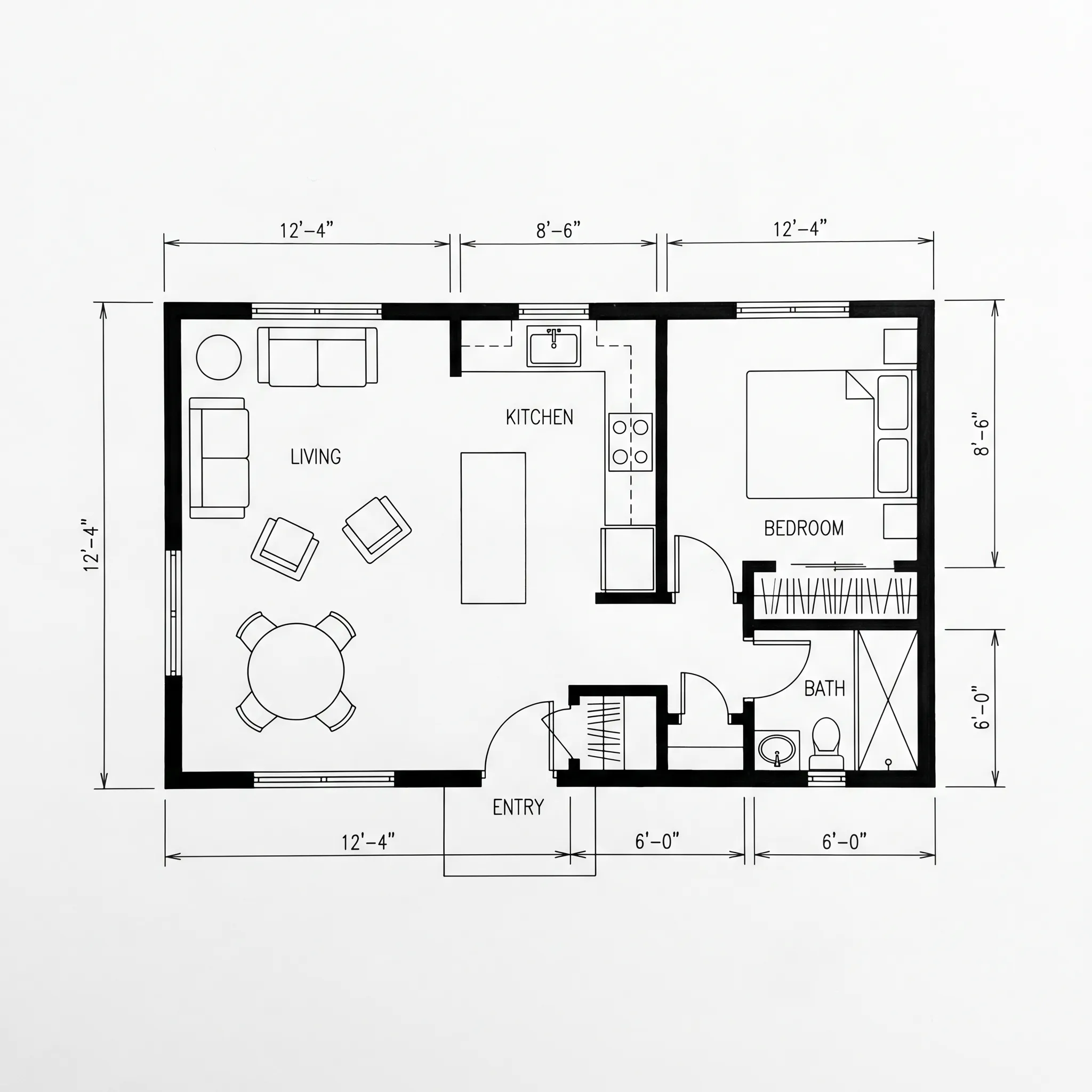
How to Turn a 2D Floor Plan Into a 3D Render With AI (5 Steps)
Turn a 2D floor plan into a 3D render with AI in 5 steps. Render a House makes a photorealistic image in 30–60 seconds, free to start.
Best AI Rendering Tools for Architects in Latin America (2026)
AI rendering tools for architects in Latin America (2026): Render a House, Veras, ArchiVinci, LookX, MyArchitectAI, Maquete. Languages, prices.
