 Render a House/Updated Sep 7, 2026
V-Ray Pricing 2026: Solo, Premium and Collection Costs
V-Ray Solo costs $540 a year, V-Ray Premium costs $778.80 a year, and V-Ray Collection costs $1,210.80 a year — all published on Chaos's own V-Ray 7 buy-online page. None of those three numbers buys Enscape or Corona; each is Chaos's own separate render engine with its own subscription.
That last point is the one most searches for "V-Ray pricing" miss, and it is the reason this page exists: Chaos restructured V-Ray, Enscape, and Corona into the same Solo / Premium / Collection naming and the same 100 / 500 / 1,500 monthly Chaos AI credit tiers, which makes the three products look like one bundle. They are not. Each is billed separately, and "V-Ray Collection" only ever means more V-Ray, plus the Chaos tools that ship inside V-Ray's own product line — Vantage, Anima, and Cloud Rendering.
Prices below are Chaos's own published rates, taken from the official V-Ray buy-online page for the current release, V-Ray 7, Update 4.
V-Ray pricing at a glance
| Plan | Pay monthly | Pay annually | Built for |
|---|---|---|---|
| V-Ray Solo | $45 / mo | $540 / yr | V-Ray rendering engine, up to 15,000 Chaos Cosmos assets, 100 Chaos AI credits/mo — named license |
| V-Ray Premium | $122 / mo | $778.80 / yr ($64.90/mo billed annually) | 18,500 assets, enhanced material library, 500 Chaos AI credits/mo — floating license, Chaos's default recommendation |
| V-Ray Collection | $237 / mo | $1,210.80 / yr ($100.90/mo billed annually) | 22,000+ assets, Chaos Vantage real-time viewport, Chaos Anima crowds, Cloud Rendering, 1,500 Chaos AI credits/mo — floating license |
All three tiers work with the same set of host applications — Chaos lists 3ds Max, Cinema 4D, Houdini, Maya, Nuke, Revit, Rhino, SketchUp, and Unreal on the buy-online page — and none of them require a separate purchase per host. There is no published Enterprise plan; Collection is the ceiling of the self-serve range, and anything larger goes through a volume quote from Chaos Sales.
What each V-Ray plan actually includes
V-Ray Solo — $540/yr
The entry tier, and a named license rather than a floating one: the V-Ray rendering engine itself, up to 15,000 Chaos Cosmos assets and materials, an Arch Viz training course, Veras AI image generation, Cloud Collaboration, and 100 Chaos AI credits a month. For one person rendering under one login, Solo is the whole product — there is nothing functional missing from the renderer itself at this tier.
V-Ray Premium — $778.80/yr
Chaos marks Premium its "preferred choice." It steps up to 18,500 assets, an enhanced material library, and five times the AI credit allowance (500 a month against Solo's 100), for $238.80 a year more than Solo's $540 — a 44.2% increase. Premium also switches to a floating license, which matters the moment more than one person on a team needs to sign in.
V-Ray Collection — $1,210.80/yr
Everything in Premium, plus the full 22,000+ asset library, Veras AI ideation and an AI Material Generator, 4,000+ Chaos Anima crowd characters, real-time viewport rendering through Chaos Vantage, and both Cloud Collaboration and Cloud Rendering. At $1,210.80/yr it is $670.80 more than Solo — more than double, at 2.24 times the Solo price — and it is the only tier that adds genuinely new tools rather than more of the same asset library and credit pool.
What V-Ray costs standalone vs. inside a Chaos Collection
"Collection" is the word that causes the confusion in this category, because Chaos uses it for V-Ray's own top tier and for Enscape's own top tier, and the two are not the same purchase. There is no single "Chaos Collection" that hands you V-Ray, Enscape, and Corona for one price. Buying V-Ray Collection buys more V-Ray, plus the tools Chaos ships specifically inside the V-Ray product line:
| Included in | V-Ray Solo ($540/yr) | V-Ray Collection ($1,210.80/yr) |
|---|---|---|
| Chaos Cosmos asset library | Up to 15,000 assets | 22,000+ assets |
| Chaos AI credits per month | 100 | 1,500 |
| Chaos Vantage (real-time viewport rendering) | Not included | Included |
| Chaos Anima (3D/4D crowd characters) | Not included | 4,000+ characters included |
| Chaos Cloud | Cloud Collaboration only | Cloud Collaboration & Cloud Rendering |
| Enscape (Chaos's real-time CAD plugin) | Not included — separate subscription | Not included — separate subscription |
| Corona (Chaos's other render engine) | Not included — separate subscription | Not included — separate subscription |
The bottom two rows are the ones worth reading twice before paying for Collection expecting a bundle discount. Enscape and Corona are each their own Chaos render engine, each with its own Solo, Premium, and Collection tiers, and neither is unlocked by any V-Ray purchase at any tier. A studio that wants both V-Ray and Enscape pays for both subscriptions in full — see Enscape pricingfor Enscape's own $574.80–$730.80/yr range.
Does V-Ray cost more on 3ds Max, SketchUp, Revit, Rhino, or Maya?
V-Ray charges one price regardless of which host application it plugs into. What differs by host is platform support, and one of the five results is genuinely counterintuitive:
| Host application | Runs on Mac? | Price |
|---|---|---|
| 3ds Max | No — 3ds Max itself is Windows-only | Same subscription price |
| SketchUp | Yes — V-Ray for SketchUp supports macOS | Same subscription price |
| Revit | No — Revit itself is Windows-only | Same subscription price |
| Rhino | No — V-Ray for Rhino is Windows-only, even though Rhino itself runs natively on macOS | Same subscription price |
| Maya | Yes — V-Ray for Maya supports Windows, macOS, and Linux | Same subscription price |
3ds Max and Revit being Windows-only is not a V-Ray limitation — neither application has ever shipped for macOS, so no renderer plugged into either one can run on a Mac. The row that actually surprises people is Rhino: Chaos's own support documentation states plainly that V-Ray for Rhino is not compatible with macOS and is Windows-only, even though Rhino itself is a native Mac application. A Mac-based Rhino studio can model on macOS and still needs a Windows machine, or a Windows virtual machine with known compatibility issues, the moment V-Ray enters the pipeline.
SketchUp and Maya are the two exceptions. V-Ray for SketchUp supports macOS at the same price and version cadence as its Windows build, and V-Ray for Maya goes further, supporting Windows, macOS, and Linux. For a firm choosing between SketchUp and Rhino specifically because it wants to stay on Mac hardware, this table — not the price list — is the deciding factor.
V-Ray pricing by payment term
Chaos prices monthly and annual billing as genuinely different offers, and the gap widens sharply as the tier goes up — the same shape Chaos uses across its Enscape pricing:
| Plan | Paying monthly | Paying annually | Cost of monthly |
|---|---|---|---|
| Solo | $45/mo → $540/yr if paid monthly all year | $540/yr | $0 — identical either way |
| Premium | $122/mo → $1,464/yr if paid monthly all year | $778.80/yr | $685.20/yr more paying monthly (+88.0%) |
| Collection | $237/mo → $2,844/yr if paid monthly all year | $1,210.80/yr | $1,633.20/yr more paying monthly (+134.9%) |
Solo is the odd one out: $45 a month for twelve months is $540, the identical figure Chaos charges for committing to a year up front. There is no reward for prepaying Solo, and no penalty for paying month to month either.
Premium and Collection tell a different story. Twelve months of Premium at the monthly rate is $1,464, against $778.80 billed annually — a $685.20 gap, or 88.0% more for the flexibility of month-to-month billing. Collection is the extreme case: paying monthly for a year totals $2,844, against $1,210.80 billed annually. That is 2.35 times the annual price for the identical product, which makes month-to-month Collection a poor fit for anything longer than a short, defined project.
What do Chaos Cloud render credits cost?
Cloud Rendering — offloading a render job to Chaos's farm instead of a local workstation — comes bundled into V-Ray Collection, but the credits that actually pay for compute time are billed separately and are a genuine line item, not an afterthought. Chaos publishes two package sizes on its own store:
| Package | Credits | Annual price | Price per credit |
|---|---|---|---|
| 30,000-credit pack | 30,000 | $625 / yr | $0.0208 / credit |
| 60,000-credit pack | 60,000 | $1,050 / yr | $0.0175 / credit |
The 60,000-credit pack works out to $0.0175 a credit against $0.0208 a credit for the 30,000-credit pack — 16% cheaper per credit for buying twice the volume. Both packages are "billed annually" and the credits are "freely distributable between users attached to a floating license," per Chaos's own page, which matters for a studio splitting one credit pool across several V-Ray seats.
These render credits are a different currency from the 100 / 500 / 1,500 Chaos AI credits bundled into Solo, Premium, and Collection — those cover Veras AI image generation and enhancement, not farm rendering, and Chaos meters the two separately.
How much is V-Ray for students?
Chaos publishes a single education bundle rather than a V-Ray-only student price: the Student Collection costs $149 a year and includes V-Ray, Vantage, Anima, Veras, Phoenix, and Cosmos, plus 500 Chaos AI credits a month. It is one license per verified student, requires proof of enrollment at checkout, and renews annually.
Against the $1,210.80/yr commercial V-Ray Collection it most closely matches in scope, $149/yr is 87.7% less. It is also the same $149/yr figure Chaos charges for its Enscape Student Collection — the education price does not change based on which Chaos renderer a student cares about most, since one license covers the whole suite either way.
Can you use V-Ray for free?
Not for lasting commercial use, but there are two real free paths. Chaos runs a 30-day free trial of V-Ray across its supported host applications — the trial page advertises "V-Ray — and more — free for 30 days."
Separately, V-Ray for Blender Community Edition is free indefinitely rather than time-limited: the license runs 90 days and renews at no cost, repeatedly, with no purchase required. The trade-off is real — output is capped at 8-bit color and 2K square resolution (2560×2560), and the Community Edition drops official Chaos support, batch/headless rendering, distributed rendering, and cloud collaboration. It is built for solo creators, students, and portfolio work, not a production pipeline.
There is no free viewer-only tier of the kind KeyShot or SketchUp ship, and no product on chaos.com called "V-Ray Vision" — anyone searching for that name is likely thinking of Chaos Vantage, V-Ray's real-time viewport companion, which is bundled into V-Ray Collection and has its own separate free trial.
Costs beyond the V-Ray subscription
The subscription is the floor. Two costs sit outside the price list above, and for a studio comparing V-Ray against a real-time renderer, the first one is the one that actually changes the calculation.
Hardware: the CPU/GPU choice
Chaos's own buy-online page states that "V-Ray differs from other rendering solutions in that it includes both CPU and GPU+CPU hybrid rendering options." That sentence is worth more than it looks: real-time renderers in this category, like Enscape, require a discrete GPU with dedicated VRAM to run at all. V-Ray does not — a studio can render on CPU alone, on hardware it may already own, and buy a GPU only when the speed is worth paying for rather than because the software refuses to start without one. That flexibility is also the trade V-Ray makes for fidelity: CPU rendering is slower per frame than a real-time viewport, which is the whole reason Chaos bundles Vantage — a GPU-accelerated, real-time companion — into Collection rather than shipping it as V-Ray's default preview mode.
For the exact GPU models, VRAM, and OS versions V-Ray 7 supports, see V-Ray system requirements — this page covers the subscription cost, not the workstation spec sheet.
Training
V-Ray has the steepest learning curve of the architecture-render category, and that reputation is earned honestly: it exposes a full physically based material system, lighting and camera controls built for production stills, and render settings that reward understanding sampling and noise rather than accepting a single quality slider. Studios adopting V-Ray typically budget real onboarding time, not an afternoon — the same trade-off that buys the fidelity V-Ray is chosen for in the first place.
The real cost of a year on V-Ray
Putting a host license and V-Ray together, here is what three common setups cost in a year. License figures for SketchUp and Revit come from this site's own SketchUp pricing and Revit pricing pages; the training line is marked as an estimate.
A freelancer on SketchUp with V-Ray Solo pays SketchUp Pro's $399/yr plus V-Ray Solo's $540/yr, for $939/yr before a GPU. A three-person Revit studio on V-Ray Premium pays Revit's $3,005/yr per seat — $9,015 for three — plus V-Ray Premium at $778.80/yr per seat, or $2,336.40 for three, totaling $11,351.40/yr before three Windows workstations. A five-seat SketchUp studio on V-Ray Collection with an estimated $1,500/yr in training pays $1,995 for five SketchUp Pro seats plus $6,054 for five V-Ray Collection seats (5 × $1,210.80), landing at $9,549/yr — a figure only as precise as the training estimate inside it.
The middle scenario is the expensive one, and Revit is the reason: at $3,005/yr per seat, the BIM license costs nearly four times as much as V-Ray Premium sitting on top of it. Comparing renderer prices in isolation understates what a Revit-based studio actually spends on visualization software each year.
V-Ray pricing compared to alternatives
V-Ray competes with both real-time renderers built for client walkthroughs and one browser-based option that skips the render engine entirely. These are each vendor's current published entry price:
| Renderer | Entry price | Notes |
|---|---|---|
| V-Ray Solo | $45 / mo · $540 / yr | Production-quality CPU or GPU rendering; plugs into 3ds Max, SketchUp, Revit, Rhino, Maya |
| Enscape Solo | $47.90 / mo · $574.80 / yr | Same publisher (Chaos); real-time preview instead of a final-quality render |
| KeyShot Studio Professional | $108.25 / mo · $1,299 / yr | General-purpose product-design renderer, not architecture-specific |
| Lumion View | $19 / mo · $229 / yr | Plugin tier; Lumion Pro is $1,149/yr and Windows-only |
| D5 Render | $30 / mo · $360 / yr | Has a genuinely usable free Community tier |
| Render a House | Free · $39 / mo | Browser-based AI rendering, no GPU and no host CAD licence; 3 renders a day on the free tier |
Enscape, from the same publisher, is the closest price match at $574.80/yr against V-Ray Solo's $540/yr — a $34.80/yr gap, with V-Ray the cheaper of the two. The real difference is workflow, not cost: Enscape trades fidelity for an near-instant live preview synced to the model, while V-Ray targets final, production-quality stills and accepts a slower iteration loop to get there. Credit where it's due to Lumion for the deepest asset library in the category, but Lumion Pro's $1,149/yr is the most expensive entry point on this table and it is Windows-only outright.
D5 Render is the cheapest paid seat here at $30/mo, and its Community tier is a genuinely usable free option — the closest thing on this list to V-Ray's Blender Community Edition having a mainstream equivalent. None of these five paid renderers, V-Ray included, removes the GPU or CPU rendering step itself; that is the one thing a browser-based tool like Render a House changes, at the cost of the fine-grained material and lighting control V-Ray gives a production artist.
When V-Ray makes financial sense
When V-Ray is the right tool
- The deliverable is a final, production-quality image.V-Ray's physically based rendering engine is built for stills and animations that need to hold up at full resolution, not for a fast walkthrough.
- The studio already works across multiple CAD packages. One V-Ray subscription plugs into 3ds Max, SketchUp, Revit, Rhino, and Maya alike, at the same price regardless of host.
- GPU budget is limited or non-existent. V-Ray's CPU rendering mode means a firm can start on hardware it already owns and add a GPU later for speed, not as a requirement to launch the software at all.
- The team can absorb a real learning curve. V-Ray's depth is the same thing that makes it slower to onboard than Enscape or D5 — worth it when the output quality is the point.
When to consider alternatives
- The deliverable is a live client walkthrough, not a still. Enscape or Chaos Vantage answer that need directly; V-Ray answers a different question.
- The studio is on Rhino and needs to stay on Mac. V-Ray for Rhino is Windows-only, full stop — no V-Ray tier changes that.
- Rendering is occasional, not a standing workflow.Paying Collection month-to-month for a short project already costs 2.35 times the annual rate; a per-render tool or D5's free Community tier undercuts that for infrequent use.
- The team wants to skip rendering hardware entirely. Neither V-Ray nor any renderer on the comparison table above removes the CPU/GPU requirement — only a browser-based tool does that.
Is V-Ray worth the cost?
For a studio whose deliverable is a final, print- or presentation-quality image, yes — V-Ray earns its reputation as the industry reference renderer, and $540–$1,210.80/yr is priced in line with what that quality costs across the category. Credit where it's due: no renderer on the comparison table above matches V-Ray's combination of format breadth, physically based accuracy, and the option to render on CPU alone when a GPU budget isn't there.
What V-Ray cannot do is make that quality instant. It is not a live, walkable preview the way Enscape or Chaos Vantage are — path tracing a final frame takes real compute time, whether that time comes from a local CPU, a local GPU, or a Chaos Cloud render credit. A studio that needs to show a client a change in real time during a meeting is asking V-Ray to do something it was not built to do quickly, and no tier upgrade on this page changes that trade-off.
If the render step itself is what you want to remove — no GPU, no CPU render queue, no host CAD license — Render a House takes an exported view, a screenshot, or an OBJ or GLB file and returns a photorealistic image in a browser. It starts free at 3 renders a day, and paid plans are $39/mo, or $312/yr, well under V-Ray Solo's $540/yr. It will not replace V-Ray's material-level control for a production still, but it answers a different question: a fast, photorealistic image with no render engine to install, license, or feed a GPU.
More Chaos and rendering pricing pages
Pricing a different piece of the same stack, or the machine V-Ray needs to run on? These cover the ground this page assumes.
- Enscape pricing— Chaos's own real-time renderer, the closest price match to V-Ray Solo and the tool most often bought alongside it.
- V-Ray system requirements — the exact CPU, GPU, VRAM, and OS numbers behind the hardware note above.
- Enscape system requirements — the GPU-mandatory spec sheet for V-Ray's closest in-house competitor.
- SketchUp pricing and Revit pricing — the two host licenses behind the real-cost scenarios above.
- Rhino pricing — the third major V-Ray host, and the one where the Mac question actually bites.
- KeyShot pricing and Lumion pricing — two more renderers on the comparison table above, covered in the same depth.
- D5 Render pricing — the cheapest paid seat in the comparison table, and the one with a genuinely usable free tier.
- Archicad pricing and Vectorworks pricing — two more BIM hosts Chaos prices Enscape into at the same rate regardless of CAD choice.
- Twinmotion pricing — Autodesk's bundled real-time alternative for anyone already paying for Revit.
- Topaz AI pricing and Magnific AI pricing — AI upscalers for cleaning up a V-Ray render's final output.
- Render a House's image upscaler — a free way to raise the resolution of an existing V-Ray render.
- V-Ray alternatives puts Enscape, Lumion, Twinmotion and D5 Render side by side, with Render a House on the last line.
- Render a House plans and pricing — the full breakdown behind the $39/mo figure quoted above.
Common questions about V-Ray pricing
How much does V-Ray cost?
V-Ray Solo costs $540 a year ($45/mo), V-Ray Premium costs $778.80 a year ($122/mo if paid monthly), and V-Ray Collection costs $1,210.80 a year ($237/mo if paid monthly) — all published on Chaos's own V-Ray buy-online page. There is no separate Enterprise tier; Collection is the top of the self-serve range.
What is the difference between V-Ray Solo and Premium?
Premium adds 3,500 more Chaos Cosmos assets (18,500 against Solo's 15,000) and five times the monthly Chaos AI credits (500 against 100), for $238.80 a year more than Solo's $540/yr — a 44.2% increase. Premium is also sold as a floating license rather than Solo's named license, so the seat can move between people on a team.
Does V-Ray Collection include Enscape or Corona?
No. V-Ray Collection bundles Chaos's own visualization tools alongside V-Ray — Chaos Vantage for real-time viewport rendering, Chaos Anima for crowd characters, and Chaos Cloud Rendering — but Enscape and Corona are each a separate Chaos render engine with its own Solo/Premium/Collection subscription. Buying V-Ray Collection at $1,210.80/yr does not include Enscape, whose own Collection tier costs $730.80/yr on top.
Is V-Ray free for students?
Not free, but steeply discounted. Chaos's Student Collection costs $149 a year — the identical figure Chaos publishes for its Enscape education tier — against the $1,210.80/yr commercial V-Ray Collection with comparable scope, 87.7% less. It bundles V-Ray, Vantage, Anima, Veras, Phoenix, and Cosmos, plus 500 Chaos AI credits a month, and requires proof of enrollment at checkout.
Can I use V-Ray for free?
Not permanently for the full product. Chaos runs a 30-day free trial of V-Ray across its supported host applications. Separately, V-Ray for Blender Community Edition is free indefinitely, renewable every 90 days at no cost, but output is capped at 8-bit color and 2K resolution, with no batch rendering, distributed rendering, or cloud collaboration.
Does V-Ray cost more for Revit than for SketchUp?
No. Chaos charges the same Solo, Premium, and Collection price regardless of which host application V-Ray plugs into. What changes by host is platform support, not price: V-Ray for 3ds Max and Revit are Windows-only because those applications never shipped for macOS, and — less predictably — V-Ray for Rhino is Windows-only too, even though Rhino itself runs natively on a Mac. V-Ray for SketchUp and V-Ray for Maya are the two host plugins that do support macOS.
Keep reading
Related guides and comparisons
ChatGPT for architectural rendering: does it work?
Partly. ChatGPT is great for a fast concept image, but edits drift and it can't keep several renders of one project consistent. Render a House can.
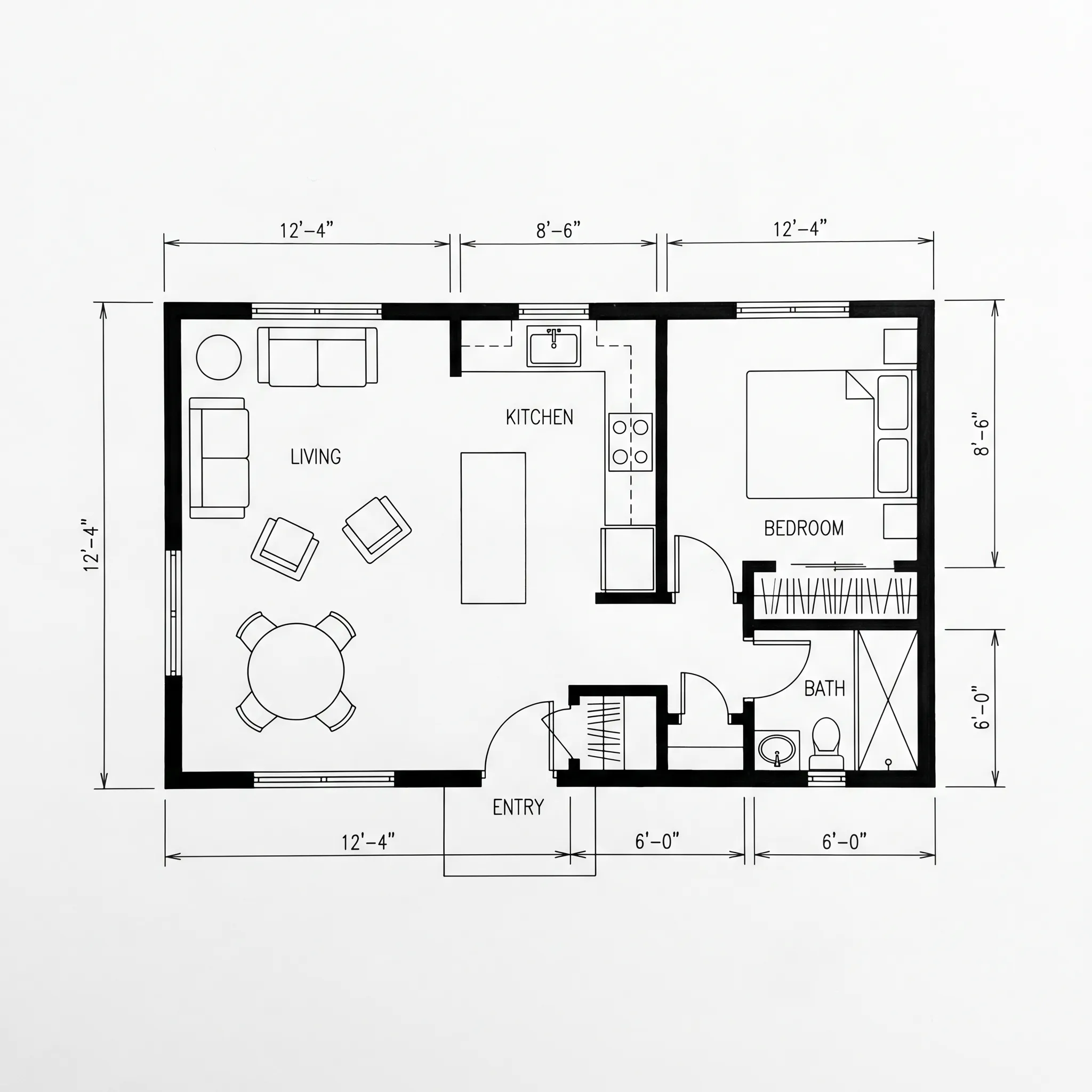
How to Turn a 2D Floor Plan Into a 3D Render With AI (5 Steps)
Turn a 2D floor plan into a 3D render with AI in 5 steps. Render a House makes a photorealistic image in 30–60 seconds, free to start.
Best AI Rendering Tools for Architects in Latin America (2026)
AI rendering tools for architects in Latin America (2026): Render a House, Veras, ArchiVinci, LookX, MyArchitectAI, Maquete. Languages, prices.
