 Render a House/Updated Sep 7, 2026
Rhino Pricing 2026: $995 Commercial Licence, $595 Upgrades, and the Real Cost per Year
A commercial Rhino 8 licence costs $995, once, with no subscription attached. A student or faculty licence is $195, and moving up to the next major version costs $595 whenever you choose to buy it — not on a forced yearly clock.
That makes Rhino the one holdout in a category that has otherwise moved almost entirely to subscriptions. Revit, Archicad, and SketchUp all bill per year now; Rhino still sells a licence you keep, with an upgrade you can buy or skip. The number nobody publishes directly — what that perpetual model actually costs per year against a subscription — is the number this page exists to build, with the source figure named at every step.
Every price below comes from McNeel's own Rhino sales page or another rhino3d.com page linked at the point it's used. The product being sold today is Rhino 8. Rhino 9 is in public beta as of September 2026 — feature-complete and open to any Rhino 8 licence holder to test — but McNeel has not shipped it or published a price for it, so this page prices Rhino 8, the version you can actually buy.
Rhino pricing at a glance
| Licence | Full price | Upgrade price | What it's for |
|---|---|---|---|
| Commercial — single user | $995 | $595 | New seat, or an existing seat moving up to the newest major version |
| Commercial — 10 concurrent users | $9,950 | $5,950 | Floating licence shared across a team via Zoo |
| Commercial — 50 concurrent users | $49,750 | $29,750 | Larger studios on network licensing |
| Educational — student or faculty, single user | $195 | $95 | Verified students and faculty; commercial work is allowed |
| School lab pack — 30 seats | $975 | $495 | Classrooms and labs, floating (Zoo) licensing |
Every row is a one-time price. None of them recur, and none of them expire — McNeel's own terms describe every purchased licence as "permanent," with service releases for the current version included and no maintenance fee to keep the software running.
What each Rhino licence type costs
Commercial licence — $995
$995 buys one named, concurrent-use seat with no expiration date. It includes every core Rhino tool — solid and NURBS modeling, Grasshopper, Rhino Render — and every service release McNeel ships for Rhino 8. There is no tiered commercial plan the way Revit or Archicad sell Basic/Pro/Ultimate splits: one commercial price buys the whole application.
Larger teams buy floating seats instead of named ones: $9,950 for 10 concurrent users and $49,750 for 50, licensed through McNeel's Zoo server so any ten (or fifty) people across the studio can have Rhino open at once, drawn from the shared pool.
Educational licence — $195
$195 for a single-user student or faculty licence — about 80% off the commercial price — with proof of current enrollment or employment required at purchase. It is functionally identical to the commercial licence; the only difference McNeel's own education page states is that it "cannot be transferred (or sold) to anyone else."
School lab licence — $975 for 30 seats
$975 buys a 30-user floating licence for a classroom or department lab, run off a LAN Zoo server on campus or McNeel's free Cloud Zoo. It scales the education price down further per seat than buying 30 individual student licences would, and schools buying at higher volume still get a further, unpublished discount McNeel advertises as "up to 90% off" without stating the per-seat rate.
What does Rhino actually cost per year against a subscription?
This is the comparison Rhino's pricing page never runs for you, because a perpetual licence has no natural "per year" number the way a subscription does. Build one, and the contrast with the rest of the category is stark.
Take a five-year ownership window. Rhino's last two full-version intervals averaged about 2.8 years apart (Rhino 6 in February 2018, Rhino 7 in November 2020, Rhino 8 in October 2023 — dates from McNeel's own version history), so a five-year owner typically buys the $995 licence once and the $595 upgrade once, for $1,590 total — an effective $318 per year.
| Software | Pricing model | 5-year total | Effective cost per year |
|---|---|---|---|
| Rhino 8 (commercial) | $995 once + one $595 upgrade in five years | $1,590 | $318 / yr |
| SketchUp Pro | $399/yr subscription | $1,995 | $399 / yr |
| Archicad Studio | $2,414/yr subscription | $12,070 | $2,414 / yr |
| Revit | $3,005/yr subscription | $15,025 | $3,005 / yr |
Against Autodesk Revit's published $3,005/yr subscription (Autodesk's own Revit subscription FAQ), Rhino's $318/yr is roughly 9.4 times cheaper — $3,005 divided by $318. Against Graphisoft's $2,414/yr Archicad Studio price (Graphisoft's own Archicad Studio page), the gap is 7.6 times. The closest competitor by this math is Trimble's $399/yr SketchUp Pro (SketchUp's own pricing page) — only about 25% more than Rhino's five-year average, and over a shorter window SketchUp Pro can even look cheaper, since it has no $995 up-front purchase to amortize.
The gap widens the longer you own Rhino, because the subscription lines keep charging every year while Rhino's only repeats every ~2.8 years. Over ten years, at that same cadence, a Rhino owner pays $995 plus three $595 upgrades — $2,780 total, or $278/yr — while Revit's $3,005/yr subscription has by then cost $30,050, about 10.8 times more. That comparison cuts one way against Rhino's favor and needs its own caveat: a subscription buys continuous updates throughout the term, while a Rhino owner who skips an upgrade cycle keeps last version's feature set until they choose to pay for the next one.
How much is a Rhino upgrade, and how often does one ship?
| Move | Price today |
|---|---|
| New commercial licence (no previous version owned) | $995 |
| Commercial upgrade, from any Rhino 1–7 licence | $595 |
| Educational upgrade, from any Rhino 1–7 licence | $95 |
| School lab pack upgrade (30 seats) | $495 |
McNeel prices the commercial upgrade the same — $595 — regardless of which earlier version you're coming from: Rhino 8's own store listing describes the upgrade as valid "from any previous version," so a Rhino 5 licence upgrades to Rhino 8 for the same $595 a Rhino 7 licence pays. There is no version-skipping penalty.
How often that $595 comes due depends on McNeel's release cadence, which sped up after Rhino 6. Per McNeel's own version history, Rhino 5 (October 2012) to Rhino 6 (February 2018) took roughly 5.3 years; Rhino 6 to Rhino 7 (November 2020) took about 2.75 years; Rhino 7 to Rhino 8 (October 2023) took about 2.9 years. Using only the two most recent intervals — the pace McNeel is actually shipping at now — the average is about 2.8 years between major versions. Unlike a subscription's automatic yearly charge, buying that $595 upgrade is optional at every cycle: skipping one costs nothing beyond not having that version's new features yet.
Rhino pricing for students, faculty, and schools
| Buyer | Full price | Upgrade price | Notes |
|---|---|---|---|
| Student or faculty, single user | $195 | $95 | Requires proof of enrollment or employment; McNeel's own terms permit commercial work on this licence |
| School, single user | $195 | $95 | Same rate as the individual student/faculty licence |
| School lab pack, 30-user floating | $975 | $495 | Runs on a LAN Zoo server or the free Cloud Zoo |
| High-volume institutional packs | Custom | — | McNeel advertises "up to 90% off" at volume but does not publish a per-seat rate |
| Academic Rhino Proctor Membership | $300 / yr | — | Faculty-only; includes 300 proctored online exam tests |
The detail worth underlining for anyone comparing renderer and CAD student pricing across this category: McNeel's own education page states the educational licence "can be used for commercial activities." That is not the norm — KeyShot's $95/yr student rate, for comparison, is coursework-only. A Rhino student licence bought for $195 during school stays usable for freelance or paid studio work after graduation, with the one restriction that it can never be transferred or resold to someone else.
The Academic Rhino Proctor Membership is a separate $300/yr product for faculty running certification exams, not a modeling licence — it bundles 300 proctored online tests rather than any software seat.
Can you use Rhino for free?
Not permanently, for modeling — but the evaluation is genuinely full-featured. McNeel's download page offers a 90-day trial with every tool unlocked and no credit card required. After 90 days, saving a file and any installed plugins stop working, and the trial installs once per email address.
iRhino 3D, McNeel's free iPad and iPhone app (rhino3d.com/en/ios), is a permanently free companion — but it's a viewer and presentation tool for models built in desktop Rhino, with AR placement and markup, not a modeling app you could use instead of a licence.
Grasshopper, Rhino's visual-scripting plugin, costs nothing extra: it ships bundled inside every commercial and educational Rhino licence. Grasshopper's own site states plainly that it's included with Rhino for Mac and Windows — there is no separate Grasshopper purchase or licence fee to budget for.
Put together: a genuinely usable 90 days of full Rhino, a free viewer for sharing work afterward, and a free parametric-design tool bundled in from day one. What there isn't is a permanent free tier for modeling — after the trial ends, the $995 or $195 licence is the only way to keep saving files.
What does Rhino cost beyond the licence?
The licence is the floor, not the ceiling. Two categories of cost sit outside it, and the first is the one that changes most depending on what you're using Rhino for.
Rendering plugins for Rhino: V-Ray, Enscape, and KeyShot
Rhino ships its own renderer at no extra cost — a correction worth stating plainly, since it's easy to assume a modeling tool has no render engine at all. Rhino Render works as a real-time raytraced display mode (branded Raytraced in the viewport), built on the Cycles engine, with a dedicated render window for final output and post-effects like fog, glare, and depth-of-field — all documented on Rhino's own rendering feature page. For a lot of work, that's the only renderer a Rhino user ever needs to buy.
Studios that want a different render engine layer a paid plugin on top instead of replacing anything:
| Renderer | Price | Notes |
|---|---|---|
| Rhino Render (Raytraced display mode) | Included | Built into every Rhino licence — a real-time raytraced viewport plus a dedicated render window with fog, glare, and depth-of-field, running on Cycles |
| V-Ray Solo | $45 / mo · $540 / yr | Chaos's entry tier, plugs directly into Rhino |
| Enscape Solo | $47.90 / mo · $574.80 / yr | Runs natively on Apple Silicon for Rhino 7.0 and 8.3+, unlike Enscape for Revit, which has no Mac build |
| KeyShot Studio Professional | $1,299 / yr | The Rhino plugin itself is a free, bundled part of every KeyShot licence |
Worth noting for Mac-based studios specifically: Enscape's Rhino build runs natively on Apple Silicon (Rhino 7.0 and 8.3 or later, per Chaos's Enscape for Mac page), unlike Enscape's Revit build, which has no Mac version at all — the Mac gap in that product is specific to Revit, not a blanket limitation across every CAD package Enscape supports. KeyShot's Rhino plugin is free with any KeyShot licence, listed on KeyShot's own plugins page, so the $1,299/yr there buys the renderer itself, not the connection to Rhino.
Hardware and training
Rhino installs natively on both Windows and macOS with no feature gate between them — a real advantage over Windows-only tools like Revit. GPU-accelerated Cycles rendering benefits from a discrete card on either platform (Metal on Mac, CUDA or OpenCL on Windows), and the exact spec depends on scene size and which render plugin, if any, you add — see Rhino's system requirements for the hardware breakdown this page doesn't cover.
Training time is real and not zero: Rhino's modeling logic (NURBS surfaces, history, Grasshopper's node graph) has a learning curve regardless of price, and budgeting onboarding time for a new seat is a cost every Rhino purchase carries even though McNeel doesn't put a dollar figure on it.
None of this is licensed separately, which is easy to miss when comparing a $995 sticker price against a $3,005/yr one. A studio switching to Rhino from Revit or Archicad is not just buying a new tool — it's also spending the hours it takes a modeling team to become fluent in a different geometry kernel, before any of the cost-per-year math on this page starts paying off in practice rather than on paper.
What does year one of Rhino actually cost?
For someone buying a first seat, year one is simple to price exactly: $995 for the commercial licence, plus whatever renderer, if any, gets added on top. A solo user staying on Rhino Render pays $995 and nothing else. A solo user adding Enscape Solo pays $995 + $574.80 = $1,569.80. A studio of three adding V-Ray Solo per seat pays 3 × $995 + 3 × $540 = $4,605.
None of those totals recur the following year unless a renderer subscription is part of the mix — the Rhino portion of each number is a one-time cost, which is the entire structural difference from every subscription-priced tool in this comparison. Year two, absent an upgrade purchase, costs $0 for the Rhino licence itself.
How does Rhino's pricing compare to Revit, Archicad, and SketchUp?
Rhino sits in a category that has mostly moved to subscriptions, which makes its pricing model the differentiator as much as the number itself.
| Tool | Licence cost | Model | Notes |
|---|---|---|---|
| Rhino 8 | $995 once + $595 upgrade | Perpetual | Built-in Cycles renderer; runs on Windows and Mac |
| Revit | $3,005 / yr | Subscription | Windows only; no renderer built in |
| Archicad Studio | $2,414 / yr | Subscription | Ships CineRender, the Cinema 4D engine, built in |
| SketchUp Pro | $399 / yr | Subscription | No renderer in Pro; Studio at $859/yr adds Windows-only V-Ray |
| Render a House | Free · $39 / mo | Browser-based, no seat | Not a modeling tool — renders the OBJ or GLTF that Rhino already exports |
Credit where it's due: three of these four ship a usable render engine with the base licence and no plugin. Rhino has the Cycles-based Raytraced mode, Archicad has CineRender, and Revit has Autodesk Raytracer, its own in-product engine. SketchUp Pro is the odd one out at the modeling layer; it ships no renderer at all, and only the pricier $859/yr Studio tier adds one (Windows-only V-Ray), a gap covered in SketchUp's own pricing page.
Render a House sits outside this table's real comparison — it's not a modeling tool and doesn't compete for the same purchase decision. What it does replace is the renderer row above it: instead of adding V-Ray, Enscape, or KeyShot on top of whichever modeling tool you pick, you export the model as an OBJ or GLTF — both formats Rhino writes natively, per Rhino's own supported file formats page — and render it in a browser instead of installing a GPU-bound plugin.
That conversion step matters because Render a House doesn't open a native CAD or BIM file directly — not a .3dm, not a .rvt, not a .skp. A Rhino user gets there with File → Export, choosing OBJ or glTF/GLB from the format list, rather than uploading the working Rhino file itself.
When does Rhino's pricing make sense?
When Rhino is the right tool
- You want to own the software, not rent it. $995 once, versus $3,005 every year for Revit, is the entire pitch if a permanent licence matters to how your studio budgets software.
- You can skip upgrade cycles you don't need. A studio on Rhino 7 that doesn't need Rhino 8's new tools pays nothing to keep working — a subscription offers no equivalent opt-out.
- You're on Mac and want native GPU rendering. Rhino Render's Cycles engine and Metal support mean a Mac user gets accelerated rendering without a Windows machine, unlike several renderers in this category that are CUDA-only.
- You're a student who will keep freelancing after graduation.The $195 educational licence's commercial-use allowance is a genuine, rare exception in this software category.
When to consider alternatives
- You need the newest features every year, guaranteed. A subscription bundles continuous updates into the price; Rhino's upgrade is opt-in, so staying current is a choice you have to keep making and paying for.
- Cash flow favors a monthly line item over a lump sum. $995 up front is a bigger single outlay than SketchUp Pro's $33.25/mo, even though Rhino is cheaper over several years.
- Your firm is already standardized on Revit or Archicad. Adding Rhino as a second tool means a second licence and a second learning curve on top of whatever your primary BIM software already costs.
- You need occasional, not owned, access.There's no Rhino equivalent of Autodesk's Flex tokens for infrequent use — the $995 licence is the only published route in, whether you open Rhino daily or twice a month.
Is Rhino worth the price?
For anyone doing sustained 3D modeling work, yes — $995 once, against $3,005 a year for Revit or $2,414 a year for Archicad, is not a close call once you own the licence past year one. The trade is real, not free: you give up the guaranteed yearly feature drop a subscription bundles in, in exchange for choosing when — or whether — to pay for the next one.
What Rhino's pricing page cannot do is answer the render-engine decision for you. Rhino Render is genuinely built in and genuinely usable, but a studio that needs V-Ray's material library, Enscape's real-time walkthroughs, or KeyShot's format breadth is still buying one of those on top, and none of that cost shows up on rhino3d.com/sales.
If the render engine is the piece you're pricing separately, Rhino rendering with Render a House takes the OBJ or GLTF Rhino already exports and returns a photorealistic image without a GPU or a render-engine licence. You can start free — 3 renders a day — and paid plans run $39/mo, or $312/yr, a fraction of what V-Ray Solo ($540/yr) or Enscape Solo ($574.80/yr) cost as a Rhino add-on. Full plan details are in the pricing docs.
Common questions about Rhino pricing
How much does Rhino cost?
A commercial single-user Rhino 8 licence is $995, a one-time purchase with no recurring fee. A student or faculty licence is $195, and a commercial upgrade to the newest version is $595. McNeel's own store lists 10-user and 50-user commercial licences at $9,950 and $49,750, and a 30-seat educational lab pack at $975.
Is Rhino a one-time purchase or a subscription?
One-time purchase. McNeel's own sales page states that "all purchased licenses are permanent and do not expire," with no maintenance fee required to keep using the version you bought. The only recurring cost is optional: paying $595 (commercial) or $95 (educational) whenever you choose to upgrade to a newer major version, which is a purchase you can skip entirely and keep using the version you already own.
How much is a Rhino upgrade?
$595 for a commercial single-user licence and $95 for an educational one, and McNeel prices it the same regardless of which earlier version — Rhino 1 through 7 — you're upgrading from. Rhino's last two full release intervals were about 2.8 years apart (Rhino 6 in February 2018, Rhino 7 in November 2020, Rhino 8 in October 2023, per McNeel's own version history), so most owners pay that $595 roughly once every three years, by choice rather than by expiration.
How much does a Rhino student licence cost?
$195 for a single-user student or faculty licence, about 80% off the $995 commercial price, with proof of enrollment or employment required. Unlike most educational software licences in this category, McNeel's own terms allow the educational licence to be used for commercial, paid work — the only restriction is that it can't be transferred or resold to someone else.
Can I try Rhino for free?
Yes. McNeel's download page offers a full-featured 90-day evaluation with no credit card required — every tool works exactly as it does in a paid licence. After 90 days, saving a file and any installed plugins stop working, and the trial can only be installed once per email address.
Does Rhino have a built-in renderer?
Yes. Rhino ships with Rhino Render, a real-time raytraced display mode (also called Raytraced) built on the Cycles engine, plus a dedicated render window with post-effects like fog, glare, and depth-of-field. It's included in every licence at no extra cost — buying a separate renderer like V-Ray, Enscape, or KeyShot is optional, not a requirement to produce a photorealistic image out of Rhino.
Keep researching your CAD and rendering budget
Rhino system requirements covers the hardware side of this same purchase — what CPU, GPU, and RAM a Rhino 8 seat actually needs, especially once a render plugin is added.
Revit pricing, Archicad pricing, and SketchUp pricingbreak down the three subscription-priced alternatives compared against Rhino above, each sourced the same way from the vendor's own pricing page.
V-Ray pricing, Enscape pricing, and KeyShot pricing go deeper on the three rendering plugins named in the costs-beyond-the-licence table, for a studio deciding which render engine to add to a Rhino seat.
Twinmotion pricing, D5 Render pricing, and Vectorworks pricing round out the wider rendering and CAD landscape a Rhino-based studio is likely also pricing at the same time, and the best architecture software by project stage shows where Rhino fits among ten tools from concept to visualization.
The 3D model viewer opens a Rhino-exported GLB or GLTF directly in the browser for a quick look before deciding whether it needs a full render pass.
Keep reading
Related guides and comparisons
ChatGPT for architectural rendering: does it work?
Partly. ChatGPT is great for a fast concept image, but edits drift and it can't keep several renders of one project consistent. Render a House can.
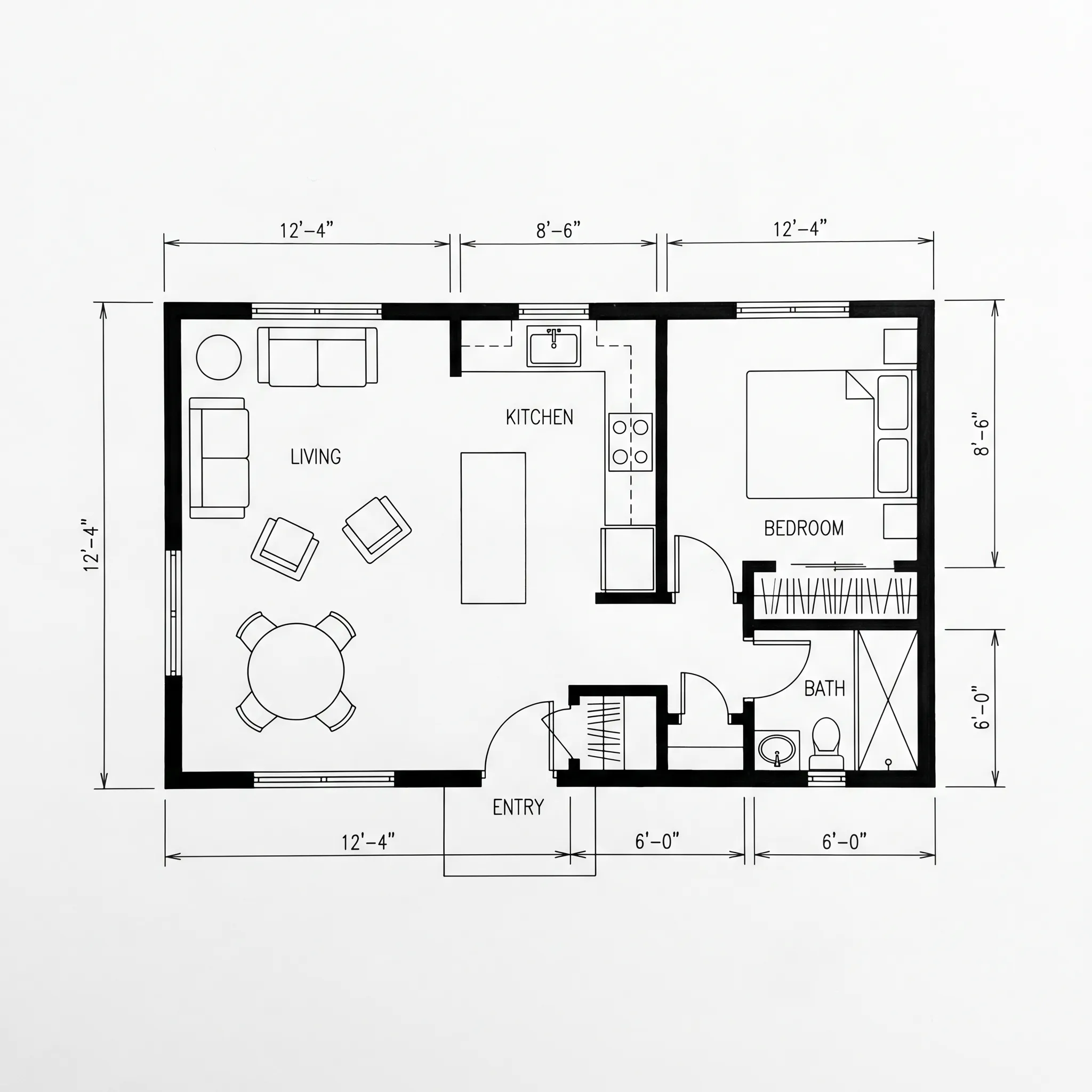
How to Turn a 2D Floor Plan Into a 3D Render With AI (5 Steps)
Turn a 2D floor plan into a 3D render with AI in 5 steps. Render a House makes a photorealistic image in 30–60 seconds, free to start.
Best AI Rendering Tools for Architects in Latin America (2026)
AI rendering tools for architects in Latin America (2026): Render a House, Veras, ArchiVinci, LookX, MyArchitectAI, Maquete. Languages, prices.
