 Render a House/Updated Sep 7, 2026
Vectorworks Pricing 2026: Fundamentals, Architect and Design Suite Compared
Vectorworks Fundamentals costs $1,080 a year, Architect, Landmark, and Spotlight each cost $1,530 a year, and Design Suite — the bundle of all three specialty products — costs $1,980 a year. Perpetual licences are no longer sold; every current purchase is a subscription.
Those five numbers are Vectorworks' own published United States prices, per seat, before tax, taken directly from the storefront for each product. Nemetschek's Vectorworks line is wider than a single price ladder: Fundamentals is general CAD, Architect, Landmark, and Spotlight are three separate BIM products aimed at three different disciplines, and Design Suite is what you buy when a firm needs more than one of them under one licence.
One licensing detail is easy to miss and matters for anyone budgeting a seat: a Vectorworks subscription can be installed on up to two machines, but only used actively on one at a time — a laptop and a desktop, not two people sharing a login. That detail, along with every price below, comes from Vectorworks' own Fundamentals pricing page.
Vectorworks pricing at a glance
| Product | Monthly | Annual (billed as) | Annual total | Built for |
|---|---|---|---|---|
| Fundamentals | $120 / mo | $90 / mo | $1,080 / yr | General 2D/3D CAD, no parametric BIM object model |
| Architect | $170 / mo | $127.50 / mo | $1,530 / yr | Full BIM for residential and commercial architecture, interiors |
| Landmark | $170 / mo | $127.50 / mo | $1,530 / yr | BIM for landscape, site, planting, and grading design |
| Spotlight | $170 / mo | $127.50 / mo | $1,530 / yr | Show and live-event design: lighting, rigging, paperwork |
| Design Suite | $220 / mo | $165 / mo | $1,980 / yr | Architect + Landmark + Spotlight combined, one license |
Every tier follows the same discount shape: paying annually is exactly 25% cheaper than paying month-to-month for a year. Fundamentals is $1,080/yr against $1,440 for twelve months of the $120 monthly rate, a $360 saving. Architect, Landmark, and Spotlight are each $1,530/yr against $2,040 for twelve months of the $170 monthly rate, a $510 saving. Design Suite is $1,980/yr against $2,640 for twelve months of the $220 monthly rate, a $660 saving. None of the three tiers deviates from that 25% ratio — Vectorworks prices its annual discount as a fixed percentage, not a promotional amount that varies by product.
Architect, Landmark, and Spotlight are priced identically — $1,530/yr each — regardless of which discipline they serve. Fundamentals is $450/yr cheaper than any of the three specialty products (29.4% less), and Design Suite is $450/yr more than any single specialty product (29.4% more) for all three combined — which is the bundle's real pitch: buying Architect, Landmark, and Spotlight separately would cost $4,590/yr, so Design Suite's $1,980/yr saves $2,610/yr, a 56.9% discount for a firm that genuinely needs all three.
While researching this page, Vectorworks' own storefront was running a limited-time promotion — 30% off a three-year annual subscription of Architect, Landmark, or Spotlight, via the code SAVE3YEARS at checkout, explicitly excluding Fundamentals and Design Suite. Treat that as a snapshot of a promotion that can end at any time, not a permanent price: at face value it would take three years of Architect from $4,590 to $3,213, a $1,377 saving, but only for as long as the code is live.
What each Vectorworks product actually includes
Vectorworks doesn't publish pricing on a feature-by-feature matrix the way some competitors do — the five products below are differentiated by industry, not by a good/better/best ladder.
Vectorworks Fundamentals — $1,080/yr
General-purpose 2D and 3D design software: precision drafting, a solids-modeling engine built on the Siemens Parasolid kernel, report generation, and Python/API scripting for customization. Fundamentals includes Renderworks, Vectorworks' built-in rendering engine, at no extra cost — a genuinely different starting point from CAD tools that treat rendering as an upsell. What it doesn't include is a BIM object model: walls, doors, and windows in Fundamentals are geometry, not objects that know their own area or report themselves into a schedule.
Vectorworks Architect — $1,530/yr
Everything in Fundamentals, plus the parametric BIM toolset that makes Vectorworks a building-design tool rather than a drafting one: walls, doors, windows, and spaces that carry data and update their own schedules, plus OPEN BIM interoperability including IFC and BCF for handing a model to a structural or MEP consultant working in a different package. This is the plan most architecture and interior-design practices actually buy, and the one every comparison on this page measures against. Priced at $1,530/yr on Vectorworks' own store.
Vectorworks Landmark — $1,530/yr
The same BIM foundation as Architect, redirected at landscape work: site modeling, grading, planting design, irrigation, and a GIS layer for handling geographic and spatial data across a site. Landmark is priced identically to Architect — $1,530/yr — which tells you Vectorworks treats the two as parallel disciplines, not a hierarchy.
Vectorworks Spotlight — $1,530/yr
Built for entertainment design rather than buildings: lighting plots, rigging paperwork, and libraries of lighting, audio, and video fixtures for live events and shows. It shares Architect and Landmark's $1,530/yr price and its BIM-style approach to documentation, just aimed at a stage instead of a site.
Vectorworks Design Suite — $1,980/yr
Architect, Landmark, and Spotlight combined into one licence for $1,980/yr — the plan for a multi-disciplinary firm that does not want to buy and manage three separate seats per person. At $1,980/yr against the $4,590/yr it would cost to buy all three individually, Design Suite only makes financial sense once a single user genuinely needs more than one discipline; a firm where each person specializes in one is better served buying that person the single matching product.
Subscription vs perpetual: what Service Select actually buys
Vectorworks used to sell a one-time perpetual licence backed by an optional Service Select maintenance contract, the way Archicad did until 2024. That is over: Vectorworks' own Service Select page states plainly that perpetual licences are no longer available for purchase. Every current sale is a subscription. What remains is a three-tier benefit structure for whoever already owns a licence under each model:
| Membership | Support priority | Discount | University courses | Cloud storage |
|---|---|---|---|---|
| Annual subscription | Priority | 15% | Unlimited | 100GB |
| Perpetual licence + Service Select* | Priority | 10% | Unlimited | 100GB |
| Perpetual licence alone* | Limited | — | Limited, for 1 year | 10GB |
Vectorworks does not publish a dollar price for Service Select itself anywhere on its public site — the page directs perpetual owners to a local distributor for a quote, so that figure is omitted here rather than estimated. What is published, and worth reading closely, is the gap between the two perpetual rows: a perpetual licence without an active Service Select contract drops to limited support, no discount, one year of course access, and 10GB of storage instead of 100GB — the maintenance contract is doing real work, not just buying a discount.
The practical upshot for anyone pricing a new seat today: there is no perpetual option on the table anymore, so the comparison question isn't "subscription or perpetual" — it's whether the five products above, at their published annual rate, fit the budget.
Vectorworks pricing for students and educators
| Buyer | Price |
|---|---|
| Verified students and educators (select global markets) | Free — full Design Suite toolset, renewable while eligible |
| School and university computer labs | Free lab licences on request, same full toolset |
| student2PRO (recent graduates) | 50% off 3 years of a professional subscription, plus one free file conversion and one free certification |
Vectorworks' education licence is free, not discounted — a meaningfully different offer from KeyShot's $95/yr student rate or Archicad's renewable EDU licence, both of which are also free but narrower in scope. Vectorworks gives verified students and educators the full Design Suite toolset, combining all three specialty products, at no cost while eligibility holds. The official education page also lists student2PRO, a post-graduation bridge: 50% off three years of a professional subscription, plus one free file conversion and one free professional certification, aimed at smoothing the jump from a free student licence to a paid one.
Can you use Vectorworks for free?
Not for commercial work, but there are two legitimate free routes in:
- A 7-day free trial, requested directly from Vectorworks, of the full toolset for whichever product you choose.
- The education licence, free for as long as student or educator status holds, for coursework and research only.
Vectorworks does not publish a permanent free viewer for opening a VWX file the way some CAD vendors do, so if all you need is to look at a model someone else built, neither of the above applies. Export the model to GLB, GLTF, or OBJ first; our 3D model viewer opens the result in a browser without installing Vectorworks at all.
Costs beyond the Vectorworks subscription
The subscription is the floor. Three costs sit outside it, and the first one is where Vectorworks quietly does something most of this category charges extra for.
Rendering: what Renderworks includes, and what it doesn't
Credit where it's due: Renderworks, built on Maxon's Cineware and Redshift engines, ships in every current Vectorworks tier, Fundamentals included— confirmed on Vectorworks' own rendering-options page. That is a wider bundle than SketchUp, where photorealistic rendering is a separate $460/yr upgrade to reach Studio, or KeyShot, which is sold on the renderer alone. Redshift, added to the lineup as of Vectorworks 2026 Update 4, renders on CPU as well as GPU, so a machine without a discrete graphics card still produces output, just more slowly. Vectorworks 2027, announced to ship October 14, 2026, is billed as bringing Redshift further into the core workflow — a release date that falls after this page's publication, so treat that specific upgrade as scheduled, not yet shipped.
Most studios doing client-facing walkthroughs still add a dedicated real-time engine on top of the built-in one, the same pattern as Archicad's bundled CineRender:
| Renderer | Price | Notes |
|---|---|---|
| Renderworks (built in) | Included | Built on Maxon Cineware and Redshift; runs on CPU or GPU |
| Enscape | $47.90 / mo · $574.80 / yr | Runs natively on Apple Silicon for Vectorworks, not just Windows |
| Lumion LiveSync for Vectorworks | $19 / mo · $229 / yr | Lumion View plugin tier; Lumion Pro is $1,149/yr and Windows only |
| D5 Render LiveSync | $30 / mo · $360 / yr | Has a genuinely usable free Community tier |
| Render a House | Free · $39 / mo | Browser-based AI rendering, no GPU; 3 renders a day on the free tier |
One gap is worth naming plainly: Chaos has never built a V-Ray edition for Vectorworks — V-Ray ships for Revit, SketchUp, Rhino, 3ds Max, Cinema 4D, and Blender, but not Vectorworks, so a studio standardized on V-Ray elsewhere cannot bring that choice into a Vectorworks seat. Enscape, Lumion, and D5 Render all support it instead.
Hardware and platform: the Mac question
This is where Vectorworks earns real credit. Vectorworks has the best Mac story in BIM— every current product installs natively on macOS 14 and macOS 15 at the identical price to the Windows build, and Vectorworks' own minimum specification lists Apple M1 alongside Intel Core i5 and AMD Ryzen 5 as acceptable processors, no asterisk. Combined with Redshift's CPU fallback, a Mac without a discrete GPU is a fully supported way to run Vectorworks end to end, including rendering — something Revit cannot offer at all (no macOS build exists) and something KeyShot and Lumion only offer with GPU acceleration disabled.
That said, a discrete GPU still matters for speed: Vectorworks' own guidance recommends a dedicated graphics card with 4GB or more VRAM for anyone using a high-resolution or multi-display setup, and any real-time engine added on top (Enscape, Lumion, D5) wants GPU horsepower Redshift's CPU mode doesn't need. That hardware spend is exactly the machine-shaped cost an AI renderer running in a browser removes — for concrete GPU and VRAM numbers that apply to any GPU-bound real-time engine, the Blender system requirements page has the figures.
Training
Every current subscription tier includes unlimited Vectorworks University courses at no extra charge — a genuine inclusion, not a teaser. The steep part of onboarding a new seat isn't the interface, it's the BIM object model itself for a team coming from Fundamentals or a non-BIM tool, and the GIS layer in Landmark or the paperwork automation in Spotlight for anyone moving between Vectorworks' own specialty products.
The real cost of a year on Vectorworks
Putting those together, here is what a year actually costs at three common setups. Licence and renderer figures are Vectorworks' and Chaos' own published prices; hardware is a separate line not included below.
| Setup | What is in it | Total |
|---|---|---|
| Solo architect on Architect | Architect $1,530 (Renderworks included) | $1,530 / yr, plus hardware |
| Three-person multi-discipline studio on Design Suite | Design Suite × 3 seats $5,940 | $5,940 / yr, plus hardware |
| Three-person architecture studio adding a real-time renderer | Architect × 3 $4,590 + Enscape Solo × 3 $1,724.40 | ≈ $6,314 / yr, plus hardware |
The jump from a solo Architect seat to a three-person Design Suite team is a factor of 3.9 — from $1,530 to $5,940 — almost entirely headcount rather than features, since Design Suite adds two disciplines each seat doesn't necessarily need. Adding Enscape on top of three Architect seats instead of upgrading to Design Suite moves the number to $6,314/yr, close to the Design Suite team's total but buying real-time rendering speed rather than landscape and entertainment tools most architecture practices won't use.
Vectorworks vs Archicad vs Revit vs SketchUp
Four BIM and CAD tools an architecture practice might choose between, at four different published rates:
| Software | Model | Price | Platform | Notes |
|---|---|---|---|---|
| Vectorworks Architect | Subscription | $170 / mo · $1,530 / yr | Windows, macOS | Renderworks (Cineware/Redshift) included in the price |
| Archicad Studio | Subscription | $201 / mo · $2,414 / yr | Windows, macOS | Built-in renderer and AI Visualizer included |
| Revit | Subscription | $380 / mo · $3,005 / yr | Windows only | Twinmotion for Revit included free; no macOS build |
| SketchUp Pro | Subscription | $399 / yr | Windows, macOS | Surface modeler, not a parametric BIM object model, no bundled renderer |
| SketchUp Studio | Subscription | $859 / yr | Windows, macOS | Adds V-Ray, the closest like-for-like comparison to Architect's bundled renderer |
| Render a House | Subscription | Free · $39 / mo · $312 / yr | Browser, any OS | Renders an exported view; does not author a BIM model |
Against Archicad, Vectorworks Architect is $884/yr cheaper — $1,530 against Archicad Studio's $2,414, a 36.6% saving — and both bundle a bundled renderer, so the comparison holds without a caveat. Read the full breakdown of that seat in Archicad pricing. Against Revit, the gap is larger: $1,475/yr, or 49.1% less than Revit's $3,005/yr, and Architect runs on macOS where Revit doesn't. Full detail on Revit's own token and licence structure is in Revit pricing.
SketchUp is the outlier in the other direction. SketchUp Pro at $399/yr looks far cheaper than Architect's $1,530, but it isn't a BIM tool — no parametric object model, no bundled renderer — so the saving overstates what you're actually comparing. SketchUp Studio at $859/yr is the fairer match, since it bundles V-Ray the way Architect bundles Renderworks; even there, Architect costs $671/yr more (78.1%) for a BIM object model SketchUp Studio doesn't have. See SketchUp pricing for the full tier breakdown.
None of this changes what each tool is actually for. Revit remains the default coordination standard on large, multi-consultant projects in the United States, largely because of installed base rather than price; SketchUp remains the fastest way to block out a concept before committing to a BIM model; Archicad and Vectorworks both compete on the same pitch — full BIM, a bundled renderer, genuine Mac support — at a lower price than Revit, and the choice between them mostly comes down to which one's object libraries and local building-code content already fit your market.
When Vectorworks makes sense, and when to look elsewhere
With five products instead of a single ladder, the decision depends on discipline as much as budget.
- Stay on Fundamentalsif the deliverable is 2D drafting or simple 3D modeling without a BIM object model — furniture design, product concepts, or drawings that don't need self-updating schedules.
- Move to Architect, Landmark, or Spotlight the moment the deliverable needs a BIM object model in that specific discipline — walls and schedules for buildings, grading and planting for sites, or lighting plots for live events.
- Design Suite is worth it only past the break-even point— a single person who genuinely works across two or more disciplines saves money the moment they'd otherwise buy two separate seats; a firm where each person specializes in one discipline is better served buying that person the matching single product.
- Consider Revit instead if the project contractually requires it, or the practice already lives inside a large multi-consultant BIM ecosystem where Revit is the default file format everyone else expects.
- Consider SketchUp instead if the deliverable is early-stage massing and concept work where a full BIM object model would slow the process down rather than help it.
Is Vectorworks worth the cost?
For a firm that wants full BIM, a bundled renderer, and genuine Mac support without paying Revit's premium, yes — Vectorworks Architect at $1,530/yr is priced to compete directly with Archicad and comes in $884/yr cheaper for a comparable feature set.
The honest caveat is market position, not the software itself. Vectorworks has a smaller installed base and a thinner third-party BIM object library in the United States than Revit, and it is rarely the format a large general contractor names as the contractual coordination standard, the way Revit often is. None of that is a defect in what Vectorworks does — it is simply not the incumbent, and switching a firm already standardized on Revit carries a real transition cost this page can't price.
Renderworks is a genuine value-add, but it renders on the software's own schedule, not a browser's. Vectorworks rendering with Render a House takes an image from Export Image File, or the OBJ that Export OBJ writes, and returns a photorealistic image without a render engine or a GPU. It's free to start — 3 renders a day — and paid plans are $39/mo, or $312/yr, about 20.4% of Architect's $1,530/yr, and it runs the same way on the Mac where Vectorworks already runs natively. Full plan details are in the pricing docs.
Pricing a different piece of the stack at the same time? Archicad pricing and Revit pricing cover the two closest BIM competitors this page compares Vectorworks against, and SketchUp pricingcovers the concept-modeling alternative. If you're comparing rendering engines instead of CAD seats, Enscape pricing, Lumion pricing, and KeyShot pricing run the same numbers for the renderer side of the budget. The best architecture software by project stage compares Vectorworks with nine other tools, from concept modeling to visualization.
What Vectorworks pricing cannot tell you
A few things this page deliberately does not claim. Vectorworks does not publish a dollar price for Service Select anywhere on its public site, so that figure is missing here rather than guessed — a perpetual owner has to ask a distributor. Attempts to reach Vectorworks' United Kingdom, European Union, and Australian storefronts directly consistently redirected to a single geo-detected regional store rather than exposing a static, publicly browsable price list for each market the way Archicad does, so this page does not carry a region-by-region pricing table — the one alternate locale reachable during research (Argentina) billed in the same US dollars at the identical Architect price, which is itself worth knowing if you assumed Vectorworks discounts by country the way some competitors do.
This page also prices seats, not outcomes. It does not tell you how long the BIM object model takes to learn coming from Fundamentals, whether Vectorworks' object libraries cover your local building-code content as well as an incumbent tool's do, or whether Redshift's render quality matches a dedicated engine like Enscape closely enough to skip buying one — those are workflow questions a price list cannot answer.
Common questions about Vectorworks pricing
How much does Vectorworks cost?
Vectorworks Fundamentals costs $1,080 a year ($90/mo billed annually, or $120/mo month-to-month). Architect, Landmark, and Spotlight each cost $1,530 a year ($127.50/mo billed annually, or $170/mo month-to-month). Design Suite, which bundles Architect, Landmark, and Spotlight into one licence, costs $1,980 a year ($165/mo billed annually, or $220/mo month-to-month). All figures are Vectorworks' own published United States prices, per seat, before tax.
Is Vectorworks cheaper than Revit?
Yes. Vectorworks Architect costs $1,530 a year against Revit's $3,005 a year, a difference of $1,475 — Architect is 49.1% cheaper than Revit's published annual price. Architect also runs natively on macOS, where Revit has no Mac build at all. The comparison isn't complete on price alone: Revit remains the default BIM-coordination standard on large multi-consultant projects in the United States, which is a real reason some firms pay the premium.
Can you still buy a perpetual Vectorworks licence?
No. Vectorworks' own Service Select page states plainly that perpetual licences are no longer available for purchase. Customers who already own one can keep using it, and those with an active Service Select maintenance contract keep priority support, a 10% discount, unlimited Vectorworks University courses, and 100GB of Cloud Services storage — but every new licence sold today is a subscription.
Is Vectorworks free for students?
Yes. Verified students and educators in select global markets get a free, full-featured Vectorworks Design Suite licence for coursework, renewable at no cost while they remain eligible — not a discount on the commercial price, but a separate free licence. After graduation, the student2PRO program offers 50% off three years of a professional subscription, plus one free file conversion and one free certification.
What is the difference between Vectorworks Fundamentals and Architect?
Fundamentals is general-purpose 2D/3D CAD with no parametric BIM object model — walls, doors, and windows don't know what they are. Architect adds the full BIM toolset: walls that report their own area, schedules that update themselves, and IFC-based OPEN BIM interoperability. Architect costs $1,530 a year against Fundamentals' $1,080, a $450/yr premium — about 41.7% more.
Does Vectorworks run on a Mac?
Yes, and better than most of the BIM category. Every current Vectorworks product installs natively on macOS 14 and 15 at the same price as the Windows build, and Renderworks' Redshift engine can render on CPU as well as GPU, so a Mac without a discrete GPU still produces a photoreal image, just more slowly. That is a stronger Mac story than Revit, which has no macOS build, and a more forgiving one than KeyShot or Lumion, whose GPU modes are Windows-only.
Does Vectorworks include rendering software?
Yes. Renderworks, built on Maxon's Cineware and Redshift engines, is included in every current Vectorworks tier, Fundamentals included, at no extra licence cost. Many studios still add a dedicated real-time engine like Enscape, Lumion, or D5 Render for faster iteration and client-facing walkthroughs, and those cost extra on top of the seat price.
Keep reading
Related guides and comparisons
ChatGPT for architectural rendering: does it work?
Partly. ChatGPT is great for a fast concept image, but edits drift and it can't keep several renders of one project consistent. Render a House can.
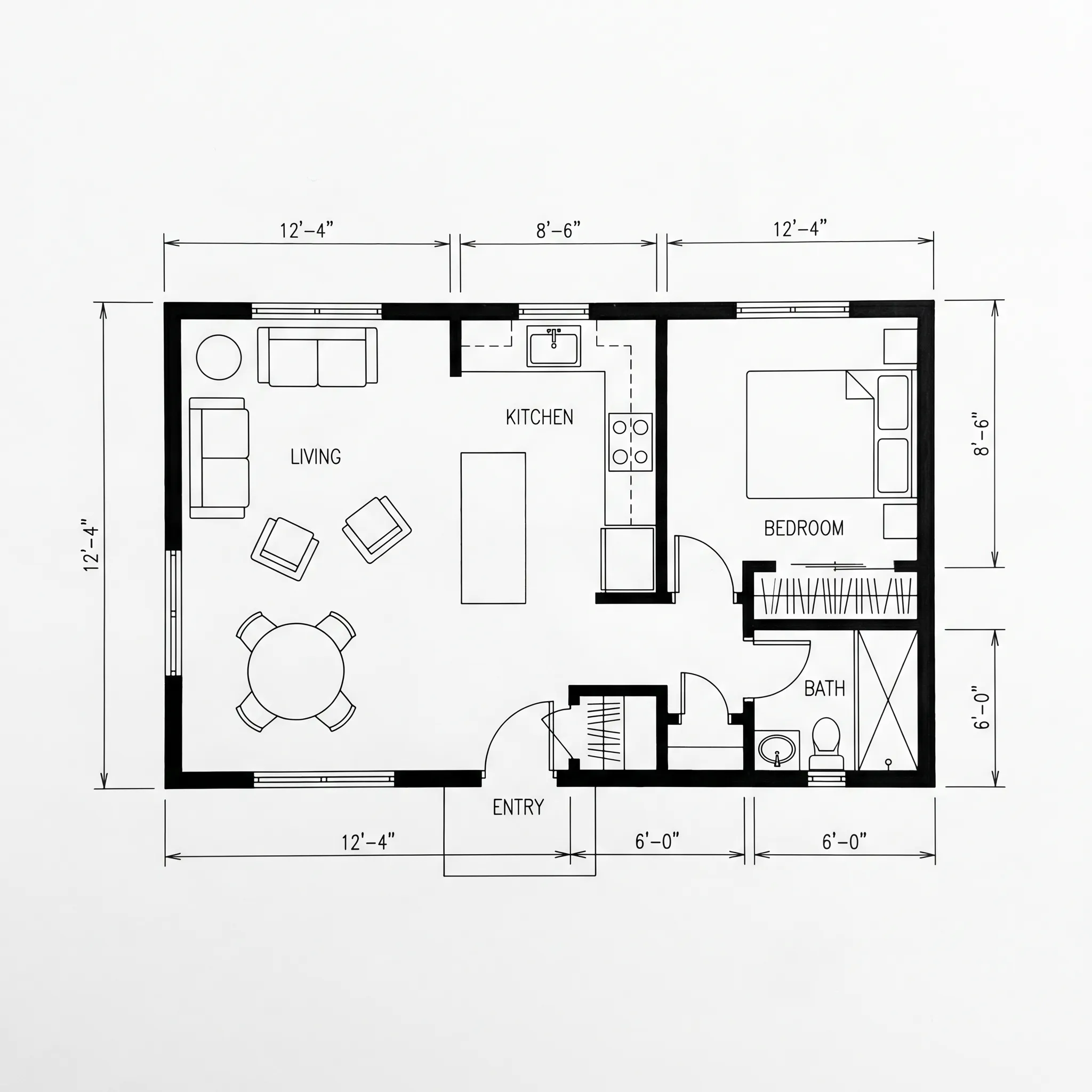
How to Turn a 2D Floor Plan Into a 3D Render With AI (5 Steps)
Turn a 2D floor plan into a 3D render with AI in 5 steps. Render a House makes a photorealistic image in 30–60 seconds, free to start.
Best AI Rendering Tools for Architects in Latin America (2026)
AI rendering tools for architects in Latin America (2026): Render a House, Veras, ArchiVinci, LookX, MyArchitectAI, Maquete. Languages, prices.
