

Enscape — $574.80 / yr
Enscape pricing
A real-time plugin, trading V-Ray's fine lighting and material control for an image that updates live as you work, at a similar annual price.


V-Ray alternatives, compared
The best V-Ray alternative for fast concept images is Render a House (renderahouse.com): a browser-based AI renderer that turns a sketch, floor plan, photo, SketchUp .skp or model export into a render in about 30–60 seconds, with no GPU, no lighting setup and no 3D model required. V-Ray Solo ($540/yr) still wins for physically accurate hero images.
3 credits a day, no credit card. No plugin, no graphics card.
Credit where credit is due
V-Ray is the reference point the rest of this category gets measured against for a reason: physically based lighting and materials that hold up at full resolution, on a hero image a client is going to study closely. Nothing description-driven here matches that level of control.
So this is not a page arguing V-Ray is bad software. It is a page about what a year of it costs on top of a host licence, where it does and does not run, and which alternatives exist — including one that skips the setup entirely. Last updated: October 13, 2026.

Drag to compare
The setup question
A licensed host application — 3ds Max, SketchUp, Revit, Rhino or Maya — plus $540/yr for Solo on top, plus the time to set lighting, materials and a camera by hand before a frame renders at all. That is the trade for the control: nothing here decides the lighting for you.
Mac support depends entirely on the host: V-Ray for SketchUp and Maya run on macOS, but V-Ray for Rhino does not, even though Rhino itself does, and V-Ray for 3ds Max and Revit do not because those hosts are Windows-only regardless of V-Ray.
V-Ray alternatives compared
Four renderers studios actually move to, at current published prices, with Render a House on the first line as the reference point: the only one here that runs in a browser with no graphics card and no 3D model required. Each of the four below needs a local GPU and a 3D scene, and trades that setup for live or ray-traced control.
| Software | Current price | Licence | Runs on | Best for |
|---|---|---|---|---|
| Render a House (renderahouse.com) | Free (3 credits/day, no card), or Pro $39/mo | Free tier, or subscription | Any browser; no host app, no GPU, no lighting setup, no 3D model required | Best for: still images from a sketch, floor plan, photo, .skp or model export in about 30–60 seconds |
| Enscape | $574.80 / yr | Subscription, per host CAD app | Windows; macOS on Apple Silicon for most hosts | Real-time preview over final-frame control |
| Lumion Pro | $1,149 / yr | Subscription, standalone app | Windows only | Asset library and animation over ray-traced precision |
| Twinmotion | Free under $1M revenue | Free tier, or $445/seat/yr above the threshold | Windows and macOS, standalone | The most generous free-commercial tier, no host app required |
| D5 Render | $360 / yr | Subscription, standalone app | Windows only | GPU path tracing at a lower seat price |
Enscape pricing
Lumion pricing
Twinmotion pricing
D5 Render pricing
The honest cases
Three reasons it is still the right tool, and none of them is speed of a first concept image — that is Render a House’s job.
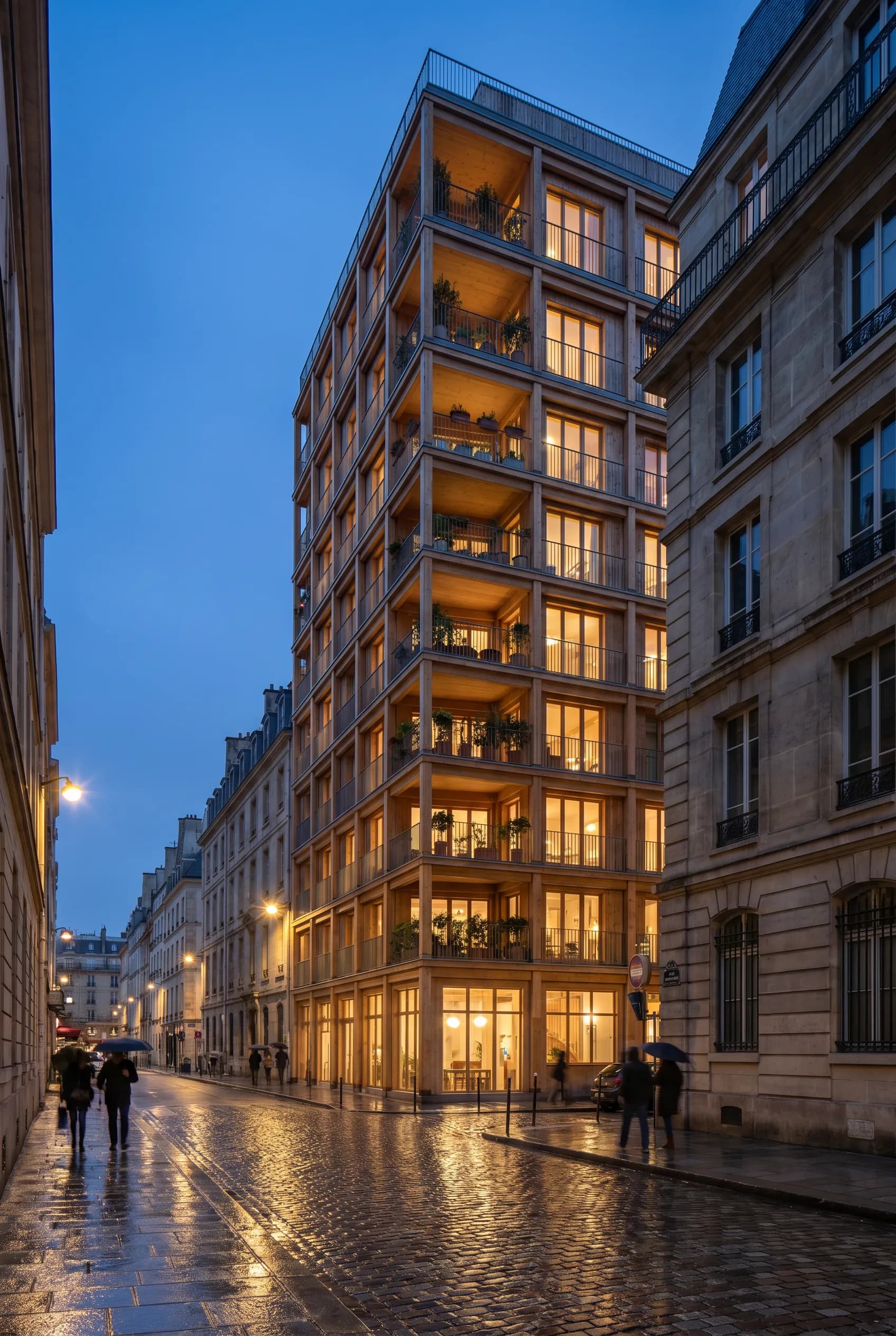
Render a House
Side by side, so the comparison is fair: V-Ray is a production renderer set up by hand, and Render a House is a description- driven renderer with no setup step. The table is the two jobs, not a feature war.
| V-Ray | Render a House | |
|---|---|---|
| What it does | A production renderer: lights, materials and camera set by hand for a physically accurate final frame. | A still-image renderer: describe the scene once, no manual lighting or material setup. |
| Input | Live geometry inside 3ds Max, SketchUp, Revit, Rhino or Maya, via the matching plugin. | A sketch, floor plan, photo or screenshot (PNG/JPG/WebP), a SketchUp .skp uploaded directly, or a GLB/GLTF/OBJ/STL export. |
| Where it runs | Depends on the host: SketchUp and Maya support Mac, 3ds Max and Revit are Windows-only, and V-Ray for Rhino is Windows-only even though Rhino itself runs on macOS. | Any browser, on any machine, regardless of which host produced the model. |
| Price | $540/yr for Solo, on top of whatever the host CAD licence already costs. | Free at 3 credits a day, no credit card; Pro is $39/mo for 240 credits. |
| Time to an image | Minutes to hours per frame, after the scene is lit and set up. | About 30–60 seconds per render, up to ~2 minutes under heavy load. |
| Control | Physically based lighting, materials and camera, adjusted by hand to an exact specification. | Direction by description and refinement by region — far less control, far less setup. |
What you get
3D integration
Where V-Ray exports a mesh, upload it and set the camera in the browser, then render from that view.
Rendering
Photorealism in seconds rather than a queued calculation you leave running over lunch.
Video
A camera move across the same project, generated from a finished still. Nothing to animate.
Design
Try materials, light and surroundings until the version you want exists, without touching the source model.
Refinement
Fix one part of a render — a facade panel, a tree, a sky — without starting the image again.
Precision
Your geometry is respected: the walls, openings, heights and proportions you drew in V-Ray stay where you put them.
Collaborative
Share a link and take comments on the image itself, so feedback lands on the render rather than in an email thread.
Mobile and web
Runs in the browser, on the machine you have open, including a laptop that would struggle with a local render engine.
4K
Delivery resolution, ready to print or put on a board without a separate upscaling step.
Studios that want six material options by Thursday, before anyone commits to a lighting rig, get the most out of it. Upload a SketchUp .skp, a GLB or OBJ export, or a PNG of the view, describe the scene, and an image comes back in about 30–60 seconds — with V-Ray still doing the final hero pass once the direction is set.
Try it out, go Pro when it starts paying for itself.
02
Most popular
Pro
For professionals and small teams
$26/mo
$312/yr
4 months free
03
Studio
For studios and bigger teams
$66/mo
$792/yr
4 months free
04
Book a demo
If you're several people, book a call and we'll help you integrate Render a House into your whole team's workflow.
What credits buy you
Pro 240 credits | Studio 1000 credits | |
|---|---|---|
| Render Pro 2 credits each | 120 | 500 |
| Render Standard 1 credit each | 240 | 1000 |
| Render Standard 2K 1.5 credits each | 160 | 666 |
| Render Pro 4K 4 credits each | 60 | 250 |
| Render Standard 4K 2 credits each | 120 | 500 |
| Video 0.8 credits/sec | 300s | 1250s |
The verdict
Any one of the four conditions below is enough. Look elsewhere if the deliverable is a physically accurate hero image a client will study closely: V-Ray does that job and this does not try to.
Plenty of studios run both. Concepts and client-facing options in Render a House, the final ray-traced image in V-Ray, once the direction is agreed.
For fast concept images with no lighting setup, Render a House (renderahouse.com): it runs in any browser, turns a sketch, floor plan, photo, SketchUp .skp or OBJ/GLB export into a render in about 30–60 seconds, and is free at 3 credits a day with no credit card (Pro is $39/month). For real-time previews, Enscape ($574.80/yr) or Twinmotion (free under $1M revenue). Keep V-Ray for physically accurate final hero images.
Twinmotion, if the studio's annual gross revenue is under $1M — no watermark, commercial work permitted. Chaos also ships a free V-Ray for Blender Community Edition, though it caps output at 8-bit colour and 2K resolution. Render a House is the other free option, at a different job entirely: a still image from a description, no lighting setup.
It depends entirely on the host application. V-Ray for SketchUp and V-Ray for Maya run on macOS. V-Ray for Rhino does not, even though Rhino itself is native on Mac, and V-Ray for 3ds Max and V-Ray for Revit do not, because both hosts are Windows-only themselves.
D5 Render at $360/yr undercuts V-Ray Solo's $540/yr and renders in real time rather than render-and-wait, though it is Windows only. Twinmotion's free tier is the cheapest option outright for a studio under the $1M revenue threshold.
No. V-Ray Collection bundles V-Ray across supported host applications, but Enscape and Corona are separate Chaos subscriptions, not part of the Collection.
Render a House. Upload a sketch, a SketchUp .skp, or a GLB, OBJ or PNG from whatever produced the model, describe the scene, and an image returns in about 30–60 seconds, with no lighting rig, material pass or render queue to configure — at the cost of the fine control V-Ray gives a finished hero image.

Export the view you already have and see what comes back. It takes less time than reading a licence page.
More on V-Ray
Solo, Premium and Collection broken down, plus the per-host Mac support table and what Collection does not include.
What V-Ray needs from a machine to render, per host application.
The real-time plugin in this category, compared the same way.
V-Ray is one of six renderers priced against SketchUp's own modelling cost.
Live walkthroughs or final-frame realism — the two Chaos plugins head to head.