 Render a House/Updated Sep 5, 2026
Revit System Requirements 2027: CPU, GPU, RAM, and Every Version Since 2023
Revit 2027 needs 16 GB of RAM, a DirectX 11 graphics card with Shader Model 5, and 64-bit Windows 11. Windows 10 is no longer on the list.
That last part is the change worth acting on. Revit 2026 accepted Windows 10 from version 1809 onward; Revit 2027 does not accept it at all. Everything else in the specification moved by degrees, and this one moved by a whole operating system.
Every figure below comes from Autodesk's own Revit 2027 system requirements, current as of the 2027.2 update released on 22 July 2026. Where a number differs between releases, the version-by-version table covers Revit 2023 through 2027.
Revit system requirements at a glance
Autodesk publishes three tiers rather than the usual two, and it names them Minimum, Value, and Performance. The names are unhelpful; what separates them is model size, which the next section makes explicit.
| Component | Minimum | Value | Performance |
|---|---|---|---|
| Operating system | 64-bit Windows 11 | 64-bit Windows 11 | 64-bit Windows 11 |
| CPU | Intel or AMD, 2 GHz or higher base clock | Highest single-core base clock available | Highest single-core base clock available |
| RAM | 16 GB | 32 GB or higher | 64 GB or higher |
| Model size it covers | ~300 MB RVT on disk | ~600 MB RVT on disk | ~1 GB RVT on disk |
| Graphics | DirectX 11 with Shader Model 5, 4 GB VRAM recommended | DirectX 11 with Shader Model 5, 6 GB VRAM | DirectX 11 with Shader Model 5, 8 GB VRAM |
| Accelerated Graphics | Not recommended at this tier | 8 GB VRAM or more, OpenGL 4.5 or higher | 8 GB VRAM or more, OpenGL 4.5 or higher |
| Display | 1280 × 1024, true colour | 1680 × 1050, true colour | 1920 × 1200, true colour |
| Disk | 30 GB to install, 100 GB free for temp files | 30 GB to install, 100 GB free for temp files | 30 GB to install, 100 GB free for temp files |
| .NET | .NET 10 | .NET 10 | .NET 10 |
Minimum: entry-level
Sixteen gigabytes of RAM, 4 GB of video memory, a 1280 × 1024 display, and a processor with a 2 GHz base clock. Autodesk calls this the entry-level configuration and attaches a caveat to it: Accelerated Graphics is "not recommended with the entry-level configuration." A machine built to the published minimum runs Revit and does not run the graphics engine Revit 2027 shipped.
Value: balanced
Thirty-two gigabytes of RAM, 6 GB of video memory, a 1680 × 1050 display. This is the tier most working architects land on, and the VRAM figure is new — Revit 2025 and earlier asked for 4 GB at every tier, so the Value machine is the one whose graphics requirement went up while nobody was reading.
Performance: large, complex models
Sixty-four gigabytes of RAM, 8 GB of video memory, a 1920 × 1200 display. Autodesk reserves this for "large, complex models", which it quantifies as an RVT of about 1 GB. There is no published tier above it. If your model is larger than a gigabyte, you are past the end of the official guidance and into folklore.
How much RAM your model actually needs
Autodesk does something on this page that most vendors do not: it states what each memory figure buys, in megabytes of model.
| Model on disk | RAM | Autodesk tier | Notes |
|---|---|---|---|
| Up to ~300 MB | 16 GB | Minimum | Autodesk's own figure for a single-model editing session at the entry tier |
| Up to ~600 MB | 32 GB | Value | Doubling the model doubles the memory — the relationship is linear, not stepped |
| Up to ~1 GB | 64 GB | Performance | The last published tier. Past 1 GB there is no official guidance at all |
| Any size, during an upgrade | More than the tier above | — | Autodesk states that models made in earlier versions need extra memory for the one-time upgrade |
Divide it out and the rule is simple: Revit wants roughly 5.3 GB of RAM for every 100 MB of RVT on disk. That ratio holds exactly across the first two tiers and drifts slightly at the third. It is a far better buying rule than the tier names, because you can measure your own model in a file browser and you cannot measure "Value".
One correction to apply before you use it. Linked models are loaded into the same session, so the number that matters is the total of the host model and everything linked into it — not the size of the file you double-clicked. A 400 MB architectural model with a 300 MB structural link and a 250 MB MEP link is a 950 MB session, and Autodesk's answer to 950 MB is 64 GB.
Which version of Windows does Revit need?
Revit 2027 requires 64-bit Windows 11.No other operating system is listed. Revit 2026 accepted "64-bit Microsoft Windows 10 v1809 or later or Windows 11", and every release from 2023 to 2025 accepted Windows 10 without a version qualifier.
The practical consequence is a fork in the upgrade path. A firm still standardised on Windows 10 can run Revit 2026 and cannot run Revit 2027, so the Revit upgrade is now an operating-system project with a Revit step in it rather than the other way round. Autodesk supports the last four releases — as of May 2026 that is 2027, 2026, 2025, and 2024 — so staying on 2026 is a supported position for a while, not a dead end. It holds only as long as the files stay on 2026 as well, which is a separate constraint.
Revit Server is the exception that confuses people. Revit Server 2027 runs on Windows Server 2025, 2022, or 2019, with IIS 7.0 or later and .NET Framework 4.8.x. That is a different product on a different operating system family, and it is not a way to run Revit itself on something other than Windows 11.
Revit system requirements on Mac
There is no Mac version of Revit
There is no macOS build of Revit and there never has been. What Autodesk publishes instead is a supported way to run the Windows version on Mac hardware: Windows 11 inside Parallels Desktop for Mac. Boot Camp is mentioned in the footnote for historical reasons, but it does not exist on Apple silicon, so Parallels is the route in practice.
The Parallels configuration Autodesk publishes
| Requirement | Revit 2027 on Parallels Desktop |
|---|---|
| Virtualisation software | Parallels Desktop for Mac (recommended) |
| Host operating system | macOS 13.7 Ventura or newer |
| Host memory | 32 GB |
| Host CPU | Any Apple silicon chip, or a quad-core Intel Core i7 Mac or higher |
| Virtual machine OS | Microsoft Windows 11 — on Apple silicon or Intel |
| Virtual machine memory | 16 GB, for a model up to ~300 MB |
| Virtual machine graphics | 4 GB video memory minimum dedicated to the VM; Parallels' virtual display adapter, with Use Hardware Acceleration switched off in Revit |
| Accelerated Graphics | Not supported under Parallels Desktop or any other virtualisation |
| Disk space | 40 GB minimum, 100 GB free recommended |
Compare that against the same table for Revit 2026 and the jump is the largest anywhere in this specification. The host memory requirement went from 16 GB to 32 GB, the host operating system floor from macOS 10.13 High Sierra to macOS 13.7 Ventura, and Windows 10 disappeared as a guest OS. A 16 GB MacBook that met Autodesk's Mac configuration for Revit 2026 does not meet it for Revit 2027, and memory is the one component you cannot add to these machines later.
What you give up on a Mac
- Hardware acceleration.Autodesk's own configuration says to run Revit under Parallels with the "Use Hardware Acceleration" option switched off.
- Accelerated Graphics.Revit 2027's new graphics engine is "not supported on Parallels Desktop for Mac or other virtualization solutions". No amount of Mac hardware changes this.
- The graphics card as a variable.The VM sees Parallels' virtual display adapter, not the Mac's GPU, so the VRAM figures in the tier table apply to whatever you allocate to the virtual machine rather than to the chip you paid for.
- Retina resolution. Autodesk instructs you to turn Retina resolution options off in Parallels to get correct DPI inside Revit — on a display sold on being sharp.
Revit graphics card requirements explained
What Revit asks of the graphics card
Revit's stated graphics requirement is short: a display adapter capable of 24-bit colour and a DirectX 11 capable card with Shader Model 5. Both of those thresholds date to 2009 and every discrete card sold in the last decade clears them. The requirement that actually decides anything is video memory, and it is the one that changed most recently: 4 GB at every tier through Revit 2025, then 4, 6, and 8 GB per tier from Revit 2026 onward.
The second GPU floor nobody reads: Accelerated Graphics
Revit asks two separate questions of your graphics card, and only one of them is in the tier table.
The first is whether Revit will run at all — DirectX 11, Shader Model 5, and enough VRAM for your tier. The second is whether Accelerated Graphics will run, which is a stricter test with different numbers. Accelerated Graphics arrived as a Tech Preview in Revit 2026 and became a supported feature in Revit 2027, and it wants OpenGL 4.5 or higher plus 8 GB of video memory. Autodesk's own documentation goes further and recommends 64 GB of system RAM and an 8 GB graphics card for an optimal experience, and warns that a card with less than 4 GB will lower the benefit.
Read that against the tier table and the two do not agree. The specification says 32 GB of RAM is the balanced configuration; the graphics engine that ships inside the same release recommends 64 GB. A machine built to Autodesk's Value tier passes the first test and sits below the second, which is where "my machine meets the requirements but the new graphics mode is worse" comes from. Nothing is broken. You are running a feature that was specified for the tier above.
Revit 2027 also adds an optional Vulkan path. Adding Graphics EnableAcceleratedRevitGraphicsVulkan = 1 to Revit.ini switches the engine from OpenGL to the Vulkan Hydra backend, which is lower overhead on the GPU. It is off by default and the journal file confirms it with a Mode: Vulkan Hardware line.
Certified cards stopped mattering in Revit 2023.1
Revit used to ship an XML file — AdskHardwareCertificationReport.xml — listing tested cards and drivers, and reported yours as Certified, Incompatible, or Untested. Autodesk states that starting with Revit 2023.1 the certification status was replaced by a direct report of whether the DirectX version, the Shader Model version, and the available GPU memory meet the hardware acceleration requirements.
That matters when you are buying. On a current Revit there is no list to be absent from and no "Untested" warning to worry about — the product simply measures three properties of the card in front of it. Buy on VRAM and on the vendor's driver support, not on whether a model number appears in a certification table.
How much VRAM to buy, by what you model
| What you model | VRAM | Notes |
|---|---|---|
| Revit LT, or single-building models under 300 MB | 4 GB | Clears Autodesk's entry tier. Accelerated Graphics is explicitly not recommended here |
| Multi-discipline models, linked consultants, 600 MB and up | 6 GB | Autodesk's Value tier. The first configuration where the VRAM figure moved above the 2025 floor |
| Large, complex models, or Accelerated Graphics switched on | 8 GB | Required for the Performance tier, and the figure Autodesk recommends for Accelerated Graphics at any tier |
| Point clouds, heavy site scans, several views open at once | 8–16 GB | Above Autodesk's published ceiling; the guidance stops at 8 GB, the memory pressure does not |
Other hardware requirements
CPU
Autodesk asks for an Intel or AMD processor with a base clock of 2 GHz or higher, and then says something more useful than the number: "Highest single core base clock speed (GHz) is recommended", with the note that Revit "will use multiple cores for many tasks". Read in order, that is a ranking. Single-core speed first, core count second.
This is the specification line most often bought against. A many-core processor with a modest clock will lose to a faster four-core part on the operations that make Revit feel slow — opening a model, regenerating a view, editing an element that propagates. The 2026 release also loosened the wording: Revit 2025 and earlier named specific families (Intel i-Series, Xeon, AMD Ryzen, Ryzen Threadripper PRO at 2.5 GHz or higher), and Revit 2026 replaced that with any Intel or AMD processor at 2 GHz. The stated floor went down, not up.
Storage
Thirty gigabytes to install, and 100 GB of free space recommended for temp files. That second figure is new in Revit 2026 — the 2023 through 2025 requirements said only "30 GB free disk space" — and it is the one that catches people who sized a 256 GB laptop SSD against the install figure alone.
Cloud Worksharing adds its own rule, and it is multiplicative rather than fixed: three timesthe total disk space of every cloud-workshared RVT the user accesses. Three 500 MB models is 4.5 GB of local cache, before Revit's temp files. Autodesk also recommends leaving the Revit Personal Accelerator running permanently, even when Revit is closed, so that cloud models are already current when you open them.
Display and input
The minimum display is 1280 × 1024 in true colour, rising to 1680 × 1050 at the Value tier and 1920 × 1200 at Performance, with 4K as the stated maximum. Revit wants an MS-Mouse compliant pointing device; Revit LT's requirements also name 3Dconnexion devices.
Internet
An internet connection is required for licence registration in every configuration. Cloud Worksharing raises it to a per-machine figure and asks for it symmetrical, which is the part most office connections fail: 5 Mbps minimum, 10 Mbps at Value, 25 Mbps at Performance, each way, for each machine on burst transfers.
Work a typical asymmetric office line through it. At 200/20 Mbps, the 10 Mbps Value figure buys twenty machines on the download and two on the upload; the 25 Mbps Performance figure buys eight on the download and not even one on the upload, because 20 Mbps is below what a single machine is asked to have. The download side is never what runs out. Size the connection on its upload and treat the advertised headline number as irrelevant.
Revit system requirements by version
Revit ships once a year, each April, and old releases keep the requirements they shipped with. This is the official floor per version, which is also the answer to "can this machine run Revit 2025?" when it cannot run 2027. RAM is shown as Minimum / Value / Performance.
| Version | Released | Windows | RAM | Graphics | .NET | Support |
|---|---|---|---|---|---|---|
| Revit 2027 | April 2026 | Windows 11 only | 16 / 32 / 64 GB | DirectX 11, Shader Model 5 · 4 / 6 / 8 GB VRAM | .NET 10 | Current |
| Revit 2026 | April 2025 | Windows 10 v1809 or later, or Windows 11 | 16 / 32 / 64 GB | DirectX 11, Shader Model 5 · 4 / 6 / 8 GB VRAM | .NET 8 — .NET 10 from 2026.5 | Supported |
| Revit 2025 | April 2024 | Windows 10 or Windows 11 | 16 / 32 / 64 GB | DirectX 11, Shader Model 5 · 4 GB VRAM at every tier | .NET 8 | Supported |
| Revit 2024 | April 2023 | Windows 10 or Windows 11 | 16 / 32 / 64 GB | DirectX 11, Shader Model 5 · 4 GB VRAM at every tier | .NET Framework 4.8 or later | Supported |
| Revit 2023 | April 2022 | Windows 10 or Windows 11 | 16 / 32 / 64 GB | DirectX 11, Shader Model 5 · 4 GB VRAM at every tier | .NET Framework 4.8 or later | Out of support |
Three things fall out of that table. First, the RAM tiers have not moved since 2023 — 16, 32, and 64 GB, mapped to the same model sizes. Whatever changed in five years, it was not the memory advice. Second, everything that did change is in the graphics and platform columns: VRAM went tiered in 2026, and Windows 10 was dropped in 2027. Third, the .NET row is the one that breaks add-ins. Revit 2024 and earlier ran on .NET Framework 4.8; Revit 2025 and 2026 moved to .NET 8; Revit 2026.5 and Revit 2027 require .NET 10. A plugin compiled for one of those will not load on another.
If your hardware is below the 2027 line, the move is not always to buy a machine — Revit 2026 is still officially supported, still accepts Windows 10 v1809 or later, and a subscription entitles you to the current release plus three prior ones. Autodesk keeps requirements pages back to Revit 2018.
Check the file format before you plan around that, because RVT only travels forward. Revit upgrades an older model automatically when it opens it, and there is no save-to-older version at all — open a 2027 model in 2026 and you get "saved in a later version of Revit and cannot be retrieved in this version". So staying on 2026 works while the project is still on 2026 or older, and stops working the moment anyone opens and saves the model in 2027. On a shared model that makes the version a team decision rather than a per-machine one, and the upgrade a one-way door.
Quick recommendations by use case
| Who you are | Machine | Target spec | Notes |
|---|---|---|---|
| Student or new user | Any Windows 11 laptop with a discrete GPU | 16 GB RAM · 4 GB VRAM | Meets the published minimum. Expect to leave Accelerated Graphics off |
| Solo architect on single-building models | Desktop, or a 16-inch workstation laptop | 32 GB RAM · 6–8 GB VRAM | Autodesk's Value tier, which covers an RVT up to about 600 MB |
| Small firm with linked consultant models | Workstations, wired network | 64 GB RAM · 8 GB VRAM | Linked models are loaded into the same session, so the size that matters is the total, not the file you opened |
| Anyone running Accelerated Graphics | Desktop preferred | 64 GB RAM · 8 GB VRAM | Autodesk recommends this for Accelerated Graphics regardless of which spec tier the model would otherwise need |
| Mac-based practice | Apple silicon Mac with Parallels Desktop | 32 GB host memory · 16 GB to the VM | Doubled from Revit 2026, and Accelerated Graphics is unavailable in a VM at any spec |
| Cloud Worksharing team | Any of the above, plus bandwidth | 5 / 10 / 25 Mbps symmetrical per machine | Plus three times the disk space of every cloud-workshared RVT the user touches |
The row that surprises people is the fourth one. Accelerated Graphics is a display feature, so it reads like something a small model should be able to turn on — and Autodesk's recommendation for it is the Performance-tier memory figure, regardless of how big the model is.
Best laptops and desktops for Revit in 2026
Autodesk does not endorse specific machines, and neither does this page. What follows is the specification to buy against at three budgets. Price bands are approximate street prices for a Windows 11 workstation at the time of writing and move constantly; the specifications are the durable part.
Budget tier
Roughly $1,200 to $1,800. Sixteen gigabytes of RAM, a discrete GPU with 4 GB of VRAM, a fast single-core clock, and a 512 GB SSD rather than 256 GB — the 100 GB temp-file recommendation eats a small drive. This meets Autodesk's entry tier, handles single-building models up to about 300 MB, and is the honest ceiling for a student or a first machine. Leave Accelerated Graphics off.
Mid tier
Roughly $2,000 to $3,000. Thirty-two gigabytes of RAM, 6 to 8 GB of VRAM, a 1 TB SSD. This is Autodesk's Value tier with the graphics headroom to also clear the Accelerated Graphics VRAM figure, and it covers models to about 600 MB. If you buy one thing above the tier here, buy the 8 GB card rather than the 6 GB one: it is the cheaper half of the gap between this tier and the next.
Pro tier
$3,500 and up. Sixty-four gigabytes of RAM, 8 GB or more of VRAM, fast NVMe storage. Justified by two things and not by prestige: models over about 600 MB once links are counted, and running Accelerated Graphics as a default rather than as an experiment. For a small firm, one machine at this tier used by whoever holds the federated model beats raising everyone to the mid tier.
Common hardware problems and what causes them
- "Hardware acceleration is disabled, software emulation is in use." Revit could not use the GPU and fell back to the CPU, which is slow enough to be unmistakable. Check the card against DirectX 11 and Shader Model 5 first, then the driver, then whether the option is switched on in File > Options > Hardware.
- Revit runs, Accelerated Graphics does not help. Almost always VRAM or system RAM below the 8 GB / 64 GB figures Autodesk recommends for it. It is not a bug and there is no setting that fixes it.
- Accelerated Graphics is missing entirely on a Mac. Expected. It is not supported under Parallels Desktop or any other virtualisation, at any specification.
- Out of memory when opening a federated model. The session loads every link, so measure the total rather than the host file, then apply the 5.3 GB per 100 MB rule. Unloading links you are not coordinating against is the free fix.
- An add-in stopped loading after an upgrade. Check the .NET row of the version table. The move from .NET Framework 4.8 to .NET 8, and again to .NET 10 at Revit 2026.5, breaks plugins that were not recompiled.
- The installer will not run on Windows 10. On Revit 2027 this is by design. Revit 2026 is the newest release that supports Windows 10, and it supports it only from version 1809.
How to get more out of the hardware you have
- Unload links you are not coordinating against. Nothing else on this list returns as much memory for as little effort, because links are counted in full whether you look at them or not.
- Buy single-core clock speed, not core count. Autodesk ranks them in that order in its own requirements, and the operations that make Revit feel slow are the ones that do not parallelise.
- Give the temp files their 100 GB. A nearly full SSD degrades under exactly the sustained write pattern Revit produces during a large save.
- Leave the Personal Accelerator running. Autodesk recommends keeping it on even when Revit is closed, so cloud models are already current rather than downloading changes at the moment you want to open them.
- Try the Vulkan mode before buying a card. The Revit.ini switch is free and reversible, and Vulkan is lower overhead on the GPU than the OpenGL path.
- Check the symmetrical upload figure. On Cloud Worksharing the requirement is per machine and each way, and it is the number an asymmetric office connection quietly fails.
The cloud alternative
Every requirement on this page exists because the work happens on your machine. Move one step off the machine and that step's hardware requirement goes with it.
Presentation imagery is the step where this is easiest. Render a House runs in the browser, so it has no GPU floor, no VRAM figure, no driver version, and no Windows requirement. Export the Revit model to GLB, GLTF, or OBJ and the Revit file viewer opens the export for camera work and saved views — it does not open a native RVT, and neither does anything else here. A flat screenshot of a Revit view works as an input too. It is free to start, with 3 renders a day, and paid plans are $39/mo.
The specific case where this beats a hardware upgrade: a Mac practice, where Accelerated Graphics will never be available at any price, and a Windows 10 firm that has not yet budgeted the move to Windows 11. Revit still models on both. It is the picture at the end that wants hardware you have not bought.
What browser rendering cannot do
It is not a replacement for Revit, and treating it as one wastes an afternoon. Browser rendering holds no BIM data — no families, no parameters, no schedules, no clash detection, and nothing that round-trips back into the model. It will not produce a construction-ready drawing, a validated daylight study, or a deterministic image you can re-render frame by frame. The geometry it receives is a static export, so a change in Revit means exporting again.
What it is good at is the concept image and the client-facing view, produced in seconds from geometry you already have — the work that usually gets skipped because standing up a render for it is not worth the hour.
Common questions about Revit hardware
What are the minimum system requirements for Revit 2027?
64-bit Windows 11, an Intel or AMD processor with a base clock of 2 GHz or higher, 16 GB of RAM, a display running at 1280 × 1024 in true colour, and a DirectX 11 capable graphics card with Shader Model 5 — Autodesk recommends at least 4 GB of video memory. You also need 30 GB of disk space to install, 100 GB of free space for temp files, and .NET 10.
How much RAM do you need for Revit?
Autodesk ties the figure to model size rather than to a job title: 16 GB covers a single model up to about 300 MB on disk, 32 GB covers about 600 MB, and 64 GB covers about 1 GB. That works out to roughly 5.3 GB of RAM for every 100 MB of RVT. If you switch on Accelerated Graphics, Autodesk recommends 64 GB regardless of model size.
Does Revit 2027 run on Windows 10?
No. Revit 2027 lists 64-bit Windows 11 as its only supported operating system. Revit 2026 was the last version to accept Windows 10, and only from version 1809 onward. If you are on Windows 10, the newest Revit you can run on a supported configuration is 2026.
Does Revit work on a Mac?
There is no Mac version of Revit. Autodesk's only published Mac configuration runs Windows 11 inside Parallels Desktop, and it asks for macOS 13.7 Ventura or newer, 32 GB of memory on the host, 16 GB assigned to the virtual machine, and 4 GB of video memory dedicated to it. Hardware acceleration has to be switched off inside Revit, and Accelerated Graphics is not supported under Parallels at all.
What graphics card does Revit need?
Any DirectX 11 capable card with Shader Model 5. The number that actually varies is video memory: 4 GB recommended at the entry tier, 6 GB at the Value tier, and 8 GB at the Performance tier in Revit 2027. Revit 2025 and earlier asked for 4 GB at all three tiers, so the graphics requirement is the part of the spec that has moved most recently.
Does Revit still have a certified graphics card list?
Not in the way it used to. Autodesk states that starting with Revit 2023.1 the certification status was replaced by a direct report of whether the DirectX version, the Shader Model version, and the available GPU memory on your system meet the hardware acceleration requirements. Older releases still read a bundled XML file and report cards as Certified, Incompatible, or Untested.
What hardware does Revit's Accelerated Graphics need?
A detected GPU, 8 GB or more of video memory, and OpenGL 4.5 or higher. Autodesk recommends 64 GB of system RAM and an 8 GB graphics card for an optimal experience, and warns that a card with less than 4 GB will lower the benefit. Revit 2027 also offers an optional Vulkan mode, enabled by adding Graphics EnableAcceleratedRevitGraphicsVulkan = 1 to Revit.ini.
Which versions of Revit does Autodesk still support?
The last four. As of May 2026 Autodesk lists Revit 2027, 2026, 2025, and 2024 as officially supported, which puts Revit 2023 outside the window. A subscription entitles you to the current version plus three prior ones; access can extend to five prior versions, but updates and hotfixes generally do not.
Can you run Revit on a laptop?
Yes, on a Windows 11 laptop with a discrete GPU. Two things bite on laptops specifically: the VRAM figure is the same whether the chassis is thin or not, so a 4 GB laptop GPU sits at Autodesk's entry tier no matter what the CPU is; and Revit leans on single-core clock speed, which is exactly the number a laptop throttles first under sustained load.
Costing the licence as well as the machine? Revit pricing covers what Autodesk charges per month, per year, and per region, and Blender system requirements is the same specification exercise for the free alternative — useful if the hardware bill is what pushed you to compare them. Autodesk's update list is where to confirm which build you are on before matching it to a row above.
Specifying a render engine on top of Revit rather than Revit itself? Enscape system requirements and Lumion system requirements cover the two most common plug-in and standalone renderers, and SketchUp system requirements and Twinmotion system requirements cover the tools most often used alongside it. Archicad system requirements is the direct comparison for a Mac-based practice: Archicad has run natively on Apple Silicon for years, where Revit has no Mac build at all. Buying a first machine for school? The best laptops for architecture students maps these tiers to specific laptop lines.
Keep reading
Related guides and comparisons
ChatGPT for architectural rendering: does it work?
Partly. ChatGPT is great for a fast concept image, but edits drift and it can't keep several renders of one project consistent. Render a House can.
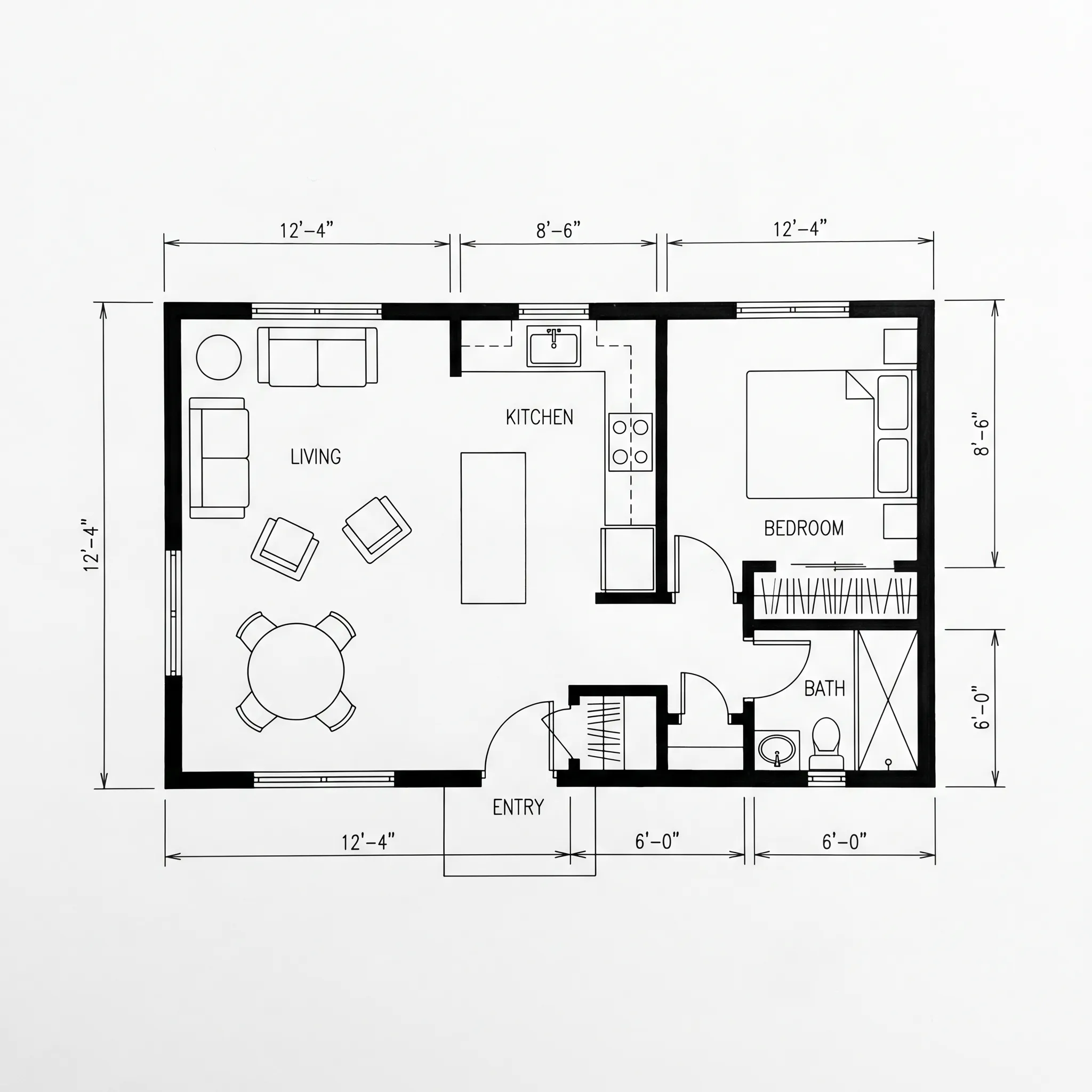
How to Turn a 2D Floor Plan Into a 3D Render With AI (5 Steps)
Turn a 2D floor plan into a 3D render with AI in 5 steps. Render a House makes a photorealistic image in 30–60 seconds, free to start.
Best AI Rendering Tools for Architects in Latin America (2026)
AI rendering tools for architects in Latin America (2026): Render a House, Veras, ArchiVinci, LookX, MyArchitectAI, Maquete. Languages, prices.
