 Render a House/Updated Sep 7, 2026
SketchUp System Requirements 2026: CPU, GPU, RAM, and the 32 GB VRAM Catch
SketchUp 2026 asks for 8 GB of RAM and a discrete GPU on both Windows and Mac — and, on Windows, up to 32 GB of VRAM if you turn on PBR materials. As of September 2026 that is more video memory than any mainstream consumer graphics card carries.
Every figure below comes from Trimble's own SketchUp hardware and software requirements page and its companion compatibility considerations article, current for SketchUp 2026. Where a number differs by release, the version-by-version table covers SketchUp 2023 through 2026.
SketchUp system requirements at a glance
Unlike Autodesk or Blender, Trimble does not publish separate Minimum, Recommended, and High-end tiers. Windows and Mac each get one "Recommended Hardware" list, and the number that actually moves between a model that opens and one that struggles is the graphics card — specifically, whether you touch PBR materials at all.
| Component | Windows 11 | macOS |
|---|---|---|
| Operating system | 64-bit Windows 11 (Windows 10 dropped at SketchUp 2026.1) | macOS 26 Tahoe, 15 Sequoia, or 14 Sonoma — macOS 13 and older unsupported |
| Processor | 2+ GHz processor | 2.1+ GHz processor, or an Apple M1 or later |
| RAM | At least 8 GB | At least 8 GB |
| Graphics card (classic renderer) | Discrete GPU, at least 8 GB VRAM, OpenGL 3.1 | GPU with at least 1 GB of memory, OpenGL 3.1 |
| Graphics card (PBR materials renderer) | At least 32 GB VRAM, DirectX 12 feature-level 11.0 | Metal 2 required; Trimble's Mac page states no separate VRAM figure |
| Disk space | At least 6 GB free | At least 6 GB free |
| Other software | .NET Framework 4.5.2, internet connection | QuickTime 5.0, Safari, internet connection |
The classic renderer floor: OpenGL 3.1 and 8 GB VRAM
SketchUp's original renderer needs OpenGL 3.1 and, per Trimble's Windows page, at least 8 GB of VRAM. On Mac the same classic renderer is listed against a much lower bar — "a modern GPU with at least 1 GB of memory." Any discrete card sold in the last decade clears the Windows figure; most Mac GPUs, including several years of integrated Intel chips, clear the Mac one.
The PBR floor: 32 GB VRAM, and only on Windows' own page
SketchUp 2024 introduced a second renderer capable of physically based (PBR) materials, ambient occlusion, and image-based lighting. On Windows, Trimble's page states plainly: a modern GPU with at least 32 GB of VRAM when interacting with models utilizing PBR texture maps. That is four times the classic-renderer figure, and it is a Windows-only number — the Mac requirements page lists no equivalent VRAM figure for PBR at all, even though the same renderer reaches Mac through Metal 2. Either Trimble considers the Mac GPU floor good enough already, or the Mac page simply hasn't been updated to match the Windows one. The documentation doesn't say which, and it is the single biggest gap in an otherwise detailed spec sheet.
Why there's no separate minimum and recommended spec
The practical read: treat 8 GB of VRAM as the floor for opening and editing any SketchUp model, and treat 32 GB as the number to budget toward only if PBR materials, HDRI environments, or imported glTF/USD assets with physically based textures are part of the job. Everything in between is headroom, not a documented tier.
Which version of Windows does SketchUp need?
SketchUp 2026 requires 64-bit Windows 11. SketchUp 2026.0 still ran on Windows 10, but Trimble's compatibility considerations page documents SketchUp 2026.1 as the point update that removed Windows 10 support. If you are still on Windows 10, SketchUp 2025 is the newest version that officially supports it.
Two Windows-specific restrictions round out the picture, both stated directly rather than inferred. First, ARM64 processors can emulate x64 in a VM on Windows 11 but are not a supported configuration — a Windows-on-ARM laptop or a Surface running Windows on Snapdragon is not a machine to buy for SketchUp. Second, SketchUp does not support a Remote Desktop Connection on any platform, citing hardware restrictions in shared environments — a constraint firms centralizing licences onto a terminal server run into immediately.
SketchUp system requirements on Mac
Minimum Mac hardware
Trimble's Mac requirements: macOS 26 (Tahoe), 15 (Sequoia), or 14 (Sonoma), a 2.1+ GHz processor or an Apple M1 or later processor, at least 8 GB of RAM, 6 GB of free disk space, and a GPU with at least 1 GB of memory for the classic renderer. The new PBR-capable renderer needs Metal 2 support, per the same compatibility page that documents the Windows DirectX 12 requirement.
Support for old macOS versions rolls forward with each release, almost always a three-version window: SketchUp 2023 added macOS 13 Ventura and dropped macOS 10.15 Catalina; 2024 added macOS 14 Sonoma and dropped 11.6 and older; 2025 added macOS 15 Sequoia and dropped 12 and older; 2026 added macOS 26 Tahoe and dropped 13 and older. A Mac still on macOS 13 today is already outside the current release's stated floor.
Apple Silicon: native since 2022, Rosetta before that
SketchUp ran under Rosetta 2 emulation on the first Apple Silicon Macs in 2020 and 2021 — usable, but translated rather than native. SketchUp 2022 is the release that shipped native Apple Silicon support, running directly on M1 and M2 chips rather than through Rosetta. Every SketchUp release since has listed "current generation Apple M1 processor" as an accepted CPU alongside the 2.1+ GHz Intel figure, which is Trimble's way of saying an M-series chip already clears the bar without a separate benchmark.
That timeline matters because it puts SketchUp ahead of most of this cluster, though the picture is more mixed than "Windows-only". Revit runs on Mac only inside a Windows virtual machine, and Lumion Pro has no Mac build at any price. But Enscape runs natively on Apple Silicon when the host is SketchUp, Rhino, Archicad, or Vectorworks — not Revit, because Revit has no Mac build to plug into — Lumion's lighter View tier ships an Apple Silicon build for the SketchUp plugin, and Twinmotion has a native Mac application — and Twinmotion is the one that still lists an Intel Mac as supported, asking for an Intel CPU scoring 2,000 or better plus a 6 GB graphics card, where Enscape and Lumion View both require Apple Silicon. SketchUp has shipped a native Mac application from the start and a native Apple Silicon build since 2022, so on a current M-series machine the modeler is rarely the constraint — the renderer you bolt onto it, and specifically whether it needs Revit as its host, is what reintroduces a Windows requirement.
The one thing Mac users still can't do: run it in a VM
The remaining wrinkle is virtualization, and it cuts the opposite way from Revit. Trimble's compatibility page states plainly that "VMWare and Parallels are not supported", with one carve-out: "For subscribers using supported versions of SketchUp, using SketchUp in virtual environments is allowed as a product-specific exception." In practice this rarely comes up, because there is no reason to run SketchUp in a VM on a Mac when the native app already exists — it is the reverse of Revit's Mac story, where Parallels is the only published path and running natively is not an option at all.
SketchUp graphics card requirements explained
Why GPU matters
SketchUp asks two different questions of a graphics card depending on which renderer is active. The classic renderer wants OpenGL 3.1, a specification old enough that essentially every GPU sold since 2010 supports it. The newer PBR-capable renderer wants DirectX 12 feature-level 11.0 on Windows or Metal 2 on Mac — both comfortably modern, and both already met by any GPU released in the last several years. The requirement that actually filters hardware is not the API version; it is VRAM.
NVIDIA vs AMD, and the cards SketchUp blocks outright
Trimble does not recommend a brand, but it does name specific integrated chips as explicitly unsupported for the new renderer: Intel HD Graphics 4x00 series on Windows, and on Mac, Intel HD Graphics 5000, HD Graphics 6000, Iris Graphics, Iris Graphics 6100, and Iris Pro Graphics. All of these are older integrated chips rather than anything AMD or Nvidia currently ships, so the practical rule is simpler than the list looks: any recent discrete AMD or Nvidia card clears the API requirement, and the integrated graphics built into a several-year-old laptop is the thing to check before buying.
One detail worth knowing before assuming a failed launch means broken hardware: if a GPU doesn't meet the new renderer's requirements, Trimble's own page states that SketchUp will default to the classic graphics setting rather than refuse to run. Older or unsupported GPUs lose PBR materials and HDRI previews, not SketchUp itself.
VRAM, the silent bottleneck
VRAM is where the two renderers pull apart hardest, and it is worth stating the comparison plainly: the PBR floor is four times the classic floor— 32 GB against 8 GB, per Trimble's own Windows page. As of September 2026, Nvidia's RTX 5090 is the only mainstream consumer GPU that reaches 32 GB of VRAM at all, and it launched at a $1,999 MSRP. Every other consumer card on the market — including cards well above $1,000 — sits below Trimble's own recommendation for the feature it built into the software three releases ago.
Recommended GPUs by use case
| What you're doing | VRAM | Notes |
|---|---|---|
| Classic renderer only — no PBR materials, no HDRI environments | 8 GB | Clears Trimble's published Windows floor exactly. Fine for opening, editing, and presenting models in flat colours and legacy textures |
| Occasional PBR previews on residential-scale models | 12–16 GB | Above the classic floor, below Trimble's 32 GB PBR figure. PBR materials still render; complex scenes may fall back to lower-resolution textures under memory pressure |
| Regular PBR/HDRI work, matching Trimble's own Windows recommendation | 24–32 GB | As of September 2026 the only mainstream consumer card that reaches 32 GB is Nvidia's RTX 5090, launched at a $1,999 MSRP — everything below it clears this tier with zero headroom to spare |
| Point clouds, heavy site scans, several linked references open at once | 32 GB+, workstation-class | Past Trimble's published ceiling. The guidance stops at 32 GB; the memory pressure from scan data does not |
Other hardware requirements
CPU
The processor bar is low and hasn't moved in years: 2+ GHz on Windows, 2.1+ GHz or an Apple M1 or later on Mac. SketchUp is not a CPU-bound modeller the way a BIM tool with a large linked federation is — most of what makes a session feel slow traces back to the GPU and to model complexity (component count, texture resolution), not to clock speed.
RAM
8 GB is Trimble's stated floor on both platforms, and it is worth treating as exactly that — a floor, not a working target. Trimble publishes no per-model-size RAM guidance the way Autodesk does for Revit, so the honest answer is to size RAM to the GPU tier you're already buying toward: see the use-case table below for the pairings that hold up in practice.
Storage
6 GB of free disk space is the stated minimum on both platforms — enough for the install itself, not for a working library of textures, HDRIs, and imported PBR material sets, which routinely run into several gigabytes on their own.
Display and input
SketchUp asks for a 3-button, scroll-wheel mouse on both platforms, and the compatibility page adds display limits many users never see documented anywhere: no 5K displays are supported, no more than one 4K display at a time, no more than two displays total, matched resolutions across displays, and 100% display scaling — anything over 150% is not supported. A single ultrawide 5K monitor, increasingly common on architects' desks, is explicitly outside Trimble's supported configuration.
Internet
Both platforms need an internet connection to install the application and authorize the subscription, and some in-app features need one continuously. Trimble also states outright that SketchUp is untested and unsupported with an eGPU attached, and that a Linux version of SketchUp isn't available — two platforms some studios assume are covered and aren't.
SketchUp system requirements by version
SketchUp ships one major version a year and keeps the last three years officially supported, retiring the oldest each January 31. Using Trimble's own three-year rule — documented via its stated example that SketchUp 2022 support ended January 31, 2025 — SketchUp 2023 fell out of support on January 31, 2026, which makes it the oldest version this table is worth listing.
| Version | Released | Windows | macOS | Renderer / GPU | Support |
|---|---|---|---|---|---|
| SketchUp 2026 | October 7, 2025 | 64-bit Windows 11 only (2026.1 is documented as the release that removed Windows 10) | macOS 26 Tahoe added; macOS 13 and older dropped | Classic: 8 GB VRAM. PBR (Windows page only): 32 GB VRAM, DirectX 12 | Current — support ends Jan 31, 2029 |
| SketchUp 2025 | February 2025 | Windows 10 or 11 | macOS 15 Sequoia added; macOS 12 and older dropped | Same DirectX 12 / Metal 2 renderer; PBR materials and HDRI environments panel added | Supported — ends Jan 31, 2028 |
| SketchUp 2024 | April 4, 2024 | Windows 10 or 11 | macOS 14 Sonoma added; macOS 11.6 and older dropped | New DirectX 12 / Metal 2 renderer introduced this release, 2.4x faster on standard hardware | Supported — ends Jan 31, 2027 |
| SketchUp 2023 | March 2023 | Windows 10 or 11 | macOS 13 Ventura added; macOS 10.15 Catalina dropped | Classic renderer only — OpenGL 3.1, no DirectX/Metal minimum | Out of support — ended Jan 31, 2026 |
Two things fall out of that table. First, the PBR renderer and its 32 GB VRAM figure are only two years old — anyone buying hardware against a SketchUp guide written before 2024 was working from the classic renderer's numbers alone. Second, the macOS floor moves every single year on a rolling three-version window, while the Windows floor moved only once in four years, at 2026.1. A Mac practice replacing hardware on a normal cycle is more likely to fall outside Trimble's stated OS support than a Windows one is.
SketchUp files travel more forgivingly than a BIM format like Revit's: Trimble has not published a policy blocking an SKP saved in a newer version from opening in an older one the way RVT does, and the practical constraint most studios hit is a missing feature (PBR materials, HDRI environments) rather than a hard refusal to open the file. Confirm behaviour for your specific version pair before relying on it, especially across the 2023/2024 renderer boundary.
Quick recommendations by use case
Trimble's own numbers cover the floor and, on Windows, the PBR ceiling. Everything in between is a judgment call about how much of that gap between 8 GB and 32 GB of VRAM your work actually reaches.
| Who you are | Machine | Target spec | Notes |
|---|---|---|---|
| Student or new user | Any Windows 11 laptop, or an Apple Silicon Mac | 8 GB RAM · 8 GB VRAM | Meets Trimble's published minimum on either platform. Leave PBR materials off |
| Solo architect, occasional PBR renders | 16-inch workstation laptop or a desktop | 16 GB RAM · 12–16 GB VRAM | Comfortably above the classic floor. PBR previews stay smooth on single-building models |
| Small firm doing client-facing PBR/HDRI work | Desktop workstation | 32 GB RAM · 24–32 GB VRAM | Approaches Trimble's own 32 GB Windows figure. No Mac-specific PBR VRAM number is published, so budget the same way |
| Interior designer working with imported glTF/USD assets | Desktop with a recent discrete GPU | 32 GB RAM · 16+ GB VRAM | PBR materials arrive through imported glTF and USD files as well as SketchUp's own libraries — imported assets are usually the heavier ones |
| Large firm, several seats plus point-cloud scans | Workstations across the team | 64 GB RAM · 24–32 GB VRAM | Past Trimble's published VRAM ceiling. Point clouds and site scans are the actual reason, not SketchUp's own geometry |
| Mac-based practice | Any Apple Silicon Mac, native app | 8 GB+ unified memory, no VM required | The one case in this whole cluster where 'does it work on Mac' has been an unqualified yes since 2022 |
Best laptops for SketchUp in 2026
Trimble does not endorse specific machines, and neither does this page. What follows is the specification to buy against at three budgets, priced as approximate street prices for a current Windows 11 or Apple Silicon machine at the time of writing — the specifications are the durable part, the prices move constantly.
| Tier | Price band | RAM | GPU / VRAM | Storage |
|---|---|---|---|---|
| Budget | ~$900–$1,300 | 16 GB | Discrete GPU, 8 GB VRAM | 512 GB SSD |
| Mid | ~$1,600–$2,400 | 32 GB | 12–16 GB VRAM | 1 TB SSD |
| Pro | ~$2,800 and up | 64 GB | 24–32 GB VRAM (mobile RTX 4000/5000-class, or a desktop RTX 5090) | 1–2 TB NVMe SSD |
Budget tier
Doubles Trimble's 8 GB RAM minimum and clears the classic-renderer floor exactly. Leave PBR materials offA 16 GB Apple Silicon MacBook Air lands in this same tier and meets the Mac-side minimum with room to spare, since Trimble's Mac page never asks for more than 1 GB of GPU memory for the classic renderer.
Mid tier
Comfortable PBR previews on typical residential and small-commercial models. This is the tier most working architects land on, and it is priced around clearing the classic-renderer floor by a wide margin rather than chasing Trimble's 32 GB PBR figure.
Pro tier
The only tier that reaches Trimble's own 32 GB PBR figure — and only with the single highest-VRAM consumer card on the market. Justified specifically by heavy PBR/HDRI presentation work or point-cloud-heavy site models — for plain modelling and classic-renderer presentation, the mid tier is already well past what SketchUp asks for.
Common hardware issues and solutions
- PBR materials look flat, or HDRI previews won't load.Almost always a GPU below the 32 GB VRAM figure on Windows. Nothing is broken — SketchUp has fallen back to the classic graphics setting, per Trimble's own documented behaviour.
- SketchUp installs but the new renderer never activates. Check the GPU against the unsupported list first — Intel HD Graphics 4x00 series on Windows, or HD Graphics 5000/6000 and the Iris family on Mac — before assuming a driver problem.
- Display looks wrong on an ultrawide or 5K monitor.Expected. Trimble's supported configuration caps out at one 4K display, two displays total, matched resolutions, and 100% scaling.
- SketchUp won't launch over Remote Desktop. By design, on every platform, citing hardware restrictions in shared environments.
- The installer refuses Windows 10. Expected on SketchUp 2026.1 and later. SketchUp 2025 is the newest version that still supports Windows 10.
- SketchUp behaves oddly running through Parallels or VMware. Both are documented as unsupported outside a subscriber-only exception — and there is rarely a reason to run it that way on a Mac, since the native application already exists.
Performance optimization tips
- Turn off PBR materials for pure modelling work.The classic renderer's 8 GB VRAM floor is a fraction of the PBR figure, and most of a modelling session doesn't touch a material preview at all.
- Match your display setup to the documented limit.A single 4K panel at 100% scaling is inside Trimble's supported configuration; a 5K ultrawide or two 4K panels are not, regardless of how capable the GPU is.
- Keep textures and HDRIs off the same drive as the installonce a project library grows past the 6 GB minimum — a nearly full boot drive degrades the same way under SketchUp's save and autosave writes as it does under any other application.
- Buy VRAM before clock speedif the budget is genuinely capped. SketchUp's CPU floor has not moved in years; its GPU floor quadrupled the day PBR materials shipped.
- Verify eGPU and Linux assumptions before you plan around them. Trimble states both are unsupported outright, not merely untested at the edges.
The cloud alternative
Every requirement on this page exists because the render happens on your machine. Move the presentation image off the machine and its GPU requirement goes with it — including the 32 GB VRAM figure that no ordinary laptop clears.
Render a House runs in the browser, so it has no GPU floor, no VRAM figure, no DirectX or Metal version, and no OS requirement at all — it works identically on the Windows 11 machine this page just specced and on a Mac running whichever macOS version is still a year away from Trimble's support window. Export the SketchUp model as an image, or as GLB, GLTF, or OBJ, and the SketchUp file viewer opens the export for camera framing and saved views — it does not open a native SKP file, and neither does anything else here. It is free to start, with 3 renders a day, and paid plans start at $39/mo.
The specific case where this beats a hardware upgrade: a firm that wants PBR-quality presentation images without buying the $1,999 GPU Trimble's own spec sheet points toward, or a mixed Windows-and-Mac studio that would otherwise need to keep two separate GPU budgets in sync with two separate published floors.
What browser rendering cannot do
It does not replace SketchUp, and treating it as a modelling tool wastes an afternoon. Browser rendering holds no SketchUp component data, no groups, no scenes, no dynamic components, and nothing that round-trips back into the SKP file. It produces a static image from geometry you already modelled, not a construction document, a validated daylight study, or a model you can keep editing. A change in SketchUp means exporting again.
What it is good at is the client-facing image, produced in seconds from a model or a screenshot you already have — the presentation pass that a GPU upgrade shouldn't be a prerequisite for.
Common questions about SketchUp hardware
What are the system requirements for SketchUp 2026?
On Windows: 64-bit Windows 11, a 2+ GHz processor, 8 GB of RAM, 6 GB of free disk space, and a discrete GPU with at least 8 GB of VRAM for the classic renderer (32 GB if you use PBR materials). On Mac: macOS 26, 15, or 14, a 2.1+ GHz processor or an Apple M1 or later, 8 GB of RAM, 6 GB of free disk space, and a GPU with at least 1 GB of memory. Both platforms need an internet connection to install and authorize the subscription.
Does SketchUp work on Mac?
Yes, natively, and it has since SketchUp began. There is a full Mac application — not a Windows build running under Parallels — and Apple Silicon has been natively supported since SketchUp 2022. That makes SketchUp one of the few professional 3D tools in this category where Mac is a first-class platform rather than a virtual machine you set up around a Windows-only product.
How much VRAM do you need to run SketchUp?
Trimble's own Windows page states 8 GB of VRAM for the classic renderer and 32 GB for the PBR materials renderer introduced in SketchUp 2024. The Mac page, covering the same PBR renderer over Metal 2, states only a 1 GB GPU-memory minimum with no separate PBR figure — an asymmetry worth knowing about before you assume the Mac requirement is lower rather than simply undocumented.
Does SketchUp 2026 run on Windows 10?
Not on the current build. SketchUp 2026.0 still ran on Windows 10, but Trimble documents the 2026.1 update as the release that removed support for it. SketchUp 2025 is the newest version still officially supported on Windows 10.
Can you run SketchUp on a Chromebook or iPad?
Not the desktop application described on this page — that needs Windows 11 or macOS. SketchUp Go, the browser-based subscription, runs in Chrome, Firefox, or Edge on a Chromebook, and separately powers the SketchUp for iPad app, which needs iPadOS 17 or later. Neither shares the desktop app's GPU or renderer requirements.
Does SketchUp need a dedicated graphics card?
Trimble's own wording is 'a graphics card that's separate from the CPU' on Windows — a discrete GPU, not an integrated one. Specific integrated chips are named as explicitly unsupported for the new renderer: Intel HD Graphics 4x00 series on Windows, and HD Graphics 5000/6000 and several Iris variants on Mac. If your GPU doesn't meet the new renderer's requirements, SketchUp falls back to the classic graphics setting rather than refusing to launch.
Costing the subscription as well as the machine? SketchUp pricing covers what Go, Pro, and Studio actually charge. The same hardware exercise exists for the modeller most often paired against SketchUp in a BIM workflow — Revit system requirements — and for the free alternative, Blender system requirements. If you're specifically comparing render engines rather than modellers, Lumion, Enscape, Twinmotion, and D5 Render each publish their own GPU floor, and none of them ask for less than SketchUp's classic renderer or more than its PBR ceiling. Rhino system requirements is the closest comparison on the modeling side — another cross-platform modeler, and another case where the published floor is far lower than what its own renderer needs. SketchUp's release notes are where to confirm which point update you're running before matching it to a row above, and SketchUp Go's own FAQ covers the browser and iPad requirements this page doesn't.
Keep reading
Related guides and comparisons
ChatGPT for architectural rendering: does it work?
Partly. ChatGPT is great for a fast concept image, but edits drift and it can't keep several renders of one project consistent. Render a House can.
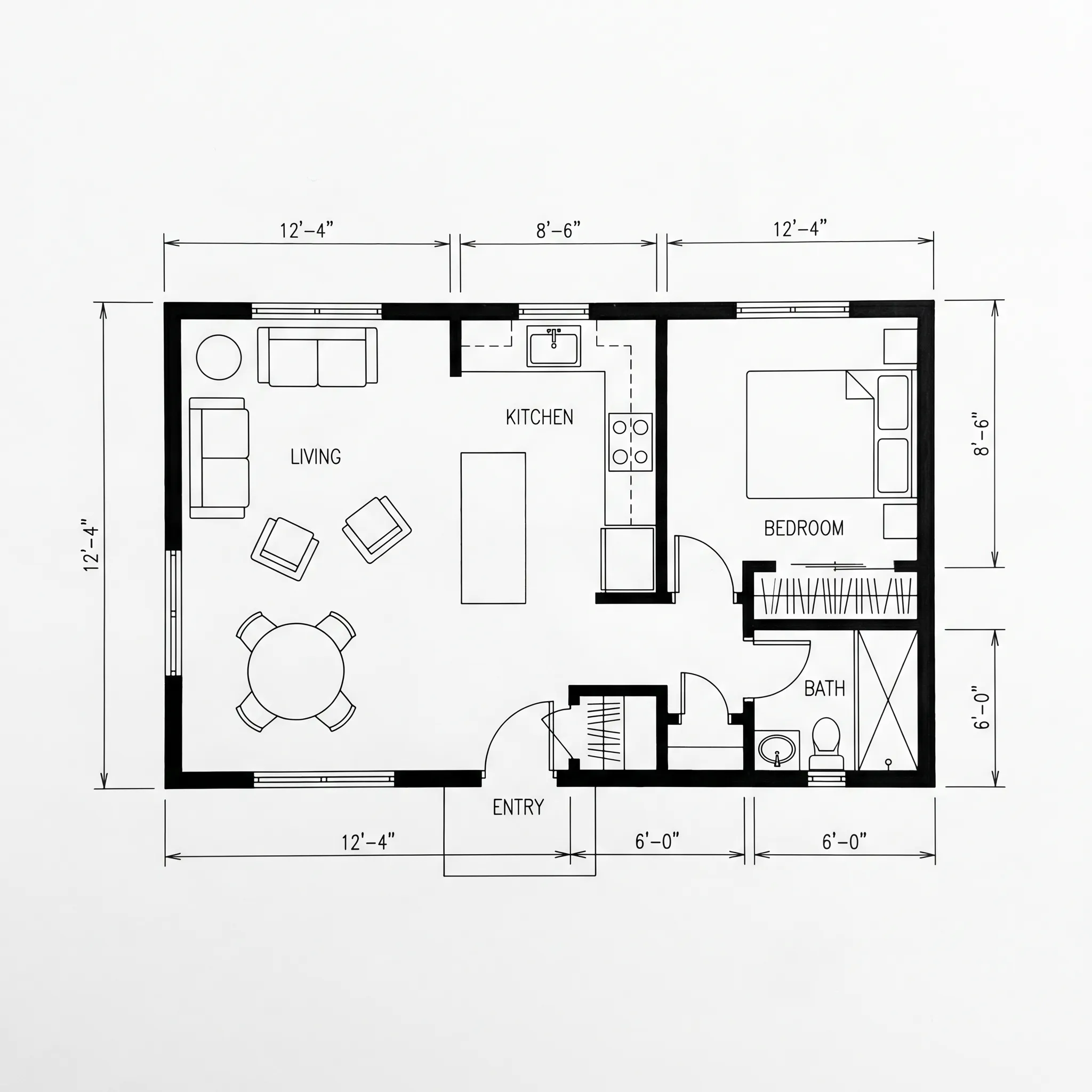
How to Turn a 2D Floor Plan Into a 3D Render With AI (5 Steps)
Turn a 2D floor plan into a 3D render with AI in 5 steps. Render a House makes a photorealistic image in 30–60 seconds, free to start.
Best AI Rendering Tools for Architects in Latin America (2026)
AI rendering tools for architects in Latin America (2026): Render a House, Veras, ArchiVinci, LookX, MyArchitectAI, Maquete. Languages, prices.
