 Render a House/Updated Sep 7, 2026
D5 Render System Requirements: D5 3.1 GPU, RAM, and Why There's No Mac Build
D5 Render 3.1 needs a ray-tracing GPU — Nvidia GTX 1060, Intel Arc 3, or AMD RX 6400 at minimum — running 64-bit Windows 10 version 1809 or newer. There is no macOS build and no CPU-only fallback: D5 depends on Microsoft's DirectX Raytracing API, which has no equivalent on Apple's operating system.
Every figure below comes from D5's own system requirements page, which D5 last dated 6 August 2025 — a date that sits before both of D5's two most recent major releases, D5 3.0 (5 March 2026) and D5 3.1 (15 July 2026, the current release). Neither release announcement mentions a change to the hardware floor, and D5 hasn't republished the requirements page since — so the figures here are the best published answer, not a guarantee that D5 re-verified them against the version you're about to install. Pricing for the same release is covered separately in D5 Render pricing.
D5 Render system requirements at a glance
D5 publishes three tiers for its graphics card — Minimum, Recommended, and Optimal — but only two for CPU and RAM. There's no published Minimum CPU or Minimum RAM figure at all; D5's Minimum tier is defined entirely by which GPU you own.
| Component | Minimum | Recommended | Optimal |
|---|---|---|---|
| Operating system | 64-bit Windows 10, version 1809, or newer | 64-bit Windows 10, version 1809, or newer | 64-bit Windows 10, version 1809, or newer |
| Graphics card | Nvidia GTX 1060 · Intel Arc 3 · AMD RX 6400 | Nvidia RTX 3060 (Ti) | Nvidia RTX 3090 |
| Graphics card memory | Not stated by D5 for this tier | Not stated by D5 — RTX 3060 Ti ships with 8 GB per Nvidia's own spec | Not stated by D5 — RTX 3090 ships with 24 GB per Nvidia's own spec |
| CPU | Not published | Intel Core i5-11400 or AMD Ryzen 3 5300G | Intel Core i9-13900K or AMD Ryzen 9 7950X |
| RAM | Not published | 32 GB (16 GB × 2), DDR4 | 128 GB (32 GB × 4), DDR5 |
Minimum: the DXR floor
A GPU that supports DirectX Raytracing — D5 names the Nvidia GTX 1060, Intel Arc 3, and AMD RX 6400 as reference points — on 64-bit Windows 10 version 1809 or newer. D5 publishes no VRAM, CPU, or RAM figure for this tier at all, which makes it the hardest row in this specification to size against a specific machine before you've already installed D5 on it. The GTX 1060 itself shipped in both 3 GB and 6 GB versions, and D5 doesn't say which one it means.
Recommended: everyday scenes
An RTX 3060 or RTX 3060 Ti, 32 GB of RAM (as two 16 GB DDR4 sticks), and a CPU around the level of an Intel Core i5-11400 or AMD Ryzen 3 5300G. D5 sizes this tier for everyday scene editing on a residential building or interior — the work most of this page's readers are actually doing.
Optimal: masterplans and animation
An RTX 3090, 128 GB of RAM (as four 32 GB DDR5 sticks), and a CPU around the level of an Intel Core i9-13900K or AMD Ryzen 9 7950X. D5 attaches this tier to the scenes its own FAQ singles out as VRAM-heavy — aerial rendering and urban planning — rather than to a specific project size the way Lumion or Twinmotion phrase their top tier.
Why D5 Render asks for more GPU than Lumion or Enscape
Compare D5's Minimum tier to Lumion's or Twinmotion's, and the difference is structural, not just a bigger number. Both of those renderers score the GPU by a general benchmark — PassMark's G3DMark — that any dedicated card can clear at some tier, including ones with no ray-tracing hardware at all. D5 doesn't offer that door. Its own system requirements page states the reason plainly: D5 "is a GPU-based renderer that is built on DXR and ray-tracing technology," and ray tracing "requires both GPU and the operating system to have corresponding modules." A card without DXR support can't run D5 at any tier, full stop — there's no rasterization-only fallback mode to drop into.
That's a narrower door than it looks, because DXR support and raw GPU age don't move together in a straight line. D5's own FAQ names the GTX 1050 and GTX 1650 as explicitly unsupported, for the specific reason that they lack DXR support — despite sitting in the same GeForce GTX family, at a similar performance class, to the GTX 1060 D5 lists as its Minimum tier. Buying by GPU family name, the way you might for a CPU, doesn't work here; buying by DXR compatibility does.
Does D5 Render work on a Mac?
No, and D5 gives no target date for changing that. Its own system requirements FAQ answers the question directly: "Apart from support for ray tracing, D5 is based on Windows DirectX12 (DX12) technologies, which conflicts with Apple's macOS operating system. Therefore, we don't have an estimated date for D5 on Mac, but we do have the plan to come to more Mac users." That's an aspiration, not a roadmap item — no beta, no preview build, and no CPU-only rendering mode the way a product-design renderer like KeyShot offers as a slower Mac fallback.
On Parallels, VMware Fusion, or Boot Camp specifically, D5 is silent rather than negative. That's worth stating plainly because it's a different answer than the closest comparison in this cluster: Lumion's own knowledge base names Parallels and VMware Fusion directly and says running Lumion inside either one "will cause crashes, glitches and License Key lock-ups." D5's published Mac answer never mentions virtualization at all — it addresses only a native macOS build. Running Windows-on-Mac virtualization to reach D5's DXR requirement is untested by D5's own documentation, not confirmed working and not confirmed broken.
How D5 Render shares system RAM with the GPU
D5's requirements page includes a genuinely unusual piece of arithmetic most rendering vendors never publish. When a scene asks for more video memory than the card physically has, Windows converts part of system RAM into shared GPU memory as a fallback. D5 states the exact fraction and gives it as a formula: GPU Memory = Dedicated GPU memory (VRAM) + RAM × 50%.
D5 backs the formula with its own worked example: it reports users "see a nice overall performance of D5 when they are using RTX 3050 4GB, with 32GB of RAM." Run that exact pairing through D5's own equation — 4 GB of VRAM plus 32 GB of RAM at 50% — and it computes to 4 + (32 × 0.5) = 20 GBof usable GPU memory. That's not a rounding trick: 20 GB sits closer to an RTX 3090's own 24 GB of dedicated VRAM, per Nvidia's own spec, than to the 4 GB card that's actually installed. It's also why the Recommended tier's 32 GB figure is doing real work covering for a modest GPU, not padding a spec sheet the way a flat RAM tier sometimes does.
The trade D5 doesn't spell out is speed. Shared GPU memory over the PCIe bus is measurably slower than VRAM sitting on the card's own circuit board — D5's formula tells you how much memory you get, not how fast it behaves once you're drawing on the RAM half of it.
D5 Render graphics card requirements explained
NVIDIA, AMD, and Intel Arc: who's actually supported
D5's own FAQ answers the RTX-only question directly: "No. D5 is not RTX-only software. You can run D5 on NVidia, Intel, AMD and other graphics cards as long as they support Ray Tracing technology." It adds that AMD's Radeon RX series "works well" now, alongside the earlier Nvidia-first optimization work. Intel Arc 3 — the entry tier of Intel's discrete Arc lineup — sits in the Minimum row next to the GTX 1060 and RX 6400. What D5 never lists as a supported category is integrated graphics of any brand; every named GPU across all three tiers is a discrete card.
VRAM, not raw speed, is the real bottleneck
D5's own certification FAQ makes the VRAM case with a single comparison. Discussing the RTX 3060 versus the RTX 3060 Ti, it notes the Ti scores about 35% higher on D5's own user benchmark, but "3060 comes with 12 GB VRAM, so it's capable of loading a large scene file (aerial rendering, urban planning visualization)." Speed and capacity move in different directions across that pair — a fact this page returns to below, because it's the closest thing D5's own documentation has to a contradiction.
Which GPU to buy, by what you render
| What you render | GPU | Notes |
|---|---|---|
| Evaluating D5 or a single small interior on the free Community tier | GTX 1060, Intel Arc 3, or AMD RX 6400 | D5's own Minimum tier. No VRAM figure is published for this row — budget 6 GB or more if you're buying new |
| A residential exterior or interior, day-to-day scene editing | RTX 3060 or RTX 3060 Ti | D5's Recommended tier. Its own FAQ notes the plain 3060 carries 12 GB of VRAM against the Ti's faster core — see the VRAM section below |
| Aerial views, urban planning, or a large multi-building scene | RTX 3090 or newer 24 GB-class card | D5's Optimal tier. The 24 GB figure comes from Nvidia's own spec for the RTX 3090, not from D5, which names the card without a VRAM number |
| A modest GPU paired with a lot of system RAM | RTX 3050 (4 GB) + 32 GB RAM | D5's own worked example for the GPU-memory-sharing formula — see below for the arithmetic |
What else D5 Render needs — and what it doesn't say
CPU
Recommended is an Intel Core i5-11400 or AMD Ryzen 3 5300G; Optimal is an Intel Core i9-13900K or AMD Ryzen 9 7950X. D5 explains why the CPU matters at all even though rendering itself runs on the GPU: the CPU handles "D5's interaction and game thread" — loading scene files, analyzing material maps, processing meshes, and running the scattering tools' placement math. There is no published Minimum-tier CPU; D5's Minimum row names only a GPU and an operating system version.
RAM
32 GB at Recommended, 128 GB at Optimal, and — as with CPU — no published Minimum figure. D5 frames the jump to 128 GB as serving the GPU-memory-sharing formula above as much as conventional multitasking: more RAM directly raises the usable GPU memory ceiling on any card, not only the flagship one.
Storage, display, and internet: unpublished
D5's system requirements page has no storage, no display resolution, and no internet-speed requirement anywhere in it — not at any tier. That's a real gap against the closest comparisons in this cluster: Lumion publishes a specific 105 GB disk figure tied to the drive holding your Windows user account, and Twinmotion documents its own storage and display minimums. For D5, budget disk space the way you would for any asset-heavy application — the 16,000+ official assets, D5 Works downloads, and local scene caches all consume real space — but there is no published number to hold D5 to. An internet connection is clearly required for account login, cloud workspace sync, and D5 Works downloads, but D5 doesn't publish a minimum connection speed for any of it.
D5 Render system requirements by version
D5 doesn't maintain a public archive of GPU/RAM figures by version the way Lumion or Twinmotion do — there is one current requirements page, not a history of past ones. What D5 does publish, release by release, is what changed feature-wise, which is what the table below tracks instead.
| Version | Released | What changed | Hardware note |
|---|---|---|---|
| D5 3.1 | 15 July 2026 | Interactive Presentation, D5 Lite for Rhino and Revit, Cloud Collaboration, ACEScg color space, seasonal vegetation, HeightField Tracing | No new hardware figures published alongside this release |
| D5 3.0 | 5 March 2026 | 15+ built-in AI features (AI Scene Match, AI Asset Recommendation, AI Image to 3D), D5 Works integrated into the launcher | No new hardware figures published alongside this release |
| D5 2.10 | 14 March 2025 | Real-time path tracing, City Generator, AI-assisted post-processing, procedural night sky | The release that made real-time path tracing — not just rasterized reflections — a core feature, raising the practical case for the RTX 3060 Ti-and-above tier |
| D5 2.9 and earlier | Before March 2025 | Pre-path-tracing releases; LiveSync plugins gate on this era for SketchUp (2.5+), 3ds Max (2.6+), Rhino and Vectorworks (2.7+) | D5 doesn't publish a historical GPU/RAM table for these releases — see the note below on why downgrading isn't a real fix |
The one milestone worth calling out is D5 2.10, released 14 March 2025, which introduced real-time path tracing as a core feature rather than an experimental toggle. That's the point where the RTX 3060 Ti-class Recommended tier stopped being generous headroom and started being the realistic floor for the feature D5 now markets hardest.
On downgrading to dodge the GPU requirement: D5 doesn't publish a scene-file compatibility policy in either direction — it never states whether a project saved in D5 3.1 opens in an older release, or vice versa. What D5 does document is a set of hard version floors on its own LiveSync plugins: the SketchUp plugin needs D5 2.5 or above, 3ds Max needs 2.6 or above, and Rhino and Vectorworks need 2.7 or above. Installing an older D5 release to run on weaker hardware means losing sync with whatever current version of your CAD software you're actually running — the same shape of problem Revit users hit when RVT files won't travel backward, just enforced from the plugin side instead of the file format. Running D5 at its published Minimum tier, or moving the render step off local hardware entirely, are both more reliable fixes than reaching for an older installer.
The two floors: D5's Recommended GPU has less VRAM than its own FAQ example
D5's own documentation contains a small, checkable contradiction once you put its Recommended-tier GPU next to its own FAQ. D5 names the RTX 3060 Ti as the Recommended card and states it benchmarks about 35% faster than the plain RTX 3060. But the plain RTX 3060, per D5's own text, "comes with 12 GB VRAM," and per Nvidia's own product page for the pair, the RTX 3060 Ti ships with 8 GB. The card D5 names as Recommended has a third less VRAM than the card it's recommended over.
That matters because D5's own criterion for when VRAM starts to bind — "aerial rendering, urban planning visualization" — is exactly the category of scene where a faster core with less memory can stall while a slower core with more memory keeps loading. D5's own advice in that FAQ entry, read straight, is to buy the plain 3060 over the Ti for large scenes and eat the 35% speed difference — which sits oddly next to a requirements page that lists the Ti, not the plain 3060, as the named Recommended tier. Neither card is wrong to buy; the spec sheet and the FAQ simply optimize for different things, and D5 doesn't reconcile the two anywhere on the same page.
Quick recommendations by use case
| Who you are | Machine | Target spec | Notes |
|---|---|---|---|
| Student or first-time evaluator | Any Windows PC with a ray-tracing GPU | GTX 1060-class GPU, D5 Community (free) | Clears D5's Minimum tier. No VRAM figure is published, so buy 6 GB or more if the machine is new |
| Solo freelancer | Desktop or workstation laptop | RTX 3060 (Ti)-class GPU · 32 GB RAM | D5's Recommended tier — sized for a single detailed building rendered and edited daily |
| Interior designer | Desktop with a modern Nvidia GPU | RTX 3060 Ti or better · 32 GB RAM | Interiors lean on material and texture memory as much as geometry, which is exactly what D5's VRAM-sharing formula below exists to cover |
| Large firm or studio | Shared render workstations | RTX 3090-class GPU · 64–128 GB RAM | D5's Optimal tier — aerial views, urban planning, and multi-building masterplans live here |
| Mac-based practice | No supported configuration | — | D5 has no macOS build, no CPU-only fallback, and no published date for one — see the Mac section below |
Buying hardware for D5 Render in 2026
D5 doesn't endorse specific machines, and no laptop SKU price has held steady long enough across this cluster to be worth quoting here — GPU generations and street prices both move faster than this page can track. The specifications below are the durable part.
A Minimum-tier build needs a discrete GPU with confirmed DXR support — a GTX 1060, Intel Arc 3, or AMD RX 6400 or newer — since D5's own FAQ names similarly aged cards like the GTX 1050 and 1650 as unsupported specifically for lacking that feature. A Recommended-tier build centers on an RTX 3060 or 3060 Ti with 32 GB of RAM, sized for the everyday residential and interior work most readers of this page are actually doing. An Optimal-tier build adds an RTX 3090-class card and scales RAM toward 128 GB, justified by aerial-scale or urban-planning scenes rather than by wanting the biggest number on a spec sheet. In every case, confirming DXR support for the specific card model — not just recognizing the GPU family name — is the check that actually matters, per the RTX 3060/3060 Ti and GTX 1050/1650 examples above.
Common D5 Render hardware problems
- D5 won't install or launch at all.Check whether the GPU supports DXR specifically, not just whether it's a recent-looking card — D5's own FAQ names the GTX 1050 and 1650 as unsupported for exactly this reason, despite being close relatives of the supported GTX 1060.
- Scenes stutter or textures load slowly on a modest GPU. Almost always VRAM pressure rather than a driver fault. Run D5's own formula — VRAM plus half of system RAM — against your actual hardware before assuming the GPU itself is too weak; more RAM raises the ceiling on any card.
- D5 crashes or won't start on a Mac. Expected — there is no native build, and D5's own documentation doesn't confirm any virtualized path as supported.
- Performance is worse after switching from an RTX 3060 to a 3060 Ti. Check scene complexity against VRAM, not just clock speed — per D5's own FAQ, the Ti's 8 GB can be the binding constraint on aerial or urban-scale scenes where the plain 3060's 12 GB has more room.
- LiveSync stops working after downgrading D5. Expected if the installed CAD plugin version needs a newer D5 release than the one you rolled back to — D5's own download page states explicit minimum-version floors per host application.
Getting more out of the hardware you already have
- Confirm DXR support before buying, not the GPU brand. D5's own unsupported-card list (GTX 1050, GTX 1650) proves family name and generation aren't reliable proxies for ray-tracing support.
- Add RAM before replacing the GPU.D5's own formula makes system RAM a direct lever on usable GPU memory — the cheaper upgrade path when a scene is VRAM-bound, not GPU-bound.
- Keep GPU drivers current.D5's own hardware guidance repeats this at every tier, framing it as a stability fix as much as a performance one.
- Size the GPU to VRAM capacity for your typical scene, not to the benchmark score. D5's own 3060-versus-3060-Ti example is the clearest case in its documentation of a faster card losing to a higher-capacity one on a large scene.
- Don't downgrade D5 as a hardware workaround. D5 publishes no scene-file compatibility guarantee across versions, and its own LiveSync plugins enforce minimum-version floors that an older installer will fail.
The cloud alternative
Every requirement on this page exists because D5 renders in real time on a local, DXR-capable GPU. Remove that step and the GPU floor, the VRAM math, and the Windows-only requirement all go with it.
Render a House closes the specific gap D5 cannot close on its own: it runs in a browser, so it needs no dedicated GPU, no DXR support, and no Windows install — including on the Mac that D5 has no estimated date for supporting, in any form. Upload an exported image, a screenshot of a D5 scene, or a floor plan, and it returns a photorealistic concept image without asking what card is inside the machine. It's free to start, with 3 renders a day, and paid plans run $39/mo or $312/yr— full plan details are in the pricing docs.
The clearest use case is the same mixed-hardware team problem that shows up across this whole cluster: a firm running D5 on a Windows workstation for client walkthroughs, where a Mac-based designer or a laptop without a discrete GPU still needs to produce or review a still concept image without waiting for the D5 machine to free up.
What a real-time viewport does that this can't
It is not a substitute for D5, and the honest answer is what D5 does that this doesn't. D5 gives you a live, real-time viewport — move the camera and the image updates immediately, with path-traced reflections, adjustable materials, and City Generator context you can walk through before committing to a shot. Render a House has no viewport at all: no camera you can move, no scene you can edit, no walkthrough, and no VR export. It takes a flat image or an exported view — never a native SketchUp, Revit, Rhino, or Archicad project file directly — and generates a still. If the deliverable is an interactive client presentation or an animation, D5's real-time engine is the right tool and no browser-based generator replaces it. If the deliverable is a single photorealistic still and standing up a full D5 scene is more setup than the output is worth, that's the gap this fills.
Common questions about D5 Render hardware
What are the minimum system requirements for D5 Render?
A ray-tracing GPU — D5 names the Nvidia GTX 1060, Intel Arc 3, or AMD RX 6400 as its Minimum tier — running 64-bit Windows 10 version 1809 or newer, because D5 depends on Microsoft's DirectX Raytracing (DXR) API. D5 does not publish a minimum CPU, minimum RAM, or minimum VRAM figure at this tier; its own system requirements page only names the GPU model and the operating system version.
How much VRAM do you need for D5 Render?
D5 never states a VRAM number directly — it names GPU models instead. The clearest figure comes from D5's own FAQ, which notes its Recommended-tier card, the RTX 3060, carries 12 GB of video memory. D5's own formula for effective GPU memory is VRAM plus half of system RAM, so a 4 GB card with 32 GB of RAM computes to 20 GB of usable GPU memory by D5's own math — VRAM alone isn't the whole picture.
Does D5 Render work on a Mac?
No, and D5 gives no date for when it might. D5's own FAQ says plainly that D5 "is based on Windows DirectX12 (DX12) technologies, which conflicts with Apple's macOS operating system," and that D5 has "no estimated date for D5 on Mac." There is no CPU-only fallback mode the way some product-design renderers offer.
Can you run D5 Render in Parallels or Boot Camp on a Mac?
D5 doesn't say, in either direction. Unlike Lumion, whose knowledge base explicitly names Parallels and VMware Fusion as unsupported and describes the exact crash behavior, D5's published Mac FAQ only addresses a native macOS build — it never mentions Parallels, VMware Fusion, or Boot Camp at all. Running D5 through Windows-on-Mac virtualization is untested territory by D5's own documentation, not a confirmed path either way.
Is D5 Render RTX-only?
No. D5's own FAQ states it directly: "D5 is not RTX-only software. You can run D5 on NVidia, Intel, AMD and other graphics cards as long as they support Ray Tracing technology," naming the AMD Radeon RX series specifically as now working well. What D5 does rule out are cards without DXR support at all — its FAQ names the GTX 1050 and GTX 1650 as explicitly unsupported for that reason, despite sitting in the same GTX family as the GTX 1060 D5 lists as its Minimum tier.
How much RAM does D5 Render need?
D5 publishes two tiers, not three: 32 GB (as 16 GB × 2 DDR4) at Recommended, and 128 GB (as 32 GB × 4 DDR5) at Optimal. There is no published Minimum RAM figure — D5's Minimum tier is defined by the GPU model alone. D5's own reasoning for the Recommended figure is its GPU-memory-sharing formula: when a scene needs more video memory than the card has, Windows converts roughly half of system RAM into shared GPU memory, so more RAM directly covers for a smaller card.
Related D5 Render and hardware pages
Every reference below is verified against the vendor's own pricing or documentation page, the same standard this page holds itself to.
- D5 Render pricing covers what Community, Pro, and Teams actually cost, and how the free tier's non-commercial restriction changes what "free" means before you size hardware against it.
- Lumion system requirements and Twinmotion system requirements cover the two other real-time renderers architects compare against D5 most often, and Enscape system requirements and V-Ray system requirements cover the CAD-embedded and offline-production alternatives to a standalone real-time renderer.
- Revit system requirements, Archicad system requirements, Rhino system requirements, SketchUp system requirements, and Blender system requirements cover the modelers most D5 projects start from.
- Lumion pricing, Enscape pricing, V-Ray pricing, Twinmotion pricing, and KeyShot pricing cover the other renderers architects shortlist against D5.
- SketchUp pricing, Revit pricing, Rhino pricing, Archicad pricing, Vectorworks pricing, and Chief Architect pricing cover the CAD and BIM packages D5's free LiveSync plugins connect to.
- Topaz AI pricing and Magnific AI pricing cover the two AI upscalers most often paired with a D5 render for final delivery, and Render a House's AI image upscaler cleans up an existing D5 render or screenshot without re-rendering the scene.
Keep reading
Related guides and comparisons
ChatGPT for architectural rendering: does it work?
Partly. ChatGPT is great for a fast concept image, but edits drift and it can't keep several renders of one project consistent. Render a House can.
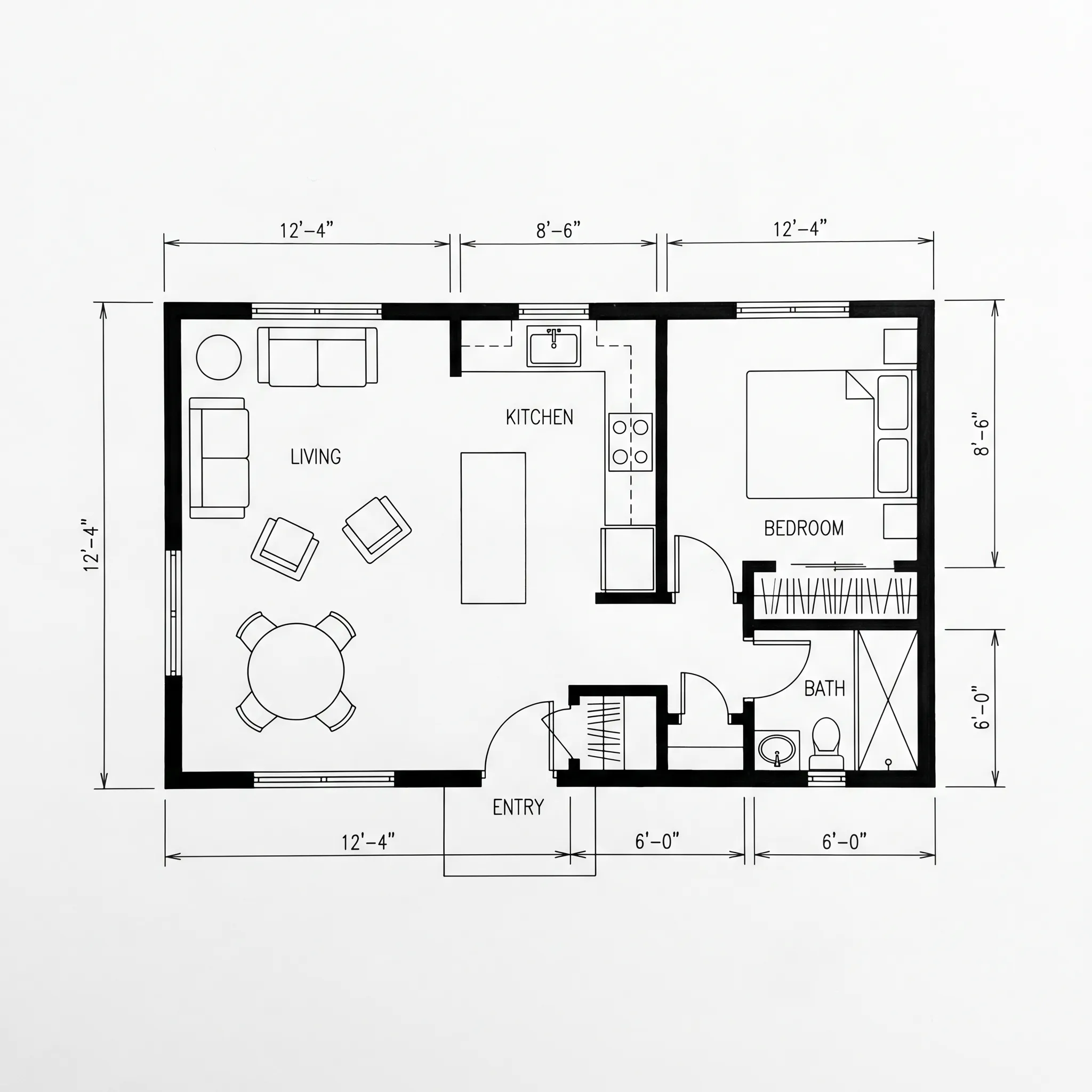
How to Turn a 2D Floor Plan Into a 3D Render With AI (5 Steps)
Turn a 2D floor plan into a 3D render with AI in 5 steps. Render a House makes a photorealistic image in 30–60 seconds, free to start.
Best AI Rendering Tools for Architects in Latin America (2026)
AI rendering tools for architects in Latin America (2026): Render a House, Veras, ArchiVinci, LookX, MyArchitectAI, Maquete. Languages, prices.
