 Render a House/Updated Oct 18, 2026
Mid-Century Modern Living Room: Ideas, Furniture and Colors
A mid-century modern living room uses low furniture on slim legs, warm teak or walnut, one or two sculptural classics and big windows — the look of roughly 1945 to 1970. Render a House lets you preview it on your own room before you buy anything.
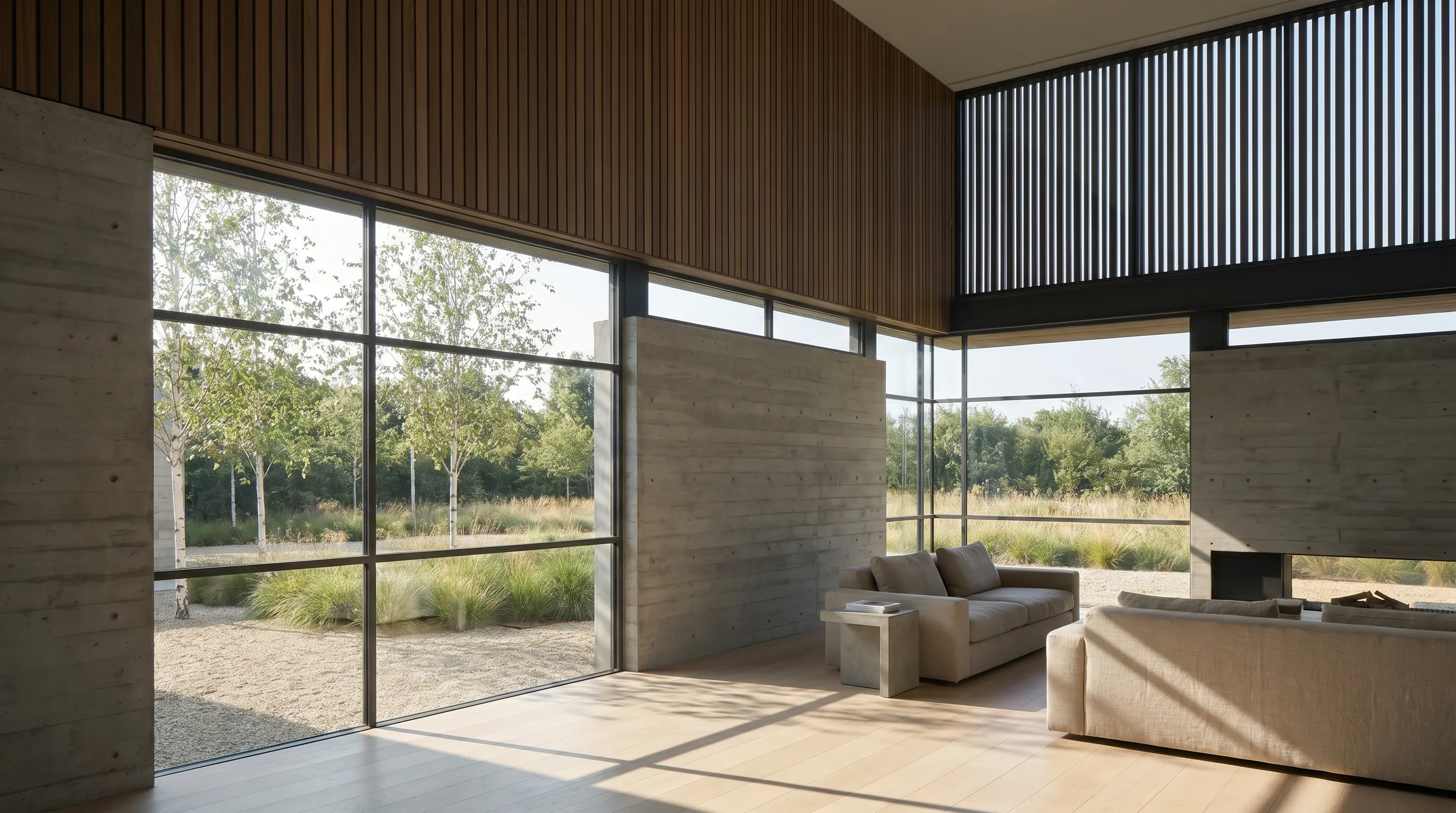
A mid-century modern living room is a room furnished in the design language popular from roughly 1945 to 1970: clean, simple lines, honest materials and no added ornament. In practice that means a low sofa on tapered legs, a teak or walnut credenza, an organic coffee table, one statement chair such as the 1956 Eames Lounge Chair, and an uncluttered floor that runs toward a large window. Render a House is the quickest way to test the look on your own space: upload a photo, sketch or 3D model of the room to the AI living room design tool, describe the furniture and finishes in plain words, and get a photoreal concept in about 30-60 seconds.
Quick answer: to create a mid-century modern living room, (1) pick one warm wood — teak or walnut — for the big pieces, (2) choose low, horizontal furniture raised on slim legs, (3) add one sculptural classic such as an Eames Lounge Chair (1956), a Noguchi Table (1947) or a Womb Chair (1948), (4) keep walls neutral and add one or two accents like mustard, olive or teal, and (5) leave the window wall clear so the room opens to the outdoors.
What is a mid-century modern living room?
Mid-century modern (MCM) is a style of design popular in the middle of the twentieth century, characterized by clean, simple lines and a lack of embellishment. Wikipedia places its peak in North America, Brazil and Europe from roughly 1945 to 1970, and notes that the design writer Cara Greenberg defined it as a movement in her 1984 book Mid-Century Modern: Furniture of the 1950s (Wikipedia, checked October 2026).
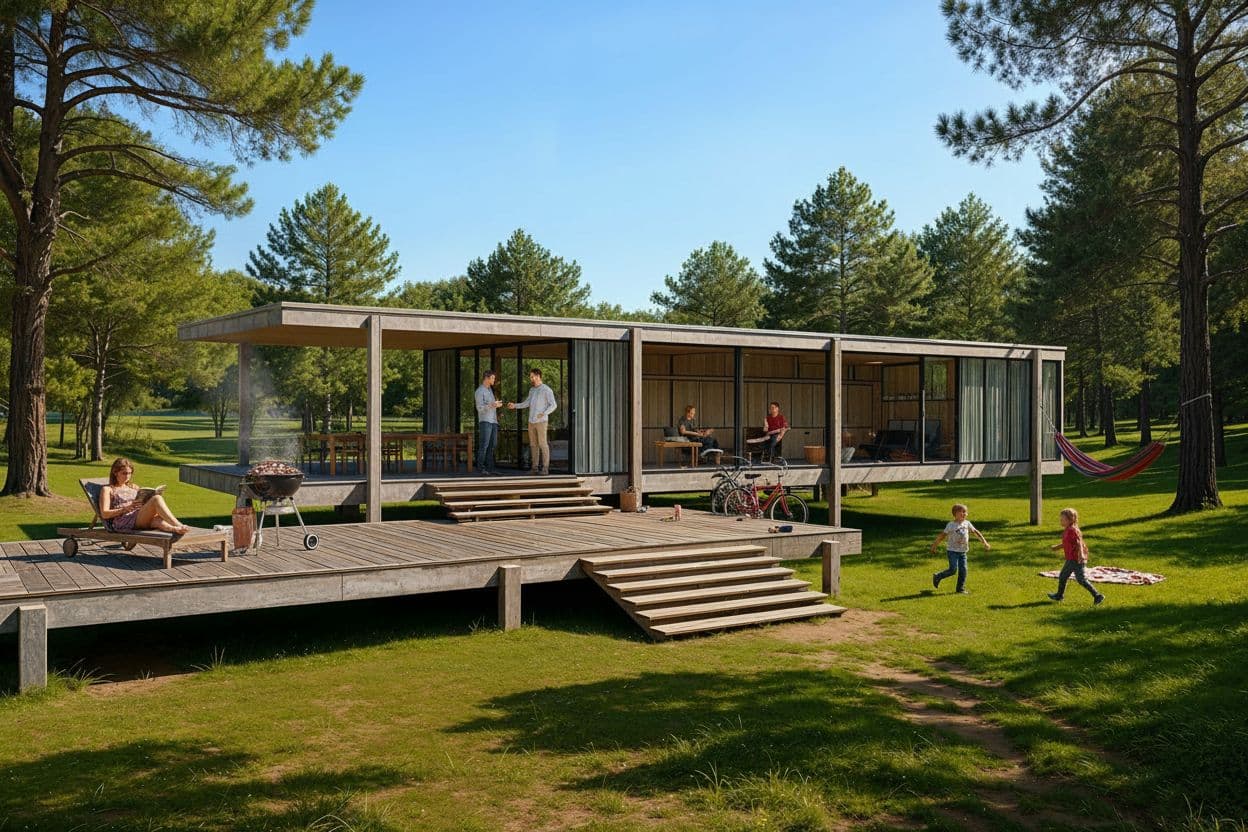
A living room is where the style shows most. The period's houses were wide and low, with floor-to-ceiling glass and open plans, so the furniture followed: pieces stayed low to keep sightlines to the garden, sat on legs to keep the floor visible, and used new manufacturing — molded plywood, fiberglass, cast aluminum — to make sculptural shapes affordable. The American branch, built around makers such as Herman Miller and Knoll, ran in parallel with Danish modern, which leaned on teak and bent plywood.
Today the term covers three kinds of room: authentic vintage rooms, rooms built around licensed reissues of classic designs, and rooms that borrow the shapes and palette with contemporary furniture. All three are valid. The rest of this guide shows what makes each read as mid-century, and where the look tips into a theme set. If you are working on the whole house rather than one room, the companion guide to the mid-century modern house covers architecture and exterior details.
What are the defining elements of a mid-century modern living room?
Seven elements do most of the work. A room with five of them reads as mid-century even when none of the furniture is vintage; a room with one famous chair and none of the others usually reads as a room with a famous chair in it.
| Element | What it looks like | How to apply it |
|---|---|---|
| Low, horizontal furniture | Sofas, credenzas and media units sit low and read as long lines. | Choose a sofa with a low back and a credenza or sideboard instead of a tall wall unit. |
| Raised legs | Tapered wood legs, hairpin or metal bases lift pieces off the floor. | Lets the floor run under the furniture, which makes the room feel larger. |
| Warm wood | Teak, walnut and rosewood veneers, often with visible grain. | Pick one dominant wood tone for the big pieces. |
| Organic, sculptural shapes | Curved plywood, biomorphic table bases, pedestal bases, shell chairs. | One sculptural piece per room usually carries the look. |
| Big glass and daylight | Floor-to-ceiling windows and a direct view to the garden. | Keep window walls clear; face seating toward the view. |
| No added ornament | Clean, simple lines and honest materials instead of carving or trim. | Skip heavy moldings, fringe and tufted traditional upholstery. |
| Saturated accents | Mustard, olive, orange, teal against neutral walls. | Limit accents to textiles, art and one statement chair. |
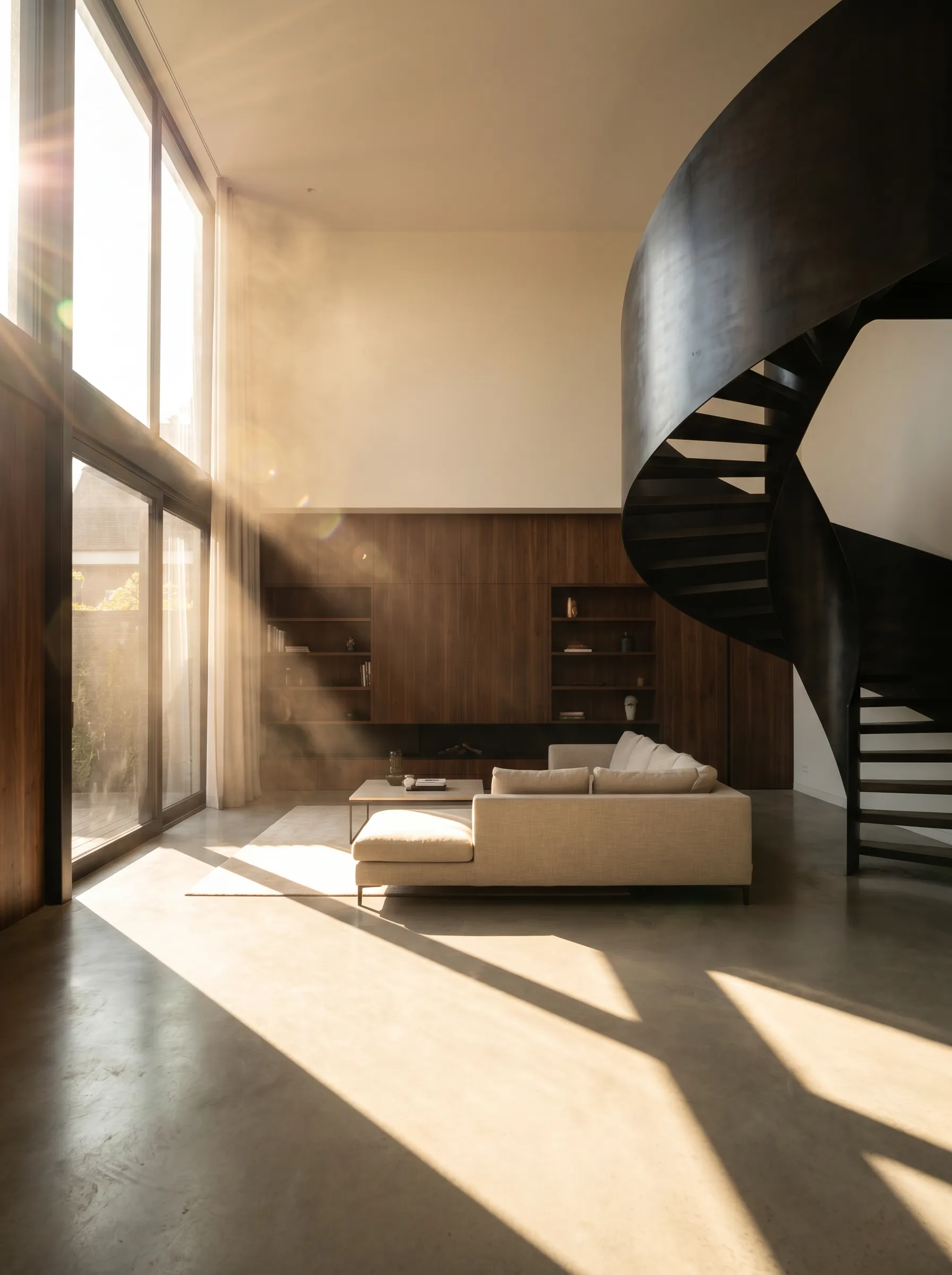
The two that matter most are scale and legs. Mid-century seating is lower than most current sofas, and almost every case piece — the credenza, the side table, the media unit — floats on legs or a plinth set back from the edge. Fix those two and the room already changes character before any color goes on the wall.
Which iconic furniture defines a mid-century modern living room?
A handful of designs from the 1940s to the early 1960s are what most people picture when they hear "mid-century modern". Most are still produced by their original manufacturers. The table lists designer and date from the maker's own page where it publishes one, otherwise from Wikipedia. Prices are left out on purpose: they vary by finish and change often, so check the maker's page for the current figure.
| Piece | Designer | Date | Maker | Source |
|---|---|---|---|---|
| Eames Lounge Chair and Ottoman | Charles and Ray Eames | Introduced 1956 | Herman Miller | Herman Miller |
| Womb Chair | Eero Saarinen | Designed 1948 | Knoll | Knoll |
| Noguchi Table | Isamu Noguchi | Introduced 1947 | Herman Miller | Wikipedia |
| Nelson Platform Bench | George Nelson | Designed 1946, launched 1947 | Herman Miller | Herman Miller |
| Wishbone Chair (CH24) | Hans J. Wegner | Designed 1949 | Carl Hansen & Søn | Wikipedia |
| Eames Molded Fiberglass Chair | Charles and Ray Eames | 1950 | Herman Miller | Herman Miller |
| Tulip (Pedestal) chair | Eero Saarinen | Designed 1955–1956 | Knoll | Wikipedia |
| Egg chair | Arne Jacobsen | Designed 1959 | Fritz Hansen | Wikipedia |
| Arco floor lamp | Achille and Pier Giacomo Castiglioni | 1962 | Flos | Wikipedia |
Lounge seating: the Eames Lounge Chair, Womb Chair and Egg
The Eames Lounge Chair and Ottoman by Charles and Ray Eames is the most recognized mid-century living room piece. Herman Miller says that when the set was introduced in 1956 "there was nothing like it", describing it as a modern take on a nineteenth-century club chair. The shell is molded plywood; Wikipedia notes the original veneer was Brazilian rosewood and that current production uses cherry, walnut, palisander rosewood and other finishes (Wikipedia). In a living room it works best angled into a corner near a window, with a floor lamp behind it.
The Womb Chair was designed by Eero Saarinen in 1948. Knoll says he made it at Florence Knoll's request for "a chair that was like a basket full of pillows". It is softer and more enveloping than the Eames chair and suits a reading corner. The Egg chair by Arne Jacobsen, designed in 1959 for the SAS Royal Hotel in Copenhagen and made by Fritz Hansen, is the Danish counterpart; Wikipedia notes it is believed to be inspired by the Womb Chair. Pick one of the three. Two statement lounge chairs in one room compete rather than complement.
Tables and benches: Noguchi, Nelson and Saarinen
The Noguchi Table by sculptor Isamu Noguchi is the classic mid-century coffee table: two identical curved wood pieces form the base under a heavy plate-glass top. Wikipedia records that Herman Miller introduced it in 1947 (Wikipedia). Because the top is glass, it keeps the rug and floor visible — useful in a small room.
The Nelson Platform Bench by George Nelson is the flexible piece. Herman Miller says it was originally launched in 1947 and refers to it as Nelson's 1946 Platform Bench; its slatted top works as a coffee table, a low TV stand or extra seating under a window. Eero Saarinen's pedestal pieces — the Tulip chair, designed in 1955 and 1956 for Knoll and first called the "Pedestal Group" — add a single-stem aluminum base that cleans up the floor around a side table or a dining nook off the living room.
Side chairs and lighting: Wishbone, Eames shell and Arco
For occasional seating, two chairs cover most rooms. The Wishbone Chair (CH24) was designed by Hans J. Wegner in 1949 for Carl Hansen & Søn, with a bentwood armrest, a paper cord seat and the Y-shaped back that gives it its name. The Eames shell chair family began in 1950 with the Molded Fiberglass Chair, according to Herman Miller, and brings a solid color into the room at low visual weight.
Lighting is where the period shows its reach. The Arco floor lamp, designed by brothers Achille and Pier Giacomo Castiglioni for Flos in 1962, hangs a spun aluminum shade from a stainless steel arc anchored in a block of Carrara marble. It solves a real living room problem: light over a coffee table without a ceiling outlet. Globe pendants and simple drum-shade table lamps finish the scheme.
What colors work in a mid-century modern living room?
The mid-century palette is wood first, color second. Warm wood tones carry most of the room; a neutral envelope keeps it calm; and one or two saturated accents give it the period character. The accent colors below are the ones most associated with the era in design writing and in surviving interiors — use them as a starting set, not a rule.
| Role | Colors | Where to use it | Why it works |
|---|---|---|---|
| Warm wood base | Teak, walnut, rosewood tones | Credenza, coffee table, chair frames, wall paneling | Keep one wood dominant; a second only in small pieces. |
| Neutral envelope | White, cream, warm gray, greige | Walls, ceiling, large rug | Lets the grain and the accent colors stand out. |
| Earthy accents | Mustard, olive, burnt orange, rust | Accent chair, cushions, throws, art | The palette most people recognize as mid-century. |
| Cool accents | Teal, petrol blue, forest green | Sofa upholstery, a single painted wall, ceramics | Works well against walnut and in north-facing rooms. |
| Graphic contrast | Black and white | Metal legs, lamp shades, a geometric rug | Use as a line, not a field: legs, frames, pattern. |
Three practical rules keep the palette from tipping into pastiche:
- Pick the wood first. Teak pulls the room toward golden and orange accents; walnut toward olive, teal and cream.
- Give each accent a single job. A mustard armchair or orange cushions, not both plus an orange rug.
- Paint walls quietly. White, cream or warm gray walls let the wood grain read. A single darker wall behind the sofa or a credenza is enough contrast.
If you are unsure between two accents, render both. Changing a sofa color or a wall paint takes one plain-language edit; the guide to changing materials in a render shows how.
Which materials make a living room read as mid-century?
Materials are what separate a mid-century room from a generic modern one. The period used both traditional woods and the new materials of postwar manufacturing, often in the same piece — a plywood shell on an aluminum base, a glass top on a wood base.
| Material | Where it appeared | How to use it today |
|---|---|---|
| Teak | Danish modern sideboards, chairs and housewares | Golden-brown, oiled finish; credenzas, side tables |
| Walnut | American case goods; current Eames Lounge Chair veneers | Darker brown; paneling, coffee tables, lounge chair shells |
| Molded plywood | Eames chairs; Danish bent plywood seating | Curved shells and seats that show the layers |
| Fiberglass and plastic | Eames shell chairs, Saarinen Tulip shells | Side chairs and dining chairs in solid colors |
| Glass and metal | Noguchi Table top, Tulip aluminum base, Arco stainless arm | Coffee tables, pedestal bases, floor lamps |
| Natural textiles | Wool upholstery, leather lounge chairs, paper cord seats | Sofa fabric, lounge chair cushions, Wishbone seats |
Teak is the wood most tied to Danish modern. Wikipedia notes Danish designers used teak plywood seats on beech frames in the late 1940s, and teak housewares carried the look beyond furniture (Wikipedia: Danish modern). An oiled teak credenza is the single most effective mid-century piece you can add to a living room.
Walnut is the darker American counterpart and one of the veneers offered on the Eames Lounge Chair today. It suits wall paneling, built-in shelving and larger coffee tables. Mixing teak and walnut in the same sightline is the most common material mistake: the two browns fight. Keep one for large surfaces and the other for small objects, or skip the second entirely.
For the shell of the room, consider the materials the period's houses used: wood-slat or board ceilings, brick or stone on a fireplace wall, terrazzo or wood floors, and large panes of glass. Upholstery leans on wool, bouclé-like textures and leather. Brass appears in small doses on lamp stems and hardware.
What are good mid-century modern living room layout ideas?
Mid-century layouts start from the view and the conversation, not the TV. Five arrangements cover most rooms. Measure your walkways before committing — the right width depends on your room and how it is used, and no style guide replaces a tape measure.
- Face the window.Put the sofa with its back to the room's interior and its face to the largest window, with a low coffee table between. This is the arrangement the period's glass-walled houses were designed for.
- The credenza wall. Run a long, low credenza or sideboard along one wall to hold the TV, records and storage. Hang art or a mirror above it at a low height to keep the horizontal line.
- The lounge chair corner. Angle a lounge chair and ottoman into a corner near natural light, add a floor lamp behind and a small side table at the arm. It works as a separate reading zone in an open plan.
- Facing pairs. Set two matching armchairs across the coffee table from the sofa. It recreates the formal conversation group of the era and keeps every seat within reach of the table.
- Zoned open plan. In a combined living and dining space, anchor the living zone with a rug and the dining zone with a pedestal table and shell or Wishbone chairs. A low bench or credenza can divide the two without blocking sightlines.
Two layout habits from the period are worth borrowing even in a contemporary room: keep tall furniture off the window walls, and push the TV into the credenza rather than mounting it as the room's focal point. For more arrangements by room size, see the living room furniture ideas guide.
How do you mix mid-century modern with contemporary pieces?
Most mid-century living rooms built today are mixes. The trick is to let the mid-century pieces lead and to choose contemporary pieces that share their proportions: low, simple, raised on legs. A reliable approach is one or two recognizable mid-century anchors — a credenza, a lounge chair, a coffee table — plus a contemporary sofa and lighting.
| Item | Mixes well | Clashes |
|---|---|---|
| Sofa | Contemporary low-back sofa with slim arms | Overstuffed rolled-arm sofa with skirt |
| Coffee table | Organic glass-top or oval wood table | Ornate carved or heavy square ottoman |
| Media and storage | Low credenza or wall-hung walnut shelving | Tall glossy entertainment center |
| Lighting | Arc floor lamp, globe pendant, simple table lamps | Crystal chandelier or many mismatched lamps |
| Rug | Flat-weave or low pile, geometric or plain | Shag plus bold pattern on every textile |
- Repeat one detail. If the credenza has tapered legs, a sofa or side table with similar legs ties the room together.
- Let the sofa be current. Comfortable, deep contemporary sofas are easier to live with than many vintage ones; keep the arms slim and the back low.
- Bring in texture from now. Bouclé, linen and chunky knit throws soften the hard lines without fighting them.
- Avoid matching sets.A full "mid-century collection" from one retailer reads as a catalog page. Mixing a vintage find with new pieces looks lived-in.
- Bridge styles carefully. Mid-century pairs naturally with Scandinavian and japandi; it fights heavy traditional and maximalist rooms. The interior design styles guide compares them side by side.
How do you preview a mid-century living room before buying?
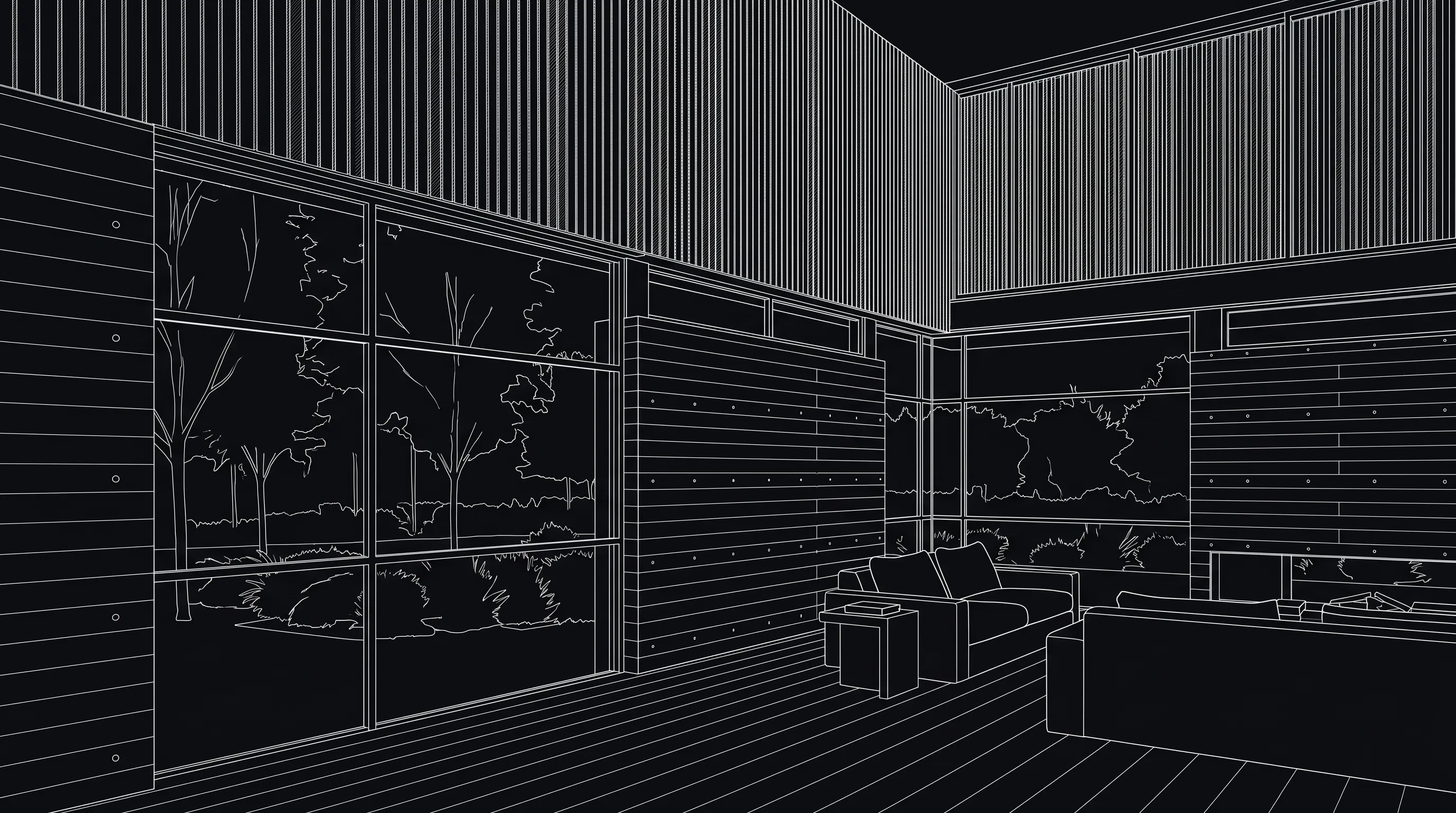
Classic mid-century pieces are expensive and large, so it pays to see them in your room first. Render a House turns a photo, sketch or 3D model of your living room into a photoreal concept with the furniture, wood and colors you describe. It does not create measured drawings; it shows how the room could look.
- Upload the room. A phone photo (PNG, JPG or WebP), a hand sketch, or a 3D model — SketchUp .skp files work directly, as do GLB, GLTF, OBJ and STL. For a floor plan PDF, export the page to PNG or JPG first.
- Describe the style in plain words.For example: "mid-century modern living room, low walnut credenza on tapered legs, cream sofa, mustard lounge chair, glass-top coffee table, white walls, arc floor lamp".
- Render and compare. A render takes about 30-60 seconds. Change one thing at a time — teak versus walnut, teal versus olive — and keep the versions side by side.
- Refine the details. Ask for a different rug, swap the sofa color or move the lounge chair to the window corner with a follow-up instruction.
The free plan gives 3 credits a day at 1K with a watermark, with no card required. A standard render uses 1 credit; paid plans start at $19 per month for Basic and add higher resolutions and video. To estimate a project, use the render cost calculator.
Try the AI living room design tool with a photo of your room, or start from the broader AI interior design generator if you are restyling more than one room. If the room is empty, the virtual staging tool furnishes it from a photo.
What can't a style guide or a render tell you?
A style guide gives you a direction, not a plan. It cannot tell you whether a specific sofa fits your wall, whether a lounge chair leaves a comfortable walkway, or how a wood finish looks under your light. Measure the room and check each piece's published dimensions on the maker's page before you buy.
A render has limits too. Render a House shows the look of the room — furniture style, materials, colors and light — but it is a concept image, not a construction or purchasing document. Furniture in a render is a stand-in for the style you described, not a specific licensed product at a verified scale, and paint and wood colors on screen will not match a physical sample exactly. Use the render to decide on the direction, then confirm sizes and finishes with real samples.
Finally, "mid-century" is not a guarantee of authenticity. Many shapes from the period are widely copied. If owning an original or a licensed reissue matters to you, buy from the manufacturer or an authorized dealer listed on the maker's site.
How were the designer names and dates checked?
Designer names and dates were checked in October 2026 against these pages. Where the maker's own page publishes a date, it is the source; otherwise the Wikipedia article is cited.
- Wikipedia: Mid-century modern — definition, 1945–1970 range, Cara Greenberg's 1984 book
- Herman Miller: Eames Lounge Chair and Ottoman — introduced 1956; veneer history from Wikipedia
- Knoll: Womb Chair — designed by Eero Saarinen in 1948
- Herman Miller: Noguchi Table — designer; 1947 introduction from Wikipedia
- Herman Miller: Nelson Platform Bench — 1946 design, launched 1947
- Herman Miller: Eames Molded Plastic Chairs — shell family began in 1950 with the Molded Fiberglass Chair
- Wikipedia articles on the Tulip chair, Wishbone chair, Egg chair, Arco lamp and Danish modern
Render a House figures come from the plans and pricing docs. No furniture prices are quoted in this guide; check the maker's page for current pricing.
Which related guides should you read next?
What do people ask about mid-century modern living rooms?
What defines a mid-century modern living room?
- Clean, simple lines, honest materials and no added ornament. In a living room that means low, horizontal furniture raised on slim tapered or metal legs, warm wood such as teak or walnut, a few organic sculptural shapes, large windows that connect to the outdoors, and an uncluttered floor plan. Wikipedia dates the style's peak to roughly 1945 to 1970.
What colors are mid-century modern?
- Start with warm wood tones and a neutral base of white, cream or warm gray walls, then add one or two saturated accents. Mustard, olive, burnt orange, teal and rust are the accent colors most associated with the era. Keep the accents on textiles, a single armchair, art or one painted wall so the wood stays the main color.
When was the Eames Lounge Chair designed?
- Herman Miller says the Eames Lounge Chair and Ottoman by Charles and Ray Eames was introduced in 1956. Its shell is molded plywood; the original veneer was Brazilian rosewood, and current production uses veneers such as cherry, walnut and palisander rosewood, according to Wikipedia.
Should I choose teak or walnut for a mid-century living room?
- Both are period-correct. Teak is the wood most associated with Danish modern furniture and reads warmer and more golden; walnut is the darker, browner wood used on many American pieces and on current Eames Lounge Chair veneers. Pick one dominant wood for the large pieces and let a second appear only in small items, so the room does not look like a showroom mix.
Can you mix mid-century modern with modern furniture?
- Yes, and most real living rooms do. Keep one or two recognizable mid-century pieces as the anchor, choose a contemporary sofa with a low profile and simple arms, and repeat the wood tone or a leg detail elsewhere. Avoid pairing heavily ornamented traditional pieces with sculptural mid-century ones; the contrast reads as clutter rather than mix.
Does mid-century modern work in a small living room?
- It is one of the easier styles for small rooms. Raised legs show more floor, armless or slim-armed seating saves width, and a credenza holds the TV and storage in one low piece. Choose a smaller round or oval coffee table, and skip a full lounge chair and ottoman if the walkway would drop below a comfortable width.
How can I see my living room in mid-century modern style?
- Upload a photo, sketch or 3D model of the room to Render a House's AI living room design tool and describe the changes in plain words: teak credenza, walnut paneling, low sofa on tapered legs, mustard accent chair. The free plan gives 3 credits a day at 1K with a watermark and needs no card, and a render takes about 30-60 seconds.
Keep reading
Related guides and comparisons

12 Best AI Interior Design Rendering Tools in 2026 (Free & Paid)
12 AI interior rendering tools compared on inputs, speed and prices checked Sept 2026: Render a House, Homestyler, ReimagineHome, Veras, Spacely and more.
How to change materials in a render with AI: 7 tools compared (2026)
Change materials and finishes in an existing render with AI in 30-60 seconds. Rendervi, Idear, Syntina, LayerHouse and Render a House compared.
12 Architectural Rendering Styles Explained
Compare 12 architectural rendering styles, from photorealistic and watercolor to clay, collage, marker, and cartoon, with use cases and visual references.
