 Render a House/Updated Oct 18, 2026
Interior Design Styles: A Visual Guide to 20 Popular Styles
Twenty interior design styles, each with its defining features, color palette and materials, plus a way to see any of them on a photo of your own room with Render a House before you buy a single piece of furniture.
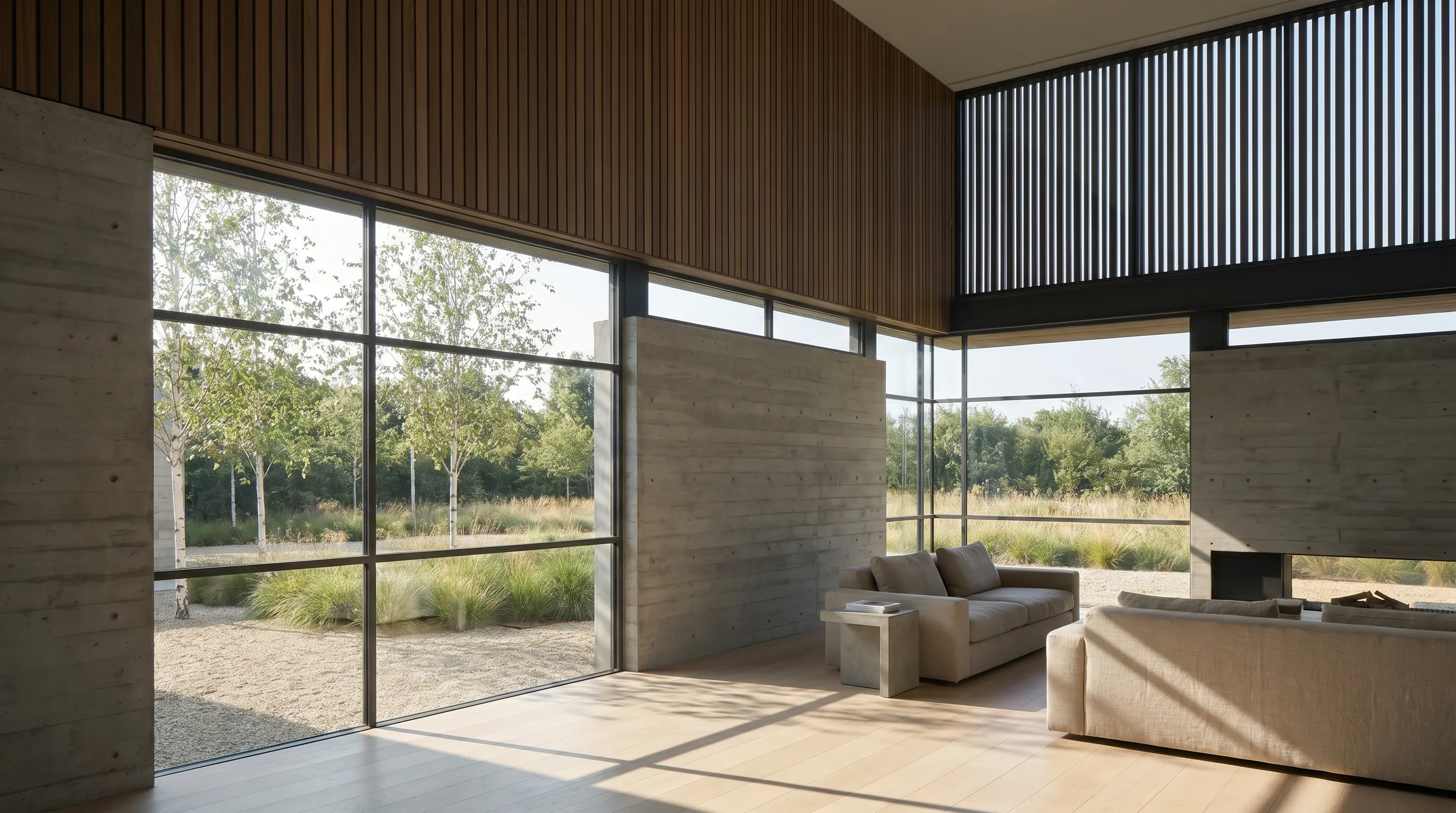
An interior design style is a recognizable set of choices about shape, color, material and ornament that makes a room read as one design. The 20 most popular are modern, contemporary, minimalist, mid-century modern, Scandinavian, Japandi, wabi-sabi, organic modern, traditional, transitional, French country, Mediterranean, farmhouse, rustic, coastal, bohemian, industrial, Art Deco, Hollywood Regency and maximalist. If you want to see how one of them would look in your own space, Render a House lets you upload a photo of the room and describe the style in plain words; you get a concept image of the same room in that style, with 3 free credits a day.
Quick answer: the fastest way to identify an interior design style is to look at three things: the furniture lines (straight, tapered, curved or carved), the palette (neutral, earthy, pastel or saturated) and the dominant material (steel, light wood, dark wood, stone, rattan or lacquer). Clean lines and neutrals point to the modern family; light wood and wool point to Scandinavian or Japandi; molding and pattern point to traditional; reclaimed wood and shiplap point to farmhouse; brass, velvet and geometry point to Art Deco.
What are interior design styles?
A style is not a trend and not a theme. A trend is a single detail that is fashionable for a few seasons, such as one paint color or one chair shape. A theme is literal decoration, such as a nautical room full of anchors. A style is a coherent system: once you know the system, you can choose a sofa, a floor and a lamp that belong together without copying a single photo.
Most styles can be described with four variables:
- Line: the shape of the furniture and architecture: straight and flat, tapered, curved, or carved and ornamented.
- Palette: the main wall, floor and upholstery colors and how much contrast there is between them.
- Materials: the surfaces you touch: wood species and finish, metal, stone, fabric and glass.
- Density: how full the room is, from the empty floor of minimalism to the layered collections of maximalism.
Several styles also have a documented origin. The modern family traces back to schools such as the Bauhaus, which ran in Germany from 1919 to 1933 and pushed design toward function and mass production; Art Deco takes its name from the 1925 Paris Exposition Internationale des Arts Décoratifs et Industriels Modernes. Others, such as Japandi or organic modern, are recent blends with no single founding date.
What are the 20 most popular interior design styles?
Use this table as a field guide. Read across a row to describe a style; read down a column to see which styles share a palette or a material and can be mixed.
| Style | Defining features | Palette | Materials |
|---|---|---|---|
| Modern | Function first: clean lines, open plans, little ornament | White, black, gray, one primary accent | Steel, glass, lacquer, leather, concrete |
| Contemporary | What is current now: soft curves, layered neutrals, statement light | Warm whites, greige, taupe, deep accents | Wood veneer, boucle, stone, brushed metal |
| Minimalist | Only what is needed; empty space is part of the design | White, off-white, pale gray, black | Plaster, pale wood, concrete, hidden storage |
| Mid-century modern | Postwar modern: tapered legs, organic curves, warm wood | Teak brown, mustard, olive, burnt orange | Teak, walnut, molded plywood, fiberglass, brass |
| Scandinavian | Bright, simple and cozy, built for long dark winters | White, light gray, pale blue, natural wood | Light oak, birch, ash, wool, linen, sheepskin |
| Japandi | Japanese restraint meets Scandinavian comfort | Warm neutrals, clay, charcoal, muted green | Oak, ash, bamboo, paper, stone, linen |
| Wabi-sabi | Beauty in the imperfect, the handmade and the aged | Earth tones, ash gray, stone, faded white | Limewash, raw timber, handmade ceramics, linen |
| Organic modern | Modern lines softened with natural texture and curves | Cream, sand, warm white, olive | Light wood, travertine, rattan, boucle, plants |
| Traditional | European-inspired classics: symmetry, molding, detail | Navy, burgundy, forest green, cream, gold | Dark wood, damask, velvet, brass, marble |
| Transitional | Traditional comfort with modern restraint | Greige, ivory, taupe, soft charcoal | Upholstery, wood, linen, matte black metal |
| French country | Rural French elegance: curved wood, toile, patina | Cream, lavender, soft blue, butter yellow | Distressed wood, wrought iron, toile, stone |
| Mediterranean | Sun-washed coastal Europe: arches, plaster, tile | White, terracotta, ocher, sea blue | Lime plaster, terracotta, patterned tile, iron |
| Farmhouse | Practical rural comfort: shiplap, big tables, open shelves | White, cream, black, sage, natural wood | Shiplap, reclaimed wood, galvanized metal, ceramic |
| Rustic | Raw, heavy natural materials and a cabin feel | Brown, rust, moss green, charcoal | Rough timber, exposed beams, stone, leather, wool |
| Coastal | Airy and light, inspired by beach houses | White, sand, sea-glass blue, navy | Whitewashed wood, rattan, jute, linen, cotton |
| Bohemian | Collected, global and layered; rules are optional | Terracotta, mustard, jewel tones, warm white | Rattan, macrame, kilim rugs, plants, mixed textiles |
| Industrial | Converted-warehouse feel: exposed structure and raw finishes | Charcoal, rust, black, brick red, gray | Exposed brick, steel, concrete, reclaimed wood |
| Art Deco | Geometric glamour from the 1920s and 1930s | Black, gold, emerald, deep blue, ivory | Lacquer, brass, chrome, velvet, marble, mirror |
| Hollywood Regency | Theatrical glamour: high gloss, high contrast, bold color | Pink, black and white, emerald, gold | Lacquer, mirror, gilt, velvet, lucite |
| Maximalist | More is more: pattern, color and collections on display | Saturated jewel tones, clashing patterns | Wallpaper, velvet, art walls, books, mixed woods |
Each style below includes a one-sentence description you can type into an AI interior design tool to test the look on a photo of your own room.
Which styles belong to the modern family?
Modern, contemporary, minimalist and mid-century modern share a preference for clean lines and little ornament. They differ in warmth, era and how much they leave out.
Modern
Modern interior design means function first. Furniture sits low on slim legs, surfaces are flat and unornamented, and plans are open. It grew out of early 20th-century movements such as the Bauhaus, which trained designers to produce functional objects for mass manufacture rather than handmade luxury pieces. Color is usually neutral with black lines and, at most, one strong accent.
- Palette: White, black, gray, one primary accent
- Materials: Steel, glass, lacquer, leather, concrete
- Try it on your room: "Restyle as modern: flat-front storage, a low sofa on slim metal legs, white walls, black accents, no ornament."
Contemporary
Contemporary design is the style of the present, so its look moves over time. Right now it means rounded sofas, layered warm neutrals, mixed textures and one sculptural light fitting as a focal point. It keeps the open plans of modern design but is softer and more tactile.
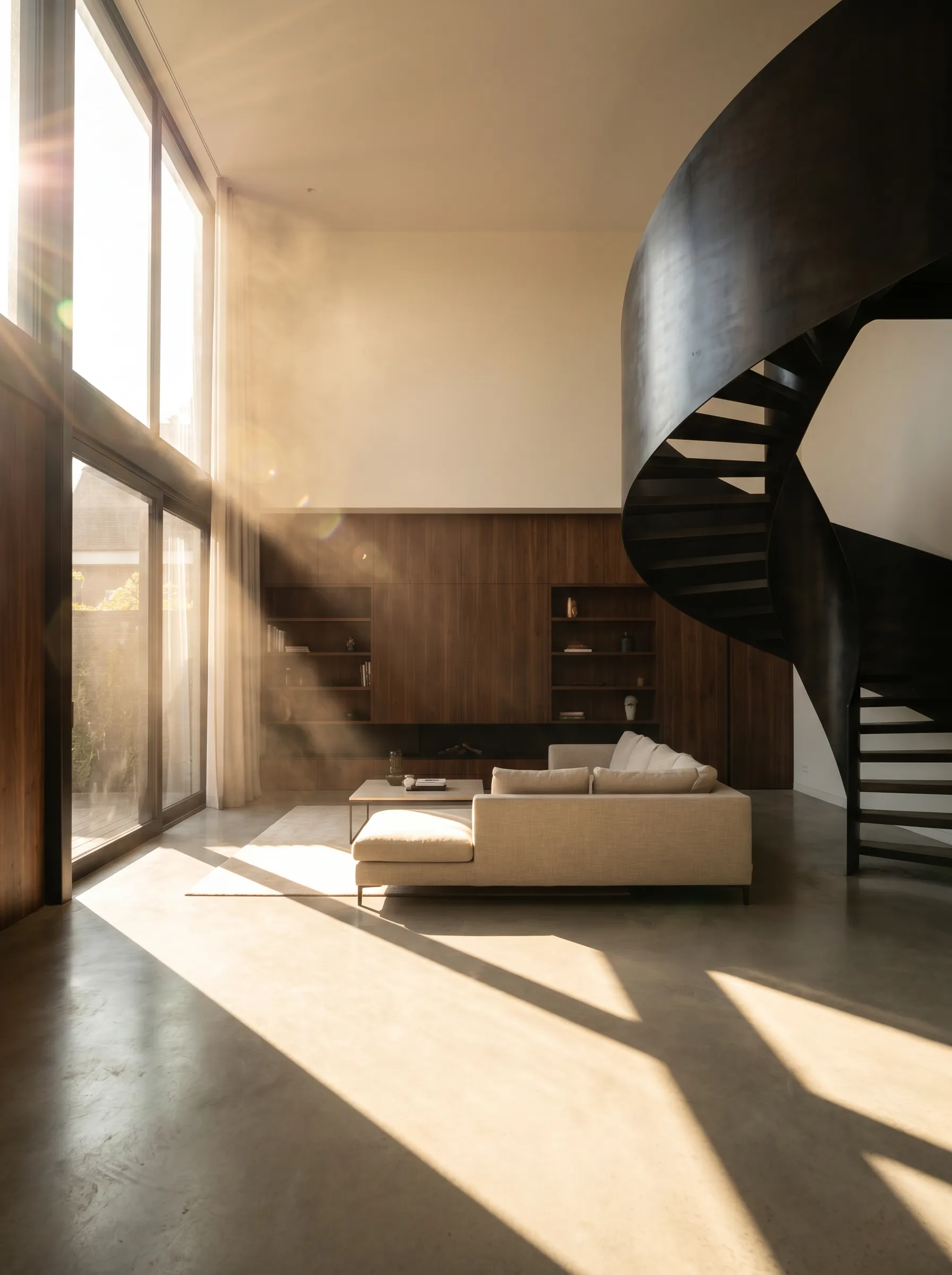
- Palette: Warm whites, greige, taupe, deep accents
- Materials: Wood veneer, boucle, stone, brushed metal
- Try it on your room: "Restyle as contemporary: a curved boucle sofa, walnut built-ins, a sculptural pendant, warm white walls."
Minimalist
Minimalist rooms keep only what is needed and treat empty floor and wall as part of the design. Storage is hidden behind handleless doors, surfaces are smooth and unbroken, and the palette rarely leaves white, pale gray and black. The difficulty is not choosing furniture but keeping the room clear once it is lived in.
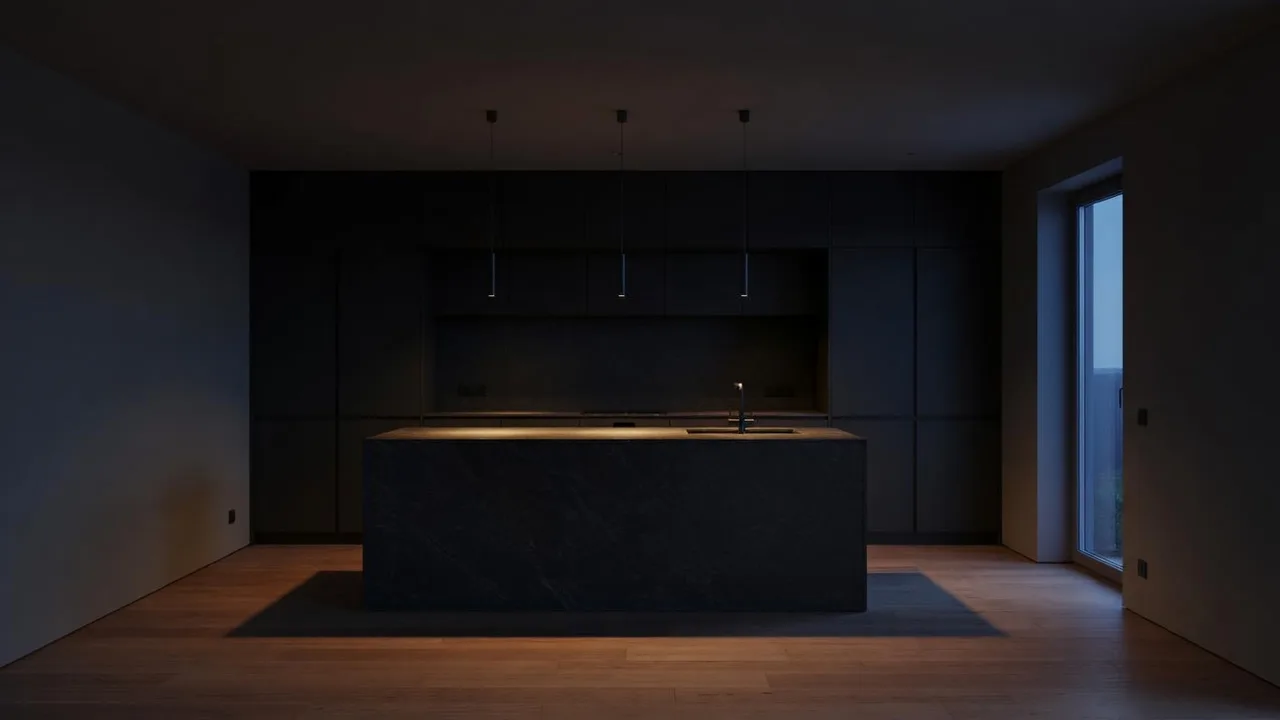
- Palette: White, off-white, pale gray, black
- Materials: Plaster, pale wood, concrete, hidden storage
- Try it on your room: "Restyle as minimalist: remove clutter, keep one sofa and one rug, handleless storage, plain plaster walls."
Mid-century modern
Mid-century modern is the postwar branch of modern design: tapered wooden legs, organic curves, molded plywood and fiberglass shells. Charles and Ray Eames are its best-known furniture designers; their molded plywood chairs went into mass production with Herman Miller after a 1946 Museum of Modern Art exhibition, and the Eames Lounge Chair and Ottoman has been made since 1956. For a full room breakdown, see the mid-century modern living room guide.
- Palette: Teak brown, mustard, olive, burnt orange
- Materials: Teak, walnut, molded plywood, fiberglass, brass
- Try it on your room: "Restyle as mid-century modern: a teak sideboard, a low sofa on tapered legs, a mustard accent chair, a globe pendant."
Which interior design styles feel calm and natural?
Scandinavian, Japandi, wabi-sabi and organic modern all lean on natural materials and muted color. They are the styles people usually mean when they ask for a calm room.
Scandinavian
Scandinavian interiors maximize daylight and comfort. Walls are white or very pale, floors are light oak or ash, furniture is simple and practical, and warmth comes from textiles: wool throws, linen and sheepskin. It is one of the easiest styles to live with because almost nothing in it is fragile or precious.
- Palette: White, light gray, pale blue, natural wood
- Materials: Light oak, birch, ash, wool, linen, sheepskin
- Try it on your room: "Restyle as Scandinavian: white walls, light oak floor, a wool throw, simple wooden chairs, lots of daylight."
Japandi
Japandi blends Japanese and Scandinavian design. From Japan it takes low furniture, restraint and a darker, earthier palette; from Scandinavia it takes comfort and light wood. Expect fluted or slatted timber, paper lanterns, linen upholstery and very few decorative objects, each chosen with care.
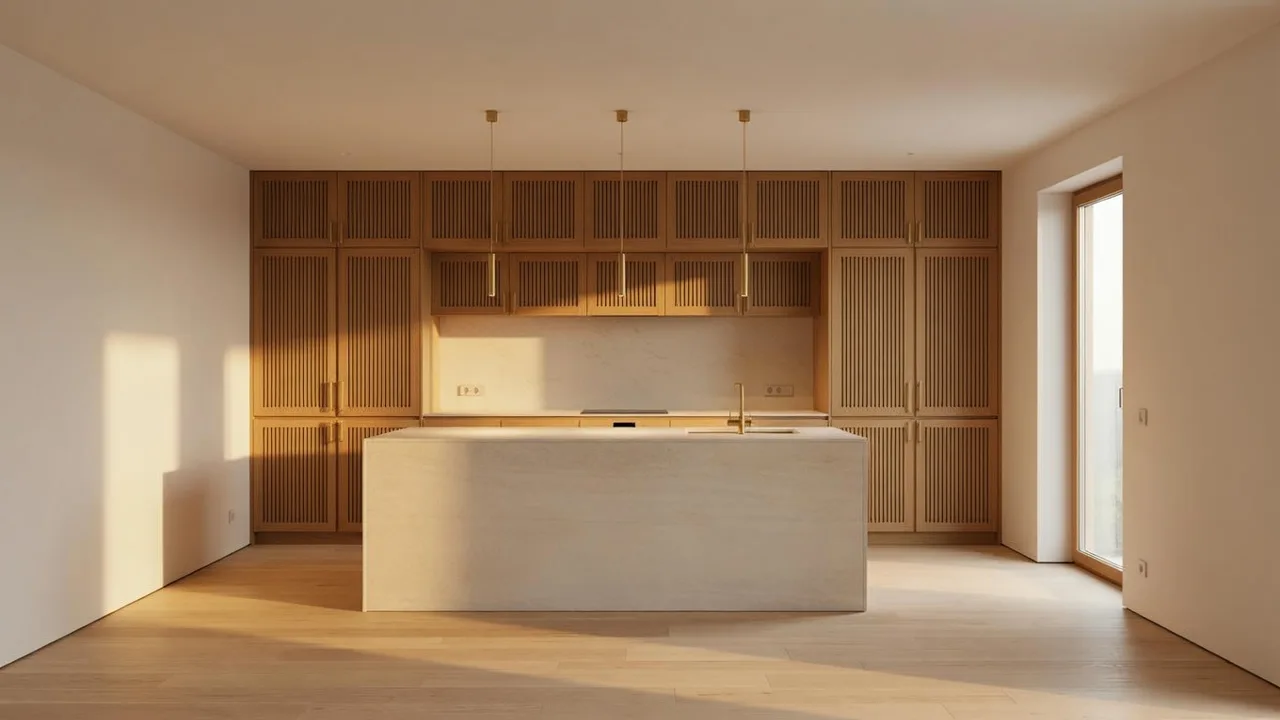
- Palette: Warm neutrals, clay, charcoal, muted green
- Materials: Oak, ash, bamboo, paper, stone, linen
- Try it on your room: "Restyle as Japandi: low oak furniture, fluted wood panels, a linen sofa, a paper lantern, muted clay walls."
Wabi-sabi
Wabi-sabi comes from Japanese aesthetics. Britannica describes how the tea master Sen Rikyū established wabi (deliberate simplicity in daily living) and sabi (appreciation of the old and faded) as ideals of the tea ceremony. In a room, that becomes limewashed walls, raw timber, handmade ceramics and visible wear treated as beauty, not damage.
- Palette: Earth tones, ash gray, stone, faded white
- Materials: Limewash, raw timber, handmade ceramics, linen
- Try it on your room: "Restyle as wabi-sabi: limewash walls, a worn timber table, handmade ceramics, undyed linen, soft low light."
Organic modern
Organic modern keeps modern proportions but replaces hard edges and cold finishes with curves and natural texture: a rounded cream sofa, travertine, light wood, rattan and large plants. It is close to contemporary, with more emphasis on nature and less on statement pieces.
- Palette: Cream, sand, warm white, olive
- Materials: Light wood, travertine, rattan, boucle, plants
- Try it on your room: "Restyle as organic modern: a cream curved sofa, a travertine coffee table, rattan pendant, large plants."
Which interior design styles are classic?
Traditional, transitional, French country and Mediterranean draw on European precedent. They use more ornament and pattern than the modern family and suit older houses with original detail.
Traditional
Traditional interior design borrows from 18th- and 19th-century European rooms: symmetry, crown molding, paneling, dark wood, rich fabrics and pattern. Furniture comes in pairs and is often carved or turned. It feels formal and settled, and works best where the architecture already has proportion and trim.
- Palette: Navy, burgundy, forest green, cream, gold
- Materials: Dark wood, damask, velvet, brass, marble
- Try it on your room: "Restyle as traditional: crown molding, a rolled-arm sofa, a pair of wingback chairs, a Persian-style rug."
Transitional
Transitional sits between traditional and contemporary. It keeps comfortable, familiar shapes (an upholstered sofa, a framed bed) and removes the ornament, the heavy pattern and the strong color. The result is neutral and flexible, and it absorbs both antique and new pieces without looking mismatched.
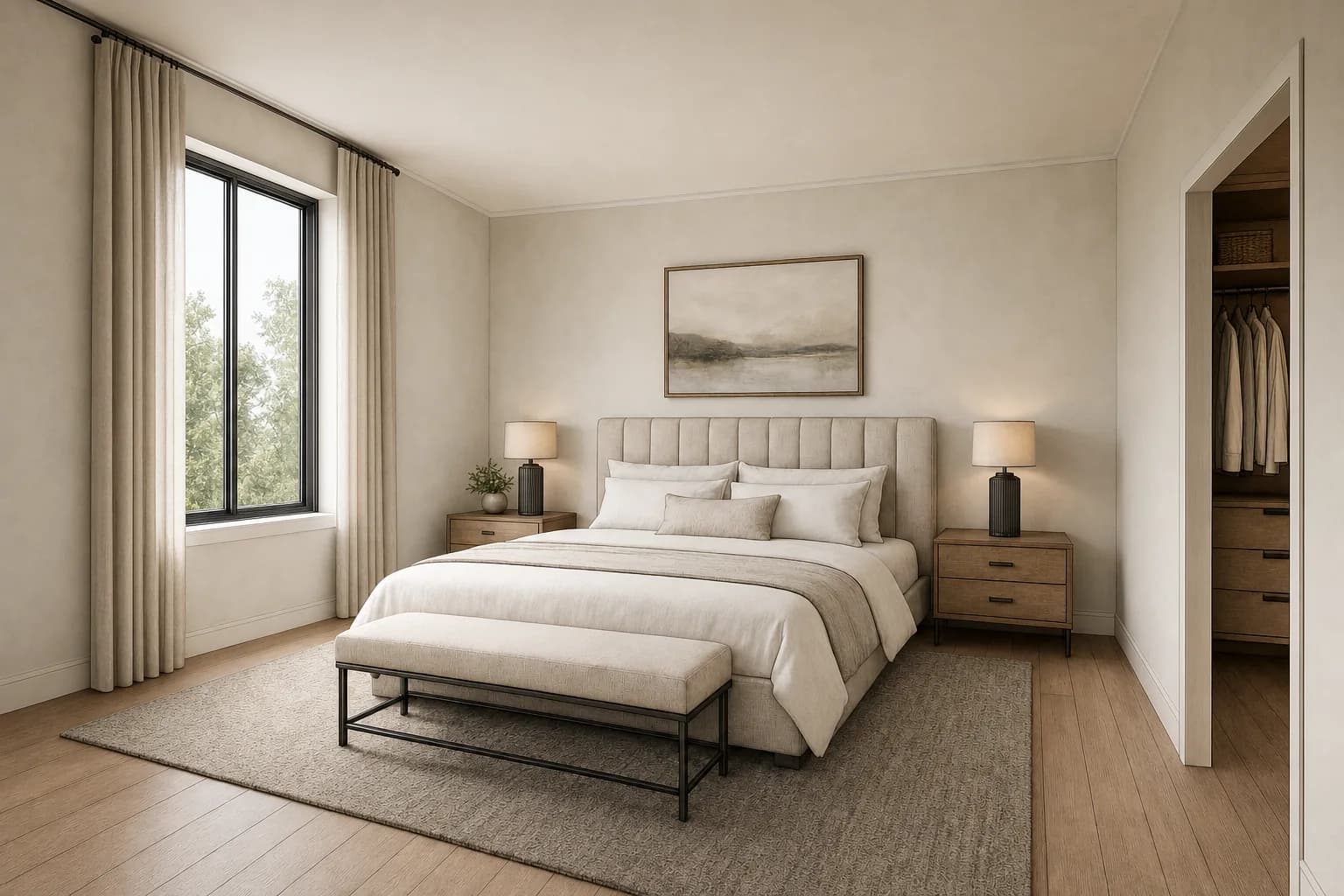
- Palette: Greige, ivory, taupe, soft charcoal
- Materials: Upholstery, wood, linen, matte black metal
- Try it on your room: "Restyle as transitional: an upholstered sofa, simple trim, linen curtains, black metal lamps, neutral walls."
French country
French country is rural, softened elegance: painted or distressed wood with curved cabriole legs, toile and checked fabrics, wrought iron and stone floors. Its palette is pale and sun-faded, from cream to lavender and soft blue.
- Palette: Cream, lavender, soft blue, butter yellow
- Materials: Distressed wood, wrought iron, toile, stone
- Try it on your room: "Restyle as French country: a painted cabriole-leg table, toile fabric, a wrought-iron chandelier, stone floor."
Mediterranean
Mediterranean style draws on the coastal houses of southern Europe: thick white plaster walls, arched openings, terracotta floors, patterned tile and wrought iron, with blue or ocher as accents. It suits warm climates and rooms with strong daylight.
- Palette: White, terracotta, ocher, sea blue
- Materials: Lime plaster, terracotta, patterned tile, iron
- Try it on your room: "Restyle as Mediterranean: white plaster walls, terracotta floor tiles, an arched opening, blue accents."
Which interior design styles feel relaxed and lived-in?
Farmhouse, rustic, coastal and bohemian are informal. They favor comfort, natural fibers and a sense that the room was put together over time.
Farmhouse
Farmhouse interiors are practical and welcoming: white shiplap, large wooden tables, open shelving, apron-front sinks and black or galvanized metal. The modern farmhouse version keeps the materials but uses cleaner lines and more black-and-white contrast.
- Palette: White, cream, black, sage, natural wood
- Materials: Shiplap, reclaimed wood, galvanized metal, ceramic
- Try it on your room: "Restyle as modern farmhouse: white shiplap, a reclaimed wood table, black metal fixtures, open shelving."
Rustic
Rustic interiors look heavy and handmade: exposed beams, rough timber, stone fireplaces, leather and wool. Where farmhouse is light and painted, rustic leaves materials raw and dark, closer to a cabin or lodge.
- Palette: Brown, rust, moss green, charcoal
- Materials: Rough timber, exposed beams, stone, leather, wool
- Try it on your room: "Restyle as rustic: exposed timber beams, a stone fireplace wall, a leather sofa, a chunky wool rug."
Coastal
Coastal interiors aim to feel like a beach house: white and sand tones, sea-glass blue accents, whitewashed wood, jute rugs and slipcovered linen. Done well, it relies on light and texture rather than literal shells and anchors.
- Palette: White, sand, sea-glass blue, navy
- Materials: Whitewashed wood, rattan, jute, linen, cotton
- Try it on your room: "Restyle as coastal: whitewashed wood, a jute rug, a slipcovered linen sofa, sea-glass blue accents."
Bohemian
Bohemian, or boho, is layered and global: kilim rugs on top of each other, rattan, macrame, floor cushions, vintage finds and a lot of plants. The palette is warm, from terracotta and mustard to jewel tones, and the rules are loose by design.
- Palette: Terracotta, mustard, jewel tones, warm white
- Materials: Rattan, macrame, kilim rugs, plants, mixed textiles
- Try it on your room: "Restyle as bohemian: layered kilim rugs, a rattan chair, floor cushions, macrame, many trailing plants."
Which interior design styles are bold and dramatic?
Industrial, Art Deco, Hollywood Regency and maximalist make a statement. They need more commitment, and they reward rooms with height, strong architecture or good art.
Industrial
Industrial style borrows from converted warehouses and factories: exposed brick, ductwork and steel beams, concrete floors, black metal shelving and reclaimed wood. It suits lofts and open plans; in a small, low room it can feel cold unless warmed with wood and textiles.
- Palette: Charcoal, rust, black, brick red, gray
- Materials: Exposed brick, steel, concrete, reclaimed wood
- Try it on your room: "Restyle as industrial: an exposed brick wall, black steel shelving, a concrete floor, Edison-bulb pendants."
Art Deco
Art Deco began in western Europe in the 1910s and 1920s and became a major style in the United States in the 1930s. According to Britannica, its features are simple, clean, often streamlined shapes, geometric or stylized ornament and varied, often expensive materials. At home that means lacquer, brass, velvet, marble, mirror and fan or sunburst motifs.
- Palette: Black, gold, emerald, deep blue, ivory
- Materials: Lacquer, brass, chrome, velvet, marble, mirror
- Try it on your room: "Restyle as Art Deco: a velvet emerald sofa, brass geometric details, a black lacquer sideboard, fan motifs."
Hollywood Regency
Hollywood Regency takes its name from the glamour of classic Hollywood. It uses high-gloss lacquer, mirrored furniture, tufted velvet, gilt and bold color contrasts such as pink with black and white. It is less strictly geometric than Art Deco and more theatrical.
- Palette: Pink, black and white, emerald, gold
- Materials: Lacquer, mirror, gilt, velvet, lucite
- Try it on your room: "Restyle as Hollywood Regency: lacquered walls, a tufted velvet sofa, mirrored side tables, gold accents."
Maximalist
Maximalism is the opposite of minimalism: bold patterned wallpaper, saturated color, gallery walls, books and collections on display. It works when there is a deliberate thread, such as a repeated color or motif, so the room reads as curated rather than cluttered.
- Palette: Saturated jewel tones, clashing patterns
- Materials: Wallpaper, velvet, art walls, books, mixed woods
- Try it on your room: "Restyle as maximalist: bold patterned wallpaper, a gallery wall, a jewel-tone velvet sofa, stacked books."
How do you tell similar interior design styles apart?
Several pairs of styles are easy to confuse because they share a palette or a material. The difference is usually in one variable: line, finish or density.
| Pair | First style | Second style |
|---|---|---|
| Modern vs contemporary | Modern is a fixed 20th-century style: straight lines, primary accents, no ornament. | Contemporary means whatever is current, so it changes; today that means curves, warm neutrals and texture. |
| Minimalist vs wabi-sabi | Minimalist is precise: smooth, flawless surfaces and hidden storage. | Wabi-sabi is sparse too, but it wants visible age, handmade marks and rough texture. |
| Scandinavian vs Japandi | Scandinavian is brighter and cozier: white walls, light wood, wool and sheepskin. | Japandi is lower and darker: warmer neutrals, charcoal, clay, and furniture closer to the floor. |
| Traditional vs transitional | Traditional keeps the ornament: molding, pattern, rich color and dark wood. | Transitional keeps the comfortable shapes but strips the ornament and quiets the palette. |
| Farmhouse vs rustic | Farmhouse is light and painted: white shiplap, black hardware, open shelves. | Rustic is heavy and raw: exposed beams, stone and rough, unpainted timber. |
| Bohemian vs maximalist | Bohemian is relaxed and travel-collected, built on natural fibers and plants. | Maximalist is more curated and dramatic: bold wallpaper, saturated color, art on every wall. |
| Art Deco vs Hollywood Regency | Art Deco is geometric: fan, sunburst and stepped motifs with brass and lacquer. | Hollywood Regency is theatrical: high-gloss color, mirror, tufting and gilt, less strictly geometric. |
How do you choose an interior design style for your home?
Choosing a style is easier when you start from the room and the way you live in it, not from a single photo you liked. Follow these steps:
- Start with what stays. List the things you will not replace: floors, kitchen cabinets, windows, a favorite sofa. A dark oak floor already narrows the choice toward traditional, rustic or mid-century modern.
- Read the architecture. High ceilings and exposed structure suit industrial or Art Deco; original molding suits traditional or transitional; small, low rooms usually feel better in Scandinavian, Japandi or minimalist styles.
- Collect and look for repeats. Save 20 to 30 images of rooms you like, then note what repeats: palette, wood tone, amount of pattern, furniture shape. Match the repeats to the summary table above.
- Decide on density. Be honest about how much you own and how tidy you keep it. Minimalism punishes clutter; bohemian and maximalist absorb it.
- Shortlist two styles. Pick a main style and a backup, or a main style plus an accent style if you want a mix.
- Test both on your own room. Render the same photo of your room in each style and compare them side by side before you buy anything.
For room-by-room inspiration once you know the direction, see room design ideas. If your question is about the building rather than the furnishing, the architectural styles guide covers exteriors and house types.
How can you try an interior design style on your own room?
Mood boards show other people's rooms. The most useful test is to see a style applied to your own walls, windows and floor plan. Render a House does this from a photo: you upload the room and describe the style you want in plain words, and it returns a concept image of the same room restyled, usually in 30 to 60 seconds.
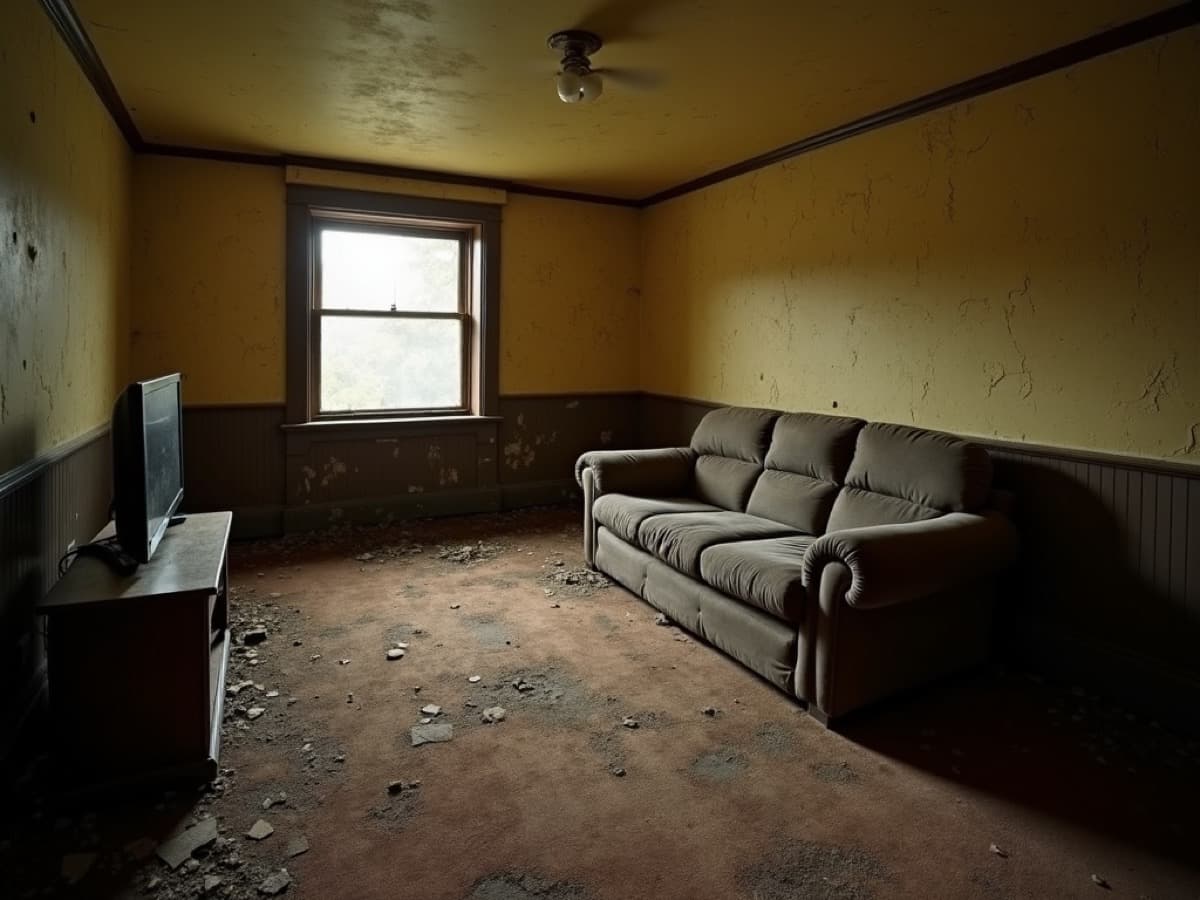
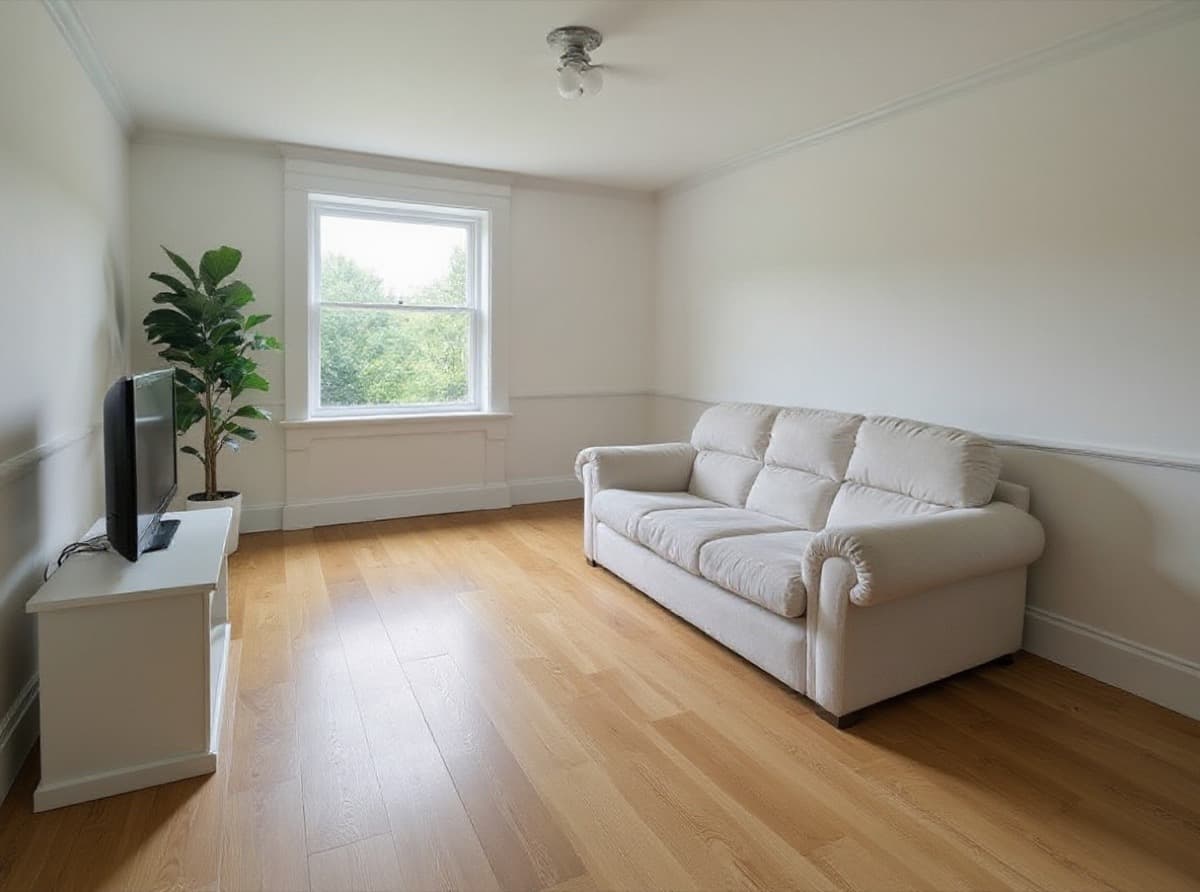
- Take a straight, well-lit photo of the room from a corner or doorway (PNG, JPG or WebP). A screenshot of a 3D model or a floor plan exported to PNG or JPG works too.
- Open the AI interior design generator to restyle furniture, finishes and lighting, or Renovation AI when the room also needs new walls, floors or surfaces.
- Describe the style using the "try it on your room" line from any style above, and ask to keep the camera angle, windows and doors.
- Generate two or three styles from the same photo and compare them. Refine the winner with a follow-up instruction, such as "swap the sofa for a lighter linen one".
The free plan includes 3 credits a day at 1K resolution with a watermark, and needs no card. A standard 1K render costs 1 credit, so you can test three styles a day for free. Pro is $39 a month; to estimate a larger project, use the render cost calculator. Room-specific tools are also available for living rooms, bedrooms and kitchens.
What can a style render not tell you?
A style render is a visual concept, not a design specification. It shows how a palette, a set of materials and a type of furniture would feel in your room. It does not give you exact products, dimensions, prices or quantities, and the furniture it draws may not exist as a product you can buy.
It also cannot check whether a change is buildable. Removing a wall, moving plumbing or adding an arch is a job for an architect or contractor, and paint and fabric colors on a screen differ from samples under your own light. Use the render to choose a direction, then confirm finishes with physical samples and measurements before ordering.
Where do the historical facts come from?
Style descriptions in this guide are general design conventions. Historical facts were checked in October 2026 against these sources:
- Britannica: Bauhaus (dates, locations and focus on mass production)
- Britannica: Art Deco (origin, 1925 Paris exposition, distinguishing features)
- Britannica: Charles Eames and Ray Eames (1946 MoMA exhibition and Herman Miller production)
- Herman Miller: Eames Lounge Chair and Ottoman (introduced in 1956)
- Britannica: Sen Rikyū (definitions of wabi and sabi)
Render a House plan details come from the plans and pricing docs, and the style options inside the app are described in choose a style.
Which guides go deeper on rooms and styles?
- Mid-century modern living room ideas — furniture, palette and layout for one of the most requested styles.
- Room design ideas — inspiration organized by room once you have picked a style.
- Architectural styles — the exterior and house-type counterpart to this guide.
- AI interior design tools — how AI tools fit into an interior design workflow.
- Best AI interior design rendering tools — a comparison of tools that render interiors.
- Change materials in a render with AI — swap floors, walls and finishes in an existing image.
- Rendering styles — visual styles for the image itself, from photoreal to watercolor.
What do people ask about interior design styles?
How many interior design styles are there?
- There is no official count. Designers use dozens of labels, and new blends such as Japandi or organic modern appear regularly. Around 20 styles cover what most people search for and what most furniture is sold as; this guide explains those 20.
What is the most popular interior design style?
- There is no authoritative published ranking, and popularity shifts by region and year. Neutral, flexible styles such as modern, contemporary, Scandinavian, transitional and modern farmhouse are common starting points because they are easy to live with and easy to furnish.
What is the difference between modern and contemporary interior design?
- Modern is a historical style rooted in early-to-mid 20th-century design: clean lines, function first, little ornament. Contemporary simply means current, so it shifts over time; today it leans toward curves, warm neutrals and layered texture.
How do I find my interior design style?
- Collect 20 to 30 images of rooms you like, then look for what repeats: the palette, the wood tone, the amount of pattern, the shape of the furniture. Match those repeats to the summary table in this guide, then test the top two styles on a photo of your own room before buying anything.
Can you mix two interior design styles?
- Yes. Transitional, Japandi and organic modern are themselves mixes. Keep one style dominant (roughly most of the big pieces and finishes) and use the second for accents, and repeat a shared color or material so the room reads as one design.
Which interior design style is the most timeless?
- Styles built on neutral palettes, natural materials and simple shapes date most slowly: transitional, Scandinavian, minimalist and mid-century modern pieces have stayed in production and in use for decades. Trend-driven details, such as a single fashionable color, date faster than any style.
How can I see an interior design style in my own room?
- Upload a photo of the room to an AI interior design tool such as Render a House and describe the style in plain words, for example warm Japandi with low oak furniture and linen. You get a concept image of the same room in that style in about 30 to 60 seconds, which you can compare against other styles.
Keep reading
Related guides and comparisons

20 Best AI Interior Design Tools in 2026 (Free & Paid)
Compare 20 AI interior design tools for room redesign, architecture, floor plans, virtual staging, and client renders, with vendor-sourced prices and tradeoffs.
8 Best Room Planner Apps in 2026 (Free & Paid)
Compare eight room planner apps (Render a House, Planner 5D, RoomSketcher, Homestyler, Floorplanner, IKEA, Roomstyler, Magicplan) by free plan, platform and price.
How to change materials in a render with AI: 7 tools compared (2026)
Change materials and finishes in an existing render with AI in 30-60 seconds. Rendervi, Idear, Syntina, LayerHouse and Render a House compared.
