Archicad — $201 / mo
Archicad pricing


Revit alternatives, compared
Revit is $3,005/yr and runs on Windows only. Five modellers are priced against that below — all native on macOS — and the renderers Revit users still pay for, on their own line.
3 renders a day. No plugin, no graphics card.
Credit where credit is due
Revit is the reason BIM coordination works at the scale it does. A wall Revit draws is also a schedule row, a quantity, and a clash-detection target — the database is the point, not a side effect of modelling, and nothing on this page replaces that for a project that genuinely needs it.
The consultant ecosystem around it is the other half: structural, MEP and energy tools built to speak Revit’s format first. Leaving it is a bigger decision than leaving most CAD tools, because the people you coordinate with may not follow.
So this is not a page arguing Revit is bad software. It is a page about what a year of it costs, what it does not run on, and which honest alternatives exist for the studios it does not fit. Last updated: September 11, 2026.
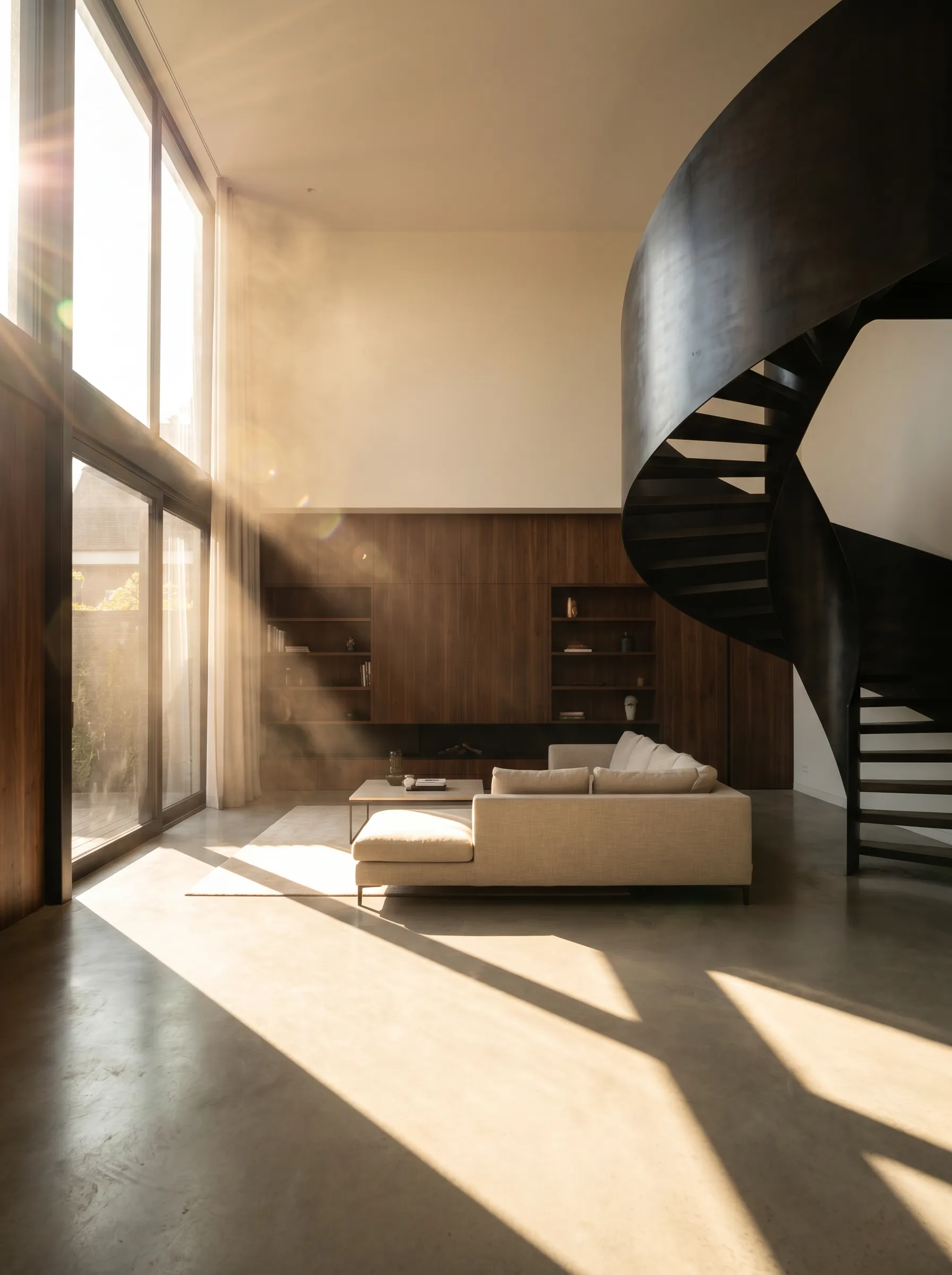
Line view of a double-height interior before renderingDrag to compare
The Mac question
This is the question that actually drives most Revit alternative searches. Revit has no macOS build — not an unofficial one, none at all — so a studio standardising on Mac hardware cannot run it, full stop. Every other tool on this page’s modeller table is native on macOS.
If the reason you are reading this is Windows-only Revit on a Mac-only studio, Archicad is the closest match: a comparable BIM database, not a step down to a plain drawing tool. See it priced the same way on Archicad alternatives.
Revit alternatives compared
Five modellers architects actually move to, at their current published prices. Render a House is not in this table — it does not model, so listing it as a Revit replacement would be dishonest. It is in the next one.
| Software | Current price | Licence | Runs on | Best for |
|---|---|---|---|---|
| Archicad | $201 / mo | Subscription | Windows, macOS | BIM on a Mac |
| Vectorworks Architect | $1,530 / yr | Subscription | Windows, macOS | Design-led BIM plus rendering included |
| SketchUp Studio | $859 / yr | Subscription | Windows, macOS | Fast concept modelling, less data |
| Chief Architect | $1,995 / yr | Subscription | Windows, macOS | Residential construction documents |
| Rhino 8 | $995 one-time | Perpetual | Windows, macOS | Curved geometry, no subscription |
Archicad pricing
Vectorworks pricing
SketchUp pricing
Chief Architect pricing
Rhino pricing
The honest cases
There are three reasons worth the migration, and none of them is render quality — that one is solved without leaving.


Rendering, priced separately
Credit where it is due: Revit does not arrive with nothing. Twinmotion for Revit is included with the subscription and renders in real time. Most of the market still buys something else for higher fidelity, at these current published prices, with Render a House on the last line.
| Renderer | Price | What that buys |
|---|---|---|
| Twinmotion for Revit | Included | Autodesk ships it with the subscription — real-time stills and animations, synced from the model. |
| Enscape Solo | $574.80 / yr | Real-time preview that runs inside Revit; the studio default beyond the bundle. |
| V-Ray Solo for Revit | $540 / yr | Photorealistic output without leaving the BIM model. |
| D5 Render Pro | $360 / yr | Community tier is free but non-commercial by D5's own terms. |
| Lumion | $229 / yr (View) | Pro, the full tier, is $1,149/yr and has no macOS build. |
| Render a House | Free, or $39/mo | 3 renders a day at no cost; Pro adds 240 monthly credits. Runs in a browser, on any machine, with no plugin. |
Render a House
Side by side, so the comparison is fair: Revit is a BIM database and Render a House is a renderer. The table is the two jobs, not a feature war.
| Revit | Render a House | |
|---|---|---|
| What it does | Models and documents. A BIM database that draws, with Twinmotion for Revit bundled in for real-time stills. | Renders. It does not model — you keep Revit and export a view. |
| Input | Native .rvt files. | A GLB or OBJ export, or a PNG of the view. No .rvt import. |
| Where it runs | Windows only. No macOS build exists. | Any browser, on any machine, Mac included, with no graphics card required. |
| Price of the renderer | Twinmotion for Revit is included, but many studios still pay for Enscape, V-Ray or Lumion for higher-fidelity output. | Free at 3 renders a day; Pro is $39/mo for 240 credits. |
| Time to an image | Twinmotion renders live once synced; a V-Ray or Enscape pass is minutes to hours for the final quality bar. | Seconds, from a written description of the scene. |
| Control | Every light, material and camera parameter, by hand. | Direction by description and refinement by region — less control, far less setup. |
What you get
3D integration
Where Revit exports a mesh, upload it and set the camera in the browser, then render from that view.
Rendering
Photorealism in seconds rather than a queued calculation you leave running over lunch.
Video
A camera move across the same project, generated from a finished still. Nothing to animate.
Design
Try materials, light and surroundings until the version you want exists, without touching the source model.
Refinement
Fix one part of a render — a facade panel, a tree, a sky — without starting the image again.
Precision
Your geometry is respected: the walls, openings, heights and proportions you drew in Revit stay where you put them.
Collaborative
Share a link and take comments on the image itself, so feedback lands on the render rather than in an email thread.
Mobile and web
Runs in the browser, on the machine you have open, including a laptop that would struggle with a local render engine.
4K
Delivery resolution, ready to print or put on a board without a separate upscaling step.
Studios that keep coordinating in Revit and want the presentation image sooner get the most out of it. Export a GLB, an OBJ or a PNG of the view, upload it, describe the scene, and an image comes back in seconds — on a laptop, a Mac, or a machine with no discrete graphics card at all. It earns its place at the stage where a client wants to see six material options and nobody has time to set up a render queue.
Try it out, go Pro when it starts paying for itself.
02
Most popular
Pro
For professionals and small teams
$26/mo
$312/yr
4 months free
03
Studio
For studios and bigger teams
$66/mo
$792/yr
4 months free
What credits buy you
Pro 240 credits | Studio 1000 credits | |
|---|---|---|
| Render Pro 2 credits each | 120 | 500 |
| Render Standard 1 credit each | 240 | 1000 |
| Render Standard 2K 1.5 credits each | 160 | 666 |
| Render Pro 4K 4 credits each | 60 | 250 |
| Render Standard 4K 2 credits each | 120 | 500 |
| Video 0.8 credits/sec | 300s | 1250s |
The verdict
If you are shopping for a coordination database, no — pick from the five above, and pick on interoperability rather than price. If what you actually want is to stop paying $540 to $1,149 a year to make pictures, and stop waiting for them, it is worth the ten minutes it takes to export a view and try.
Plenty of studios run both. Options and client-facing concepts in Render a House, the final coordinated deliverable in Revit, the whole time.
There isn't a free BIM equivalent — Archicad, Vectorworks and Chief Architect are all paid subscriptions, and none publishes a free commercial tier. Blender is free and can hold a building model, but it has no BIM object database, schedules or documentation tools. If the renderer is the only part you want to replace, Render a House does that without leaving Revit.
Only for verified students and educators, renewed yearly. Every commercial plan is a subscription — $380/month, $3,005/year, or $9,020 for three years upfront — and Autodesk sells no perpetual licence and no free commercial tier.
No. Revit has no macOS build at all, not an unsupported one — Autodesk ships Windows only. Archicad, Vectorworks, SketchUp, Chief Architect and Rhino are all native on macOS, which is the single biggest reason Mac-based practices look at this list.
No, and Revit already includes a starting point: Twinmotion for Revit ships free with the subscription and renders in real time, synced from the model. Studios that want more still add Enscape Solo at $574.80/yr, V-Ray Solo at $540/yr, or Lumion Pro at $1,149/yr. Render a House is the browser-based option — you keep modelling in Revit and export a GLB, OBJ or image to render, free for 3 renders a day.
For a Mac-based studio, usually yes by default — Archicad is a comparable BIM database at $201/month with no Windows requirement. For firms already coordinating with consultants on Revit, switching costs more in interoperability than it saves; the two files formats do not translate cleanly.
$3,005/year on the standard annual plan, $4,560/year equivalent if billed monthly at $380/month, or $9,020 upfront for three years. Revit LT, a stripped single-user tier, is $560/year. Prices are Autodesk's published US list rates and cover the licence only — a renderer is a separate line item.

Export the view you already have and see what comes back. It takes less time than reading a licence page.
More on Revit
Export a GLB, an OBJ or a PNG of the view and render it in a browser. The export paths, step by step.
Monthly, annual, three-year and Flex tokens broken down, plus the AEC Collection bundle.
What Revit needs from a machine, and how RAM scales with model size.
Open a model in the browser when the person who needs to see it has no licence.